

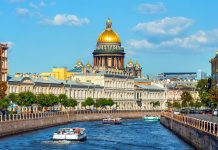








A major oil terminal in St. Petersburg was hit in an overnight Ukrainian strike, says Ukrainian President Volodymyr Zelensky.
Zelensky said the facility was an important piece of “infrastructure that generates revenue for Russia’s war”, adding that Ukrainian forces also targeted a major Russian naval base in the area.
St. Petersburg Governor Aleksandr Beglov confirmed the city had faced what he described as a “massive” drone attack. He acknowledged that the oil terminal had been struck but said there were no casualties.
Ukraine has stepped up its long-range drone campaign against Russia’s critical energy infrastructure in recent months, contributing to significant fuel shortages. Kyiv claims the attacks have put nearly 43% of Russia’s oil refining capacity out of operation, although the BBC has not independently verified that figure.
Ukraine argues that Russian oil and gas facilities are legitimate military targets because Moscow depends heavily on fossil fuel exports to finance its full-scale invasion.
Last week, Vladimir Putin made the unusual admission that Ukrainian strikes had contributed to fuel shortages. On Saturday, he signed a law designed to increase fuel supplies for Russia’s domestic market.
Zelensky said the targets in St Petersburg and the surrounding Leningrad region were roughly 850km from Ukraine’s border.
The full extent of the damage was not immediately known, though a video shared by the Ukrainian president appeared to show a drone approaching its target, followed by a large plume of black smoke rising from the site.
Ukraine’s military described the facility as one of Russia’s largest oil terminals, with an annual production capacity of 12.5 million tonnes of petroleum products. It also claimed responsibility for striking a key naval base of Russia’s Baltic Fleet in Kronstadt.
Russia has not publicly responded to that claim.
Beglov said Russian air defences had shot down 72 Ukrainian drones over St Petersburg and the wider Leningrad region. He urged residents (St Petersburg has a population of more than five million people) to remain indoors until the threat had passed and warned that mobile internet services could also be disrupted.
Separately, Ukraine rejected Russian claims that the strategically important eastern town of Kostyantynivka had fallen under Moscow’s control, if acknowledging that small Russian infantry units had infiltrated deep into Ukrainian positions. Kostyantynivka is one of several heavily fortified towns forming Ukraine’s defensive “fortress belt” in the eastern Donetsk region, much of which is occupied by Russian forces.
However, Zelensky wrote on Telegram that if Kostyantynivka were truly under Russian control, Putin should have no difficulty meeting him there to pursue diplomatic efforts to end the war.
“But still, he will not cross the front line: the truth is very different from Putin’s words,” Zelensky wrote.
Russia, meanwhile, has accused Zelensky of trying to divert the attention of Ukrainians and Ukraine’s international backers from the aftermath of one of Russia’s largest and deadliest attacks on Kiev on July 2.
Both sides appear to be seeking an advantage ahead of next week’s NATO summit in Turkey.
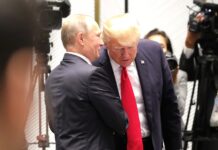
On Saturday, Putin sent a message to US President Donald Trump congratulating him on US Independence Day and expressing hope for “constructive relations” between Russia and the United States.
