


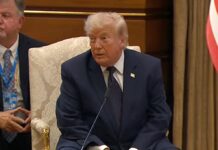

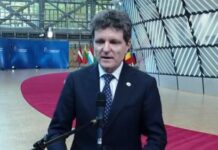
Călin Georgescu won the first round of the presidential elections, and after his first-round victory in the worldly realm of politics, his messianic profile only took on even more biblical proportions in the eyes of his supporters.
It is clear as daylight that the voters who opted for Călin Georgescu see in him a man on his feet, absolutely autonomous, untainted by the past, without strings tied to his hands, feet or, neck, as is usually the case with any puppet. In fact, this is also the essence of his message for them.
Somehow, Calin Georgescu’s voters are right to look at him in this way.
However, some of them had no idea who Călin Georgescu was and where he came from. They voted for him because the algorithms insistently delivered him to them on TikTok.
Others suspected or were event sure they knew about this character from somewhere else than on TikTok. For example, from his wife’s YouTube appearances, Facebook, Instagram accounts or social media accounts managed by his wife.
Her words, of Cristela Georgescu, Călin Georgescu’s wife: “I am in charge of the technical army behind Călin!”.
All these people came together for their favorite Călin Georgescu on November 24 to take the first place and qualify for the runoff risk being deeply disappointed.
Folks, Calin Georgescu is far removed from what he lets you see and he is far removed from what you might try to understand.
Instead of the independent, self-invented, upright and totally autonomous character, Călin Georgescu is as follows:
- In terms of style, he is an extension of his wife.
- In essence, he is a manifestation of a broader phenomenon: a phenomenon related to the underground workings of communist diplomacy, to the obsessions, habits, fixed ideas and fears that the generation of the ’60s and ’80s Ceausescu diplomats had. Diplomats who, immediately after the Revolution, became the mentors of the new generation of top diplomats and economists of the new Romania. The generation of Mircea Geoana, Călin Georgescu, Daniel Dăianu (former Finance Minister and public personality), Mugur Isărescu (National Bank governor), etc.
Let’s start with Point 1.
Cristela, Călin Georgescu’s wife, sells books and CDs that, she says, “take readers of all ages, beyond the strictly dietary context, descending into the depths of being, where we can really feel like in life, everything is food, and the most important thing is the food beyond food.” (The bold type is hers)
On top of all this, Georgescu’s wife is a kind of “naturopathic”, “holistic” coach and so on. She sells web courses, conference tickets, is good at just about anything – from parenting, to empowerment, to healing the body with the power of thought.
And I’ll stop here, because I don’t intend to fish for clients for Călin Georgescu’s wife.
I just outlined the broad themes of the possible future “first lady”’s chosen job and, quoted her from her site, not just for the sake of it, but to draw attention to an interesting detail: the strident similarities between Cristela and Călin Georgescu’s expressions. Vocabulary, expressions, ideas – pretty much everything overlaps.
In reality, the presidential candidate bewitches his audience using his wife’s words. What he did in addition to what she delivered to her was to add some historical-biblical salt and some political-sovereignist pepper to the dish, because his field is different from the one on which she tactically built her business.
It’s plausible to assume that Cristela Georgescu’s loyal customers have become the hard core of Călin Georgescu’s electorate.
Take even just these quotes: “The water was bottled in plastic bottles so that it would not give you any information” / “Every tap in every house will have pure water”.
Whoever visited Cristela’s website will swear that these are her own words. But anyone who has listened to Călin in a few interviews knows that these are his words. It is clear that they could have belonged to any of them.
So, Cristela seems to have fully “empowered” Calin..
Let’s now move on to Point 2.
Here things get a little complicated, as the real Calin Georgescu is less “idyllic-holistic-naturopathic.”
Călin Georgescu publicly admitted that his mentor was Mircea Malița – a member of the Central Committee of the Romanian Communist Party, an academician, a minister during Ceausescu’s time and a top diplomat, as ambassador and as permanent representative of socialist Romania to the UN.
During the period in which Mircea Malița was active, especially from ’60s to the ’80s, the diplomacy of Ceausescu’s Romania looked like a pyramid scheme, an ongoing game at as many ends as possible.
These were the times in the communist camp, a camp where propaganda spoke of brotherly states, while the behind the scenes, things were strangely hostile.
The mentality of diplomats of Malița’s type and rank was irremediably marked by suspicion and mistrust, fear and contradictions.
Somehow, it was normal to be like this: since the end of the ’60s, the Russians and the Chinese weren’t getting on and even briefly went to war. The Eastern European countries in Moscow’s orbit sided with the Russians, but were afraid of them. China sought to penetrate them, the USSR tried to make sure they weren’t penetrated. America and Western Europe sought to take advantage of this whole web of intra-fraternal dissensions.
So it’s easy to imagine the top Romanian diplomats of those times and the tension and atmosphere they lived in. The flaws they acquired in those times, which inevitably perverted their relationship to the international world and foreign affairs, not only accompanied them to the grave, but were also transferred to the apprentices of the diplomacy of the first two decades of post-Communist Romania.
Some of them, it is true, got rid of a significant part of the baggage they inherited from their mentors, like Malița. Others though were unable to get rid of the burden and will keep it close to them like their predecessors, right up until the end.
Călin Georgescu is, judging by his position on foreign affairs, definitely an example of the latter category.
‘I play at as many ends as possible;’ this is essentially what Georgescu proposes for Romania’s foreign policy.
He proposes this because, on the one hand, this is what he learned in his youth, and on the other hand, because he failed to learn anything else along the way, even when everything changed.
Someone like Mircea Malița had somehow been forced by circumstances to play the games of the Russians, and the games of the Chinese, and, to some extent the games of the Americans, the English or the French. At that time, Romania had a precarious status, with alliances full of allies that he suspected of being capable of treason at any time. Călin Georgescu, on the other hand, lives in a profoundly different Romania, in a fundamentally different security architecture, in a framework of alliances that is as far removed as it gets.
You would have Georgescu’s mind today to be completely different to the mind of yesterday of his mentor Malița. But we see that this is not the case, the man slips up as if he were frozen, as if he was stuck in the swamp of those sulphurous times of Romanian foreign policy, although at that time he was just a kid.
At the same time, we can’t exclude that Călin Georgescu limited himself to remembering another point from Romanian history, that Romanians had in their DNA the ability to change sides in the blink of an eye, as well as the fact that they had a tendency to play at multiple ends.
These two elements are complementary and connected to each other, because the realities in this region have always been complex, and threats and fears constantly tormented our minds.
The twentieth century was even a work of art in this sense; we often played at many ends, and we demonstrated an astonishing ability to be ready to jump into another boat at any time. This is historically proven.
It happened in World war I and World War II, but it also happened during communism, when we danced on the Soviet-Chinese and Arab-Israeli wires, juggling marshmallows and curses against Americans and Western Europe.
In the past, the fear of Moscow pushed Bucharest towards a rapprochement with Beijing. The rapprochement with Beijing covered Ceausescu’s back in relation to the Kremlin, during the Prague Spring. Bucharest’s response to the Czechoslovak Spring led to warmer relations with the US, Great Britain, even France, and also with international political-financial institutions.
The generation that carried out this diplomacy, sitting at the table with everyone and eating something from everyone’s plate, was made by Mircea Malița’s generation; as I said, by the generation that provided mentoring and later retained a strategic influence on the MAE-ASE ’90 generation – Geoana, Daianu, Isarescu. The list can go on with less well-known names. And yes, Călin Georgescu is on that list.
But the world has changed massively in the meantime, but Georgescu missed the opportunity to get in line with modern times.
This why he thinks today with the mind and fears of yesterday.
It is true that the present times is also starting to be more and more turbulent, due to Russia’s war in Ukraine, due to the disturbing rise of China.
Probably, the new context reactivated the old thinking, the old reflexes and the old current of thought in numerous sensitive areas of the state from institutions of force, to clubs of semi or pseudo-active “former” players. In these areas, his old temptation probably returns “Let’s play at several ends again”. He’s tempted by: “We have the US, NATO, EU, but let’s go with China, let’s go with Russia. If they make fun of us, we’ll stay with the others.”
It would have been logical 50-60 years ago, but it’s as stupid as possible nowadays, because it’s like giving the sparrow out of your hand to the sparrow on the fence!
It’s stupid, but the spheres in which this stupidity is popular are satisfied. Why? Because they have found the right man to do the dirty work, the indecent pirouette, to change minds that can cost us everything.
They found an unreformed Călin Georgescu, who took on the foundations of the exponents of the old generation of Ceausescu diplomats, and then suddenly stopped developing. evolution.
Călin Georgescu is, as we said at the start, his wife’s man. Unfortunately, Calin Georgescu is also the man, the incarnation, and the Messiah of characters and a school of thought which are frozen in the past, and incapable of deciphering the present, and powerless in anticipating what the future may hold.
