











The current administration in Washington has the talent for living off and feeding on contradictions. The disease is so serious, and it’s so advanced, that it has become a caricature.
As for the “Chinese” dimension of Donald Trump’s foreign policy, things appear to have gone off the rails.
But before we get into the details, a review of the most pressing contradictions and a look at its foundation are welcome:
- Donald Trump was voted president by a broad spectrum of voters. But voters are s brutally hit by the “Big and Beautiful Law” – that Trump intensely promoted, passed by Congress and at the same time causing a huge scandal between the president and Elon Musk. Essentially, as a result of the new law, a few rich and super-rich will line their pockets, while tens of millions of ordinary people will experience modest benefits or, on the contrary, substantial damages.
- The same “big and beautiful law” (its very name suggests things that are not at all honorable about President Trump’s tastes and mentality) risks deepening the already huge budget deficit of the United States by several trillion dollars. What could be a stronger contradiction between this effect and Trump’s campaign promise to reduce the deficit?
- Trump arrived at the White House promising Americans that he would make America great again. After less than half a year in office, even the already existing greatness is continuously fading, and the prospect of a “greater” greatness seems like a joke. Because of the trade wars, because of the treatment applied to Ukraine, although it is a victim, and because of the uncertainties about the fulfillment of the US commitments to European and Asian allies, on the security line, America’s sex appeal in the world is in steep decline. And the international influence of the US is also experiencing a similar setback. How great can you be, narrowing your channels of influence, obstructing your commercial potential and tarnishing your reputation acquired in eight decades in just a few months? The question is, of course, rhetorical.
- In the Middle East, the Trumpist contradiction is already manifesting itself in relation to the first term, but it has reached a hallucinatory peak now, in the second. In his first term, Trump pulled the US out of the JCPOA deal, after three years in which the deal had proven effective in curbing Tehran’s nuclear program. In his second term, however, Trump wanted to negotiate another agreement with the Iranians (of course, a new agreement could not have been much different from the initial one). In the years when there was no longer US involvement in the JCPOA, Iran has, as anticipated, made huge progress in reaching the nuclear threshold. In his second term, Trump initiated negotiations with Iran, that is, he did exactly what Obama had done. In addition, he bombed Iran, although he had accused his predecessors of initiating wars. According to all the assessments of the American security institutions, the bombings did not cancel Iran’s nuclear program or delay it significantly longer than the JCPOA agreement had done, peacefully. Was this a cContradiction? Absolutely!
- Moreover, on the Iran issue, during the month of June, for a few days, Trump himself left open the possibility of regime change. It is not clear how deeply he thought about it, it is not clear whether he gave up on the idea, but it is clear that Donald Trump has taken at least a first step in the very direction that he had so vehemently challenged in the campaign: the direction of the famous “regime change”.
- Finally, Russia and Ukraine. Trump had promised to bring peace within 24 hours. Then, when it was clear that the few hours had already passed for a few weeks, then a few months, he announced that he would bring peace even if it would take time. At one point, taken aback by the fact that nothing was happening, he even threatened to give up bringing peace to Ukraine. Exactly what Trump wants from this war and what he is still able to do to stop it, is not clear. What is clear, however, is that Trump’s efforts towards peace between Russians and Ukrainians have led to an intensification of the war and especially to the breaking of records after records of Russian bombing of civilians in Ukraine and especially those in its capital, Kyiv. To promise peace, but in fact to aggravate the war – this is a contradiction, to the point of caricature!
But I seem to have started this text by evoking the Trumpist contradiction on the Chinese dimension of American policy in the Trump era. Therefore, let’s stop now on this level.
Two sub-dimensions stand out.
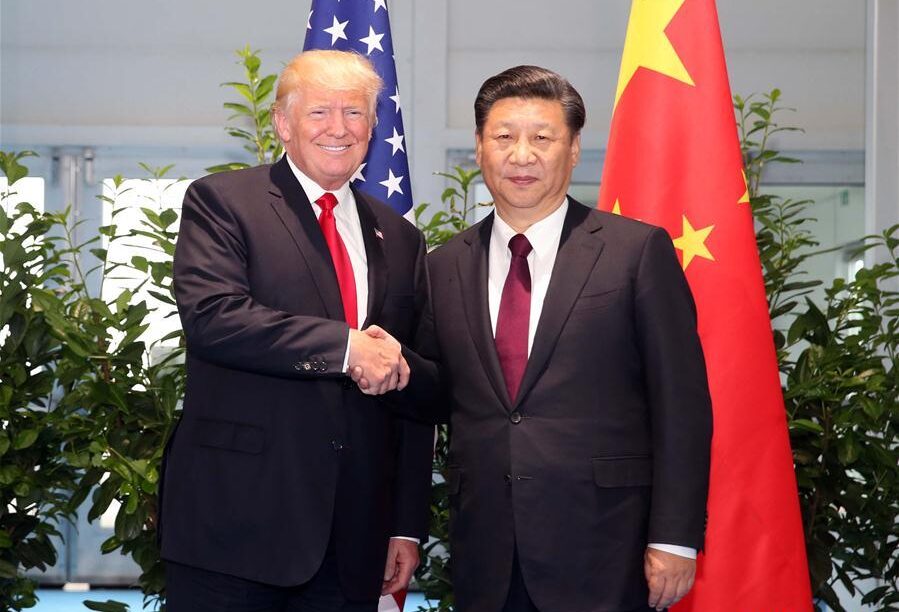
- On the one hand, there is the commercial one. Amid so many trade wars unleashed against almost all countries, but with a focus on America’s traditional allies, Trump has helped China appear more frequentable than it had been before he returned to the White House. Obviously, this helped him be even more influential. How does the new reality fit in with the interest in Trump’s narrative of making America greater and China less great? Of course, they don’t match in the slightest.
- And on the other hand, there is the military and security dimensions. And here there are two other levels. One is related to Taiwan: since Trump came to the White House, uncertainties have exploded among America’s allies in East Asia, in much the same way that the same type of uncertainty has exploded among America’s allies in Europe. Trump and other officials in his administration have done, in less than six months, what no one in Washington has done in the past seven decades, to weaken Taiwan’s stance toward China. Today, China feels more emboldened than ever to consider trying its luck to the limits of U.S. determination to protect the island. Finally, the other level is related to Ukraine. Trump’s strategy to stop the war in Ukraine has failed. Putin himself confirmed it to him in every possible _and impossible way. But, incredibly, China itself stepped out of the official line and said the same thing. According to the South China Morning Post (a CNN report you can see HERE) the Chinese foreign minister told his counterpart in the EU that Beijing is not interested in ending the Russian-Ukrainian war by defeating Russia for fear that the US would be relieved of this outcome and would turn its full attention to China. China’s top diplomat, Wang Yi, said something outside Beijing’s usual line prompting the question what pushed him to do this. But even “more” extraordinary is the background against which the Chinese dignitary projected the recent and shocking US decision to stop military aid to Ukraine. Part of the American press revealed that there was no real coordination between the main institutions in the political, military and security spheres in Washington. That, obviously, there was no coordination with NATO allies. Finally, the American press also revealed that the decision came from Pe Hegseth. And yet… No matter how “normal” it may seem that such a thing is possible today in Washington, given the amount of cockroaches sipping in the nooks and crannies of the Trump administration’s internal kitchen, by its contradictory nature the American decision regarding arms deliveries to Ukraine is still shocking, when you corroborate it with the Chinese perspective on the Russian-Ukrainian war, the one just mentioned by Minister Wang Yi.
In other words, how can the US treat China , its main adversary and strategic priority, and also please Beijing by helping Russia prolong and possibly even win the war against Ukraine?
The finding sounds disturbing:
- Before Donald Trump returned to the White House, the Russians and the Chinese worked closely and very closely on the Ukraine file. After Trump reinstalled himself in the White House, the close collaboration between the Russians and the Chinese continued, but, lo and behold, now Beijing no longer feels as vulnerable as it once did, since it has abandoned the ballet of appearances.
Trump did not make America great again, but made it irrelevant instead!
Romania’s PM expresses gratitude for ‘constant support’ of United States in July 4 message
