















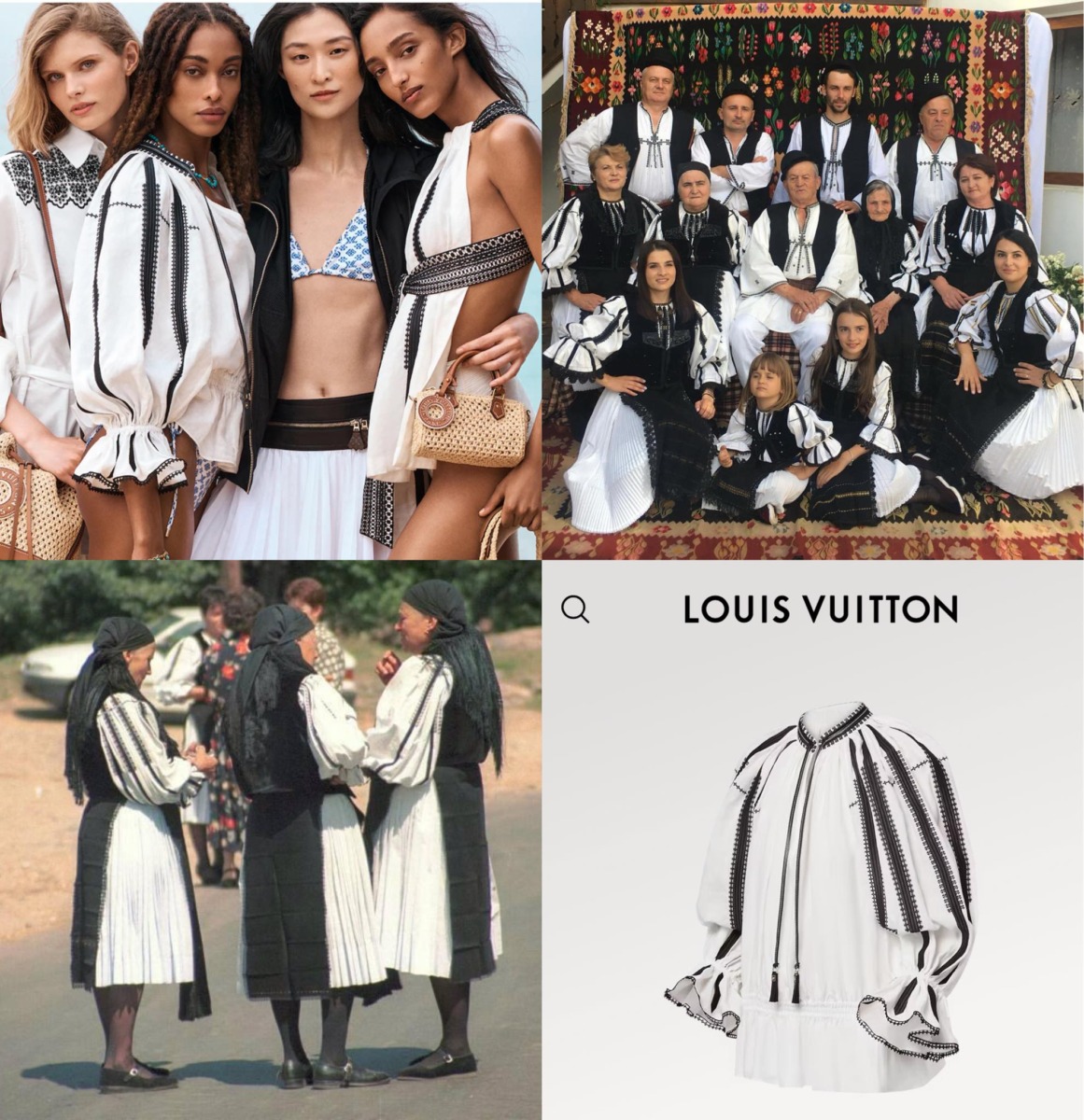
Romanian officials want French luxury fashion house Louis Vuitton to own up that a traditional Romanian blouse was the inspiration for a 2024 collection.
“We will request that Louis Vuitton recognize the heritage and cultural value of the traditional blouse model with ribbons,” Culture Minister Raluca Turcan wrote on Facebook. She said it was an opportunity for international recognition of the “inestimable value” of Romanian tradition.
The blouse in question is called an ‘ie’ in Romanian and features intricate embroidery and is considered a symbol of the country’s ancient folk culture. In 2022, certain embroidered garments were added to a UNESCO list of intangible cultural heritage.
European lawmaker Nicu Stefanuta, who comes from the area where the blouse is made, said he would notify the European Commission and call on them to apply a recent EU regulation that protects the geographical origin of craft that is blended into fashion and design.
“Nicu Stefanuta….is passionate fan of folk dances and loves the traditional costume, often wearing traditional costume in the European Parliament,” a statement said.
Paula Popoiu, the curator of the Village Museum, a space featuring traditional Romanian houses, said that a rule was needed where the source of inspiration was mentioned.
However, diplomat and adviser to President Klaus Iohannis, Sandra Pralong, speaking in a private capacity, said the brouhaha was an opportunity to promote Romanian cultural diversity and not scold the reputable fashion house.
“Maybe Louis Vuitton can use more (Romanian culture) and Romania can negotiate royalties (or at least) get vast publicity,” sandra pralong told Universul.net.
Mrs. Pralong has worked for the United Nations and is an aficianado of haute couture.
Louis Vuitton has not reacted so far.
The garments that picked up attention in Romania were in Nicolas Ghesquiere’s Resort 2024 collection for Louis Vuitton, some of which run into the thousands of euros.
Romanians launched a campaign for Louis Vuitton to “give credit” to its national heritage by ‘La Blouse Roumaine, a group that fights for recognition of traditional apparel that is used in fashion collections.
Its not the first upset of its kind. In 2017, U.S. designer Tory Burch altered the description of one of her coats, after Romanians were angered she marketed it as Africa-inspired. Burch updated saying: they “missed a reference to a beautiful Romanian coat which inspired one of the pieces.”
“This is not the first time that fashion houses use the motifs and patterns of traditional clothes. That is why I am proud to have voted for a European regulation that will allow us to better protect cultural heritage in the future,” Mr. Stefanuta said.
