










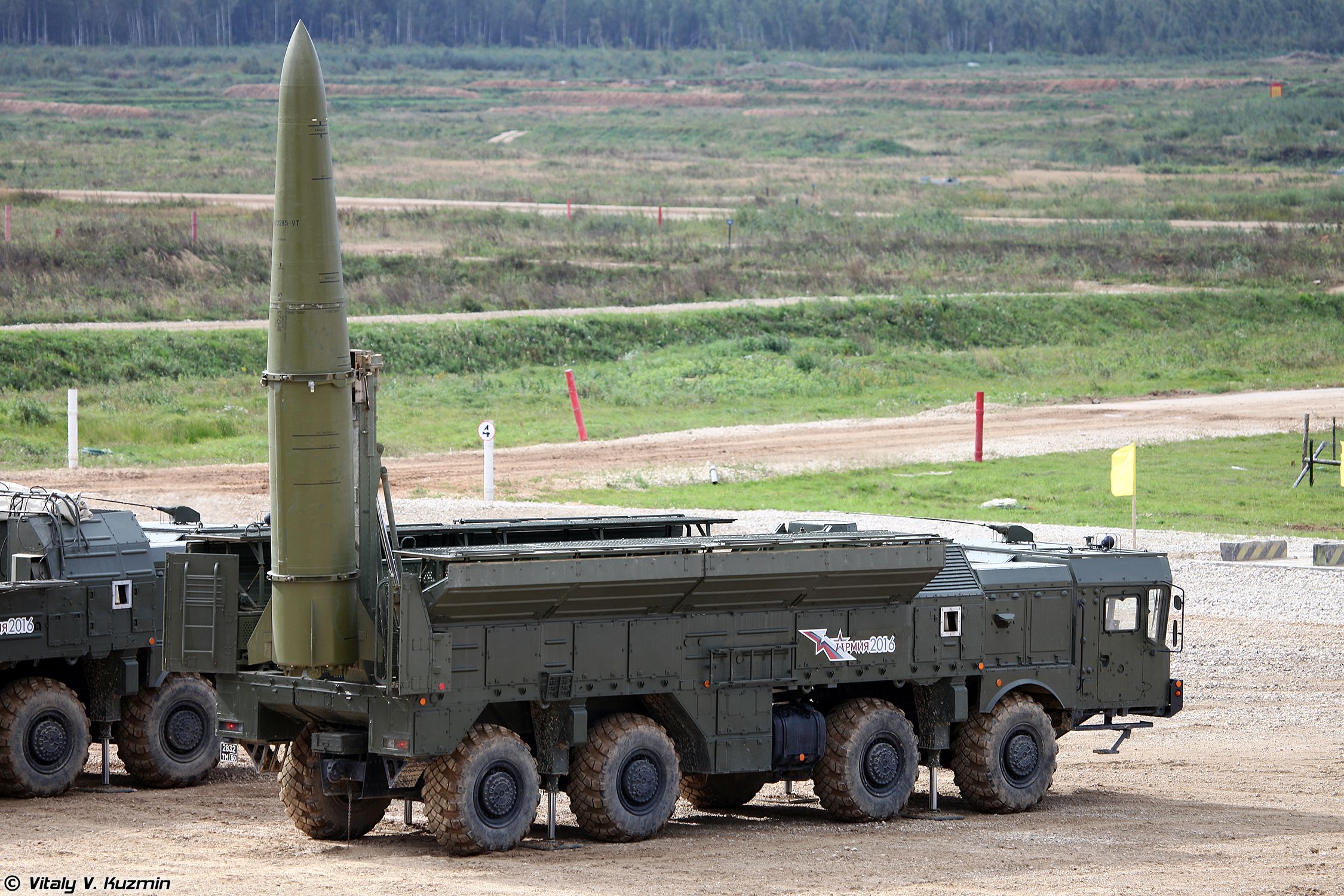
Russia defends atomic weapons as guarantors of peace, but also offers the prime example of how they allow conventional outrage under the blackmail of nuclear escalation. That explains much about Iran.
Kremlin spokesman Dmitry Peskov said this week that nuclear weapons are “the only thing that protects the world from a global war.” That is rich, coming from the country that launched one of this era’s most outrageous wars because its nukes shield it from consequences. But ridicule is not a strategy, and the assertion deserves attention.
Peskov’s remarks – which can fairly be viewed as Putin’s, in effect – came months after the expiration of New START, the final remaining strategic arms control treaty between Russia and the United States, and at a moment when concerns about a renewed global arms race are mounting. His central proposition — that nuclear deterrence has prevented another world war — is not novel, reflecting a foundational assumption since 1945: that mutual assured destruction would keep rivals thusly equipped behaving within acceptable (or at least accepted) guardrails.
Russia is the now poster child for how dangerous that assumption is. This is the country with the world’s largest territory by far (almost twice the size of the United States) which has sacrificed hundreds of thousands of lives to gain a tiny bit more territory. It first attacked Ukraine in 2014, seizing Crimea, and launched a failing full-scale war in 2022.
It is an ongoing crime against Ukraine, and an action despised by almost the entire world community (though China may find it useful as a precedent-test regarding Taiwan). Putin has been getting away with it for two reasons: first, Russia had persuaded the world to sweet-talk Ukraine (under the 1994 Budapest Memorandum) into handing Moscow the nukes it inherited from the Ukrainian Soviet republic, promising never to attack it; second, Russia has nuclear weapons, and so can tell the world to go to hell.
Given this, it does not seem like nuclear weapons kept the peace in Ukraine.
During a television interview (above) discussing Peskov’s remarks, I summarized matters metaphorically: “Every criminal wants a gun to prevent the police from arresting him.” A firearm does not necessarily keep the peace; that depends on who possesses it and for what purpose; but like nuclear weapons, it can certainly protect the evildoer from consequences.
To understand how we got here, it is worth returning to the origins of the nuclear age. When the United States dropped atomic bombs on Hiroshima and Nagasaki in August 1945, the destructive potential of modern warfare changed overnight. For a brief period Washington possessed a monopoly on nuclear weapons, but that ended in 1949 when the Soviet Union successfully tested its own device. Over the following decades, technological advances transformed relatively crude atomic bombs into thermonuclear weapons capable of destroying entire metropolitan regions.
The Cold War became an unprecedented strategic experiment. Rivals that were not just competing empires in the familiar sense but deeply committed ideological enemies accumulated enormous nuclear arsenals while avoiding direct military conflict. By the mid-1960s, both Washington and Moscow possessed secure second-strike capabilities, meaning that neither side could eliminate the other’s ability to retaliate after absorbing a first attack. This gave rise to the doctrine of Mutual Assured Destruction, often abbreviated as MAD. The concept was grim but coherent: since any nuclear exchange would result in catastrophic destruction for both sides, rational leaders would refrain from initiating one.
The doctrine contributed to stability, which is why Peskov might feel confident in his gaslighting. The United States and the Soviet Union competed fiercely across the globe through proxy wars, espionage, political subversion and ideological competition, but they remained acutely aware that a direct military confrontation risked annihilation. American students were made to practice hiding under desks, which was idiotic to be sure – but in any case proved unnecessary.
Even so, the Cuban Missile Crisis of 1962 demonstrated just how close the world could come to catastrophe. For thirteen days, miscalculation threatened to produce a nuclear exchange unlike anything humanity had experienced. The eventual diplomatic resolution profoundly shaped both superpowers’ appreciation of nuclear risk and accelerated subsequent efforts to establish communication channels and arms control agreements. Also, interesting, the USSR folded.
Beginning in the late 1960s and continuing through the end of the Cold War, successive treaties sought to reduce those risks. The Nuclear Non-Proliferation Treaty (NPT), signed in 1968, rested on a grand bargain. Countries without nuclear weapons agreed not to pursue them, while the recognized nuclear powers committed to pursuing eventual disarmament and facilitating the peaceful use of nuclear technology. The Strategic Arms Limitation Talks, followed by the START agreements and eventually New START in 2010, imposed limits on deployed strategic arsenals and established verification mechanisms designed to reduce uncertainty between Washington and Moscow.
The record of these agreements is imperfect but significant. Although the world’s nuclear powers never eliminated their arsenals, the treaties helped reduce stockpiles dramatically from Cold War peaks and fostered a degree of transparency that lowered the risk of accidental escalation. Equally important, the NPT proved remarkably successful in limiting proliferation — though far from totally successful, as the below amply illustrates:

Dozens of technologically advanced countries – including Germany, Japan, Canada, Australia, Sweden and South Korea – possessed the scientific capacity to develop nuclear weapons but chose not to do so. South Africa remains the only country to have voluntarily dismantled a fully developed nuclear arsenal (other than, as mentioned above, former Soviet republics, which included not only Ukraine but Kazakhstan and Belarus).
Yet the history of nuclear deterrence contains another lesson that receives far less attention. Even if two adversaries believe nuclear escalation is too costly to contemplate, they may become actually more willing to engage in conventional conflict, proxy warfare or coercive diplomacy precisely because each expects the other to avoid actions that could trigger a nuclear crisis.
The rivalry between India and Pakistan illustrates this dynamic. Since both countries became overt nuclear powers in 1998, they have avoided another full-scale conventional war despite enduring hostility. Yet nuclear deterrence has hardly produced lasting peace. Instead, repeated crises have demonstrated how nuclear weapons can constrain escalation while leaving room for persistent instability that cannot be resolved by one side’s victory.
Israel, too, has been shielded by its (undeclared) nuclear arsenal – and critics would certainly argue that this has enabled it to misbehave. Israel gets a pass on this from many (including me) for the simple reason that this (flawed) democracy is the world record holder for being endangered by its neighbors, many of whom hate it with a fanatical passion driven in part by a radical interpretation of Islam. It is a complicated story.
North Korea offers a simpler example. Pyongyang’s nuclear arsenal has transformed the strategic landscape on the Korean Peninsula. The regime remains deeply authoritarian and continues to violate international norms, yet its nuclear capability has dramatically narrowed the range of options available to outside powers. Any effort to remove the regime by force now carries unacceptable risks, not simply for South Korea and Japan but potentially for the broader international community.
The implications extend directly to Iran, whose nuclear ambitions have preoccupied policymakers for more than two decades. Much of the public discussion focuses on the prospect of Iran actually using a nuclear weapon. That is almost certainly the wrong question. Nuclear deterrence is designed precisely to make direct use less likely. The more immediate strategic consequence of an Iranian bomb would be to alter the balance between Iran and those seeking to constrain its behavior.
The Islamic Republic is determined not just to crush the will of the Iranian people but to project power well beyond its own borders. It has long supported Hezbollah in Lebanon, the Houthis in Yemen, Shiite militias in Iraq, including factions within the Popular Mobilization Forces, and other armed partners across the Middle East. Its support of Hamas helped scuttled a two-state solution in Israel-Palestine, by fomenting war. At this very moment, it meddles in Lebanon, seeking to leverage Trump’s desperation for a deal in the Persian Gulf in order to rescue Hezbollah, which the Lebanese government wants disarmed.
For this illegitimate regime, a nuclear deterrent would fundamentally alter the equation. Every future confrontation with Iran — whether over regional proxy activity, maritime security, its massacres of protestors, or its nuclear program itself — would unfold beneath the shadow of possible nuclear escalation. Decisions that are already difficult would become impossible. Angst over the Strait of Hormuz would look, by comparison, ridiculous.
There is a precedent against directly and publicly threatening the use of nuclear weapons. Putin actually broke it four years ago, and last year developed that into a “doctrine” outlining scenarios where Russia would be justified in using such weapons (when threatened, basically.
Expect nothing different from a nuclear Iran. It would carry a big nuclear stick.
That’s why people who view nukes as a “right” are so wrong. They will tell you that if Israel has nuclear weapons then Iran also has the right. That would be a very dangerous principle to implement – because the real question is whether we’re talking about a criminal with a gun. Judging who is a criminal is messy, to be sure; misjudge, however, and you’ll be dealing with much worse than a mess.
