














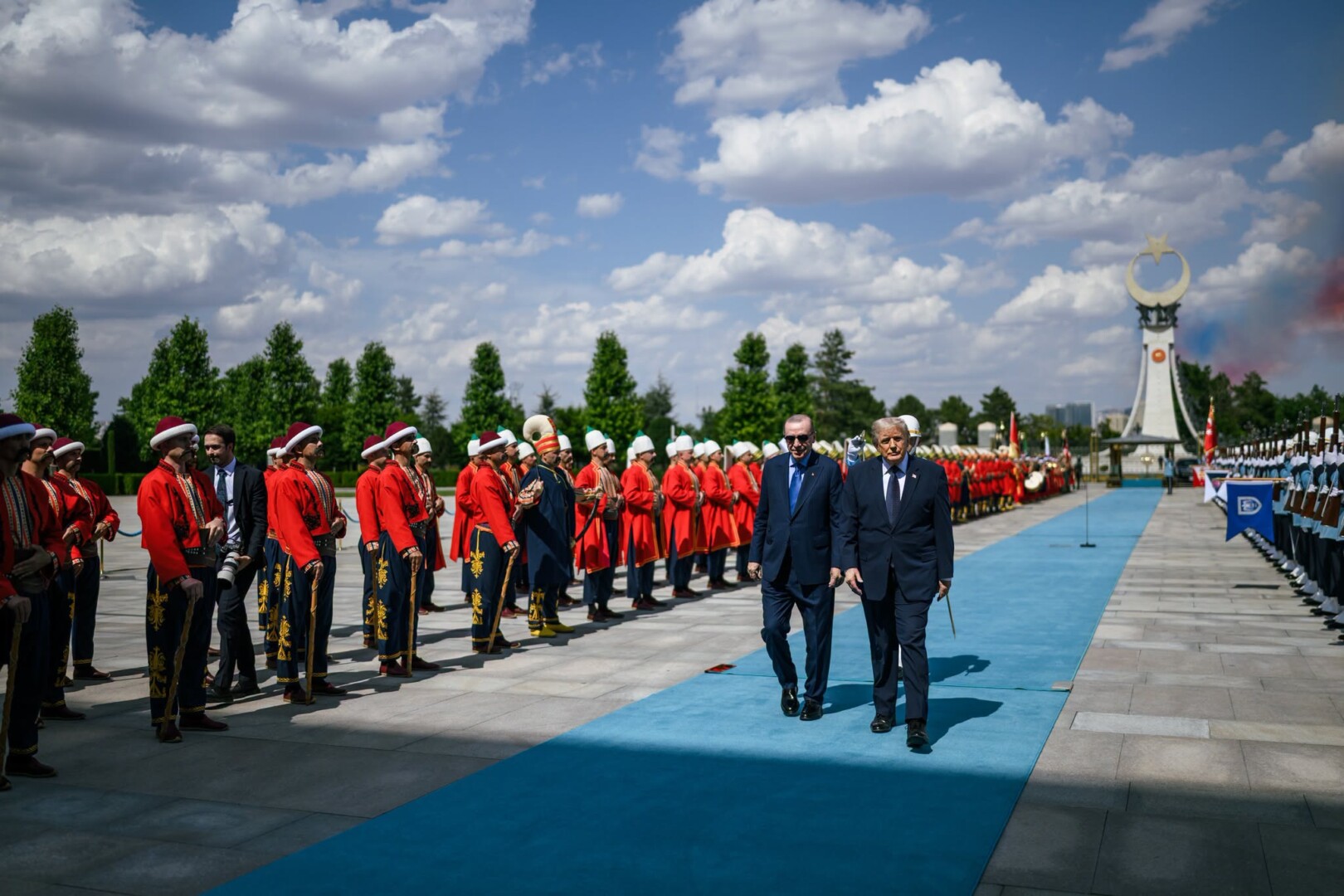
Erdogan, whom Trump “likes,” has gutted democracy, menaced allies, drifted toward America’s adversaries and turned anti-Israel radicalism into state policy
Trump has always had a peculiar affection for strongmen. He admires rulers who concentrate power, dominate institutions, intimidate enemies and present themselves as the living embodiment of the nation. Few fit that description better than Turkey’s Recep Tayyip Erdogan, so Trump now wants to sell him F-35 stealth fighters, which would harm American security.
Ankara was expelled from F35 eligibility in 2019 after purchasing Russia’s S-400 air defense system for an excellent reason: its partnership with Russian air defense systems could weaken the F35’s ability to evade Russian radar – which was, inter alia, critical to the ability of the United States (and Israel) to control the skies over Iran in the recent war with that country’s regime. At the NATO conference this week, Trump said he would lift sanctions on Turkey and consider selling it these planes.
The fear that Moscow could gain insight into NATO’s most advanced aircraft will probably create congressional hurdles to the administration’s plans to make such a sale. But there are plenty of other reasons to resist this idea.
It would reward one of the Western alliance’s most successful authoritarian rulers. Turkey under Erdogan still holds elections, but the foundations that make elections meaningful have been destroyed. In Erdogan’s Turkey, judges are pressured, journalists are jailed, academics are dismissed, civil servants are purged, generals are prosecuted and opposition figures are harassed. After the failed coup attempt of 2016, Erdogan used the emergency to pass constitutional changes have made the presidency into an instrument of personal rule.
Critically, the press has been brought to heel through a mixture of state control, crony ownership, intimidation and prosecution. Reporters Without Borders now ranks Turkey 163rd out of 180 countries in its 2026 World Press Freedom Index, with dismal scores across the political, economic, legal, social and security indicators. So: a NATO country now sits near the global bottom on press freedom. That fact alone should give Washington pause before handing Erdogan the most sophisticated fighter aircraft in the American arsenal.
Erdogan — who has turned Turkey into a fake democracy (see our in-depth analysis) — has repeatedly strained the alliance whose protection he enjoys. Turkey bought the Russian S-400 system despite American warnings. It delayed Nordic NATO enlargement. It has created repeated crises with Greece and Cyprus, part of which it in effect occupies. It has pursued military operations in Syria that collided with Western priorities. It has backed dictatorial Azerbaijan against Armenians in Nagorno-Karabakh, helping create the conditions for the flight of more than 100,000 ethnic Armenians from a region where they had lived for generations. It has flirted with Russia while still demanding the benefits of NATO membership.
This is the heart of the matter. NATO was built as a community of democracies, not a club of transactional military clients. Its members are supposed to share a basic commitment to constitutional government, rule of law, civilian restraint and collective security. Those values are the reason members trust one another with intelligence, bases, integrated defense systems and advanced weapons. When a member state behaves as Erdogan’s Turkey does, this edifice is badly eroded.
Turkey’s posture toward Israel has made the rot even clearer. Erdogan has long used Israel as a foil, but the rhetoric from his government has become steadily more extreme. Foreign Minister Hakan Fidan recently called Israel “a burden that humanity can no longer bear” and and “a problem for the whole world,” and Interior Minister Mustafa Ciftci publicly expressed his desire to serve one day as “governor of Jerusalem,” while suggesting that Jerusalem would eventually return to Turkish sovereignty.
Then came the reaction to Israel’s move toward recognizing the Armenian Genocide. Israel’s Cabinet approved a proposal to formally recognize the mass killing of Armenians by the Ottoman Empire during World War I as genocide, as the United States and most democracies have done. Turkey reacted with fury.
Supporters of accommodating Turkey always invoke geography. Turkey controls access to the Black Sea, borders the Middle East, sits near Russia, hosts important facilities and possesses NATO’s second-largest military. All of that is true. It also proves the opposite of what the appeasers claim. The more strategically important Turkey is, the more America should not encourage it to be an authoritarian, resentful, Islamist-inflected, neo-Ottoman rogue on the world stage.
The F-35 is a flying intelligence platform, a symbol of trust and a core component of American and allied air superiority. Countries receive it because Washington believes they will safeguard its technology and not pass it on to Russia. Turkey broke that trust when it bought the S-400.
The Turkish people deserve a democratic future, and a free Turkey could again become one of the most important partners of the United States and Europe. But Erdogan’s Turkey has moved in the opposite direction. America should not reward that trajectory
Sadly, Trump’s apparent willingness to look past all this is not surprising. If anything, he is also a fan of Vladimir Putin, and a president who wants Russia to prevail in its criminal war against Ukraine. None of that obligates the Republican Party and its representatives in Congress. Rather, they might consider whether Trump’s wholesale abandonment of American values and interests might not be punished by the voters.
So Congress should block any restoration of F-35 access while the S-400 issue remains unresolved and while Erdogan continues to behave like an authoritarian spoiler inside the alliance. The president of the United States should be telling Turkey that NATO membership carries obligations, that advanced American technology requires trust and that alliances mean more than whether Trump “likes” you.
