













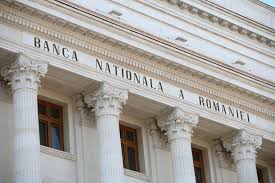
On Financial Education Day, on April 11, we hosted the third edition of the Financial Education Forum at the National Bank of Romania, an event that has been taking place, since 2022, under the High Patronage of the President of Romania. In this festive context, together with the Governor of the National Bank of Romania, I sent congratulations to the finalists of the “Eugeniu Carada” National Competition for Financial-Banking Education and I had the pleasure of handing over the diplomas to the winners.
The Forum benefited from the participation of the Prime Minister, the Minister of Education and the Honorary Advisor to the Interim President of Romania, and together with our partners – the Financial Supervisory Authority, the Academy of Economic Studies in Bucharest and the Romanian Association of Banks – we highlighted the decisive importance of financial education for building a responsible and prosperous society, capable of facing challenges competitively, with balance and wisdom.
The picture of 2025 belongs to a wide spectrum of uncertainties and challenges, economic and political, internal and external.
For Romania, the key challenges remain related to the consolidation of public finances and financial sustainability, especially after the slippage of the budget deficit in 2024. The essential objective of financial stability can be achieved, in a sustainable manner, but only through the fair sharing of discipline and adjustment efforts.
These are the remarks I made at the opening of the Financial Education Forum 2025:
“Distinguished audience, Dear colleagues, ladies and gentlemen,
I also welcome you to the National Bank of Romania, to the third edition of the Financial Education Forum. I remember with joy that I encouraged initiatives to promote financial education since the first edition of the Forum, in 2022, when I initiated, from the Presidential Administration, the High Patronage of the President of Romania dedicated to financial education projects.
Today, we can say that the intention to ensure such a large-scale institutional framework, for collaboration and debates on financial education, has also managed to pass the test of time.
The holding of the Forum this year under the High Patronage of the Interim President of Romania represents a continuation of the recognition of the importance of our efforts. Regardless of what the future will bring, we hope that this support will remain, in the coming years, on the agenda of priorities of the public authorities and the Presidential Administration.
Ladies and gentlemen,
The geopolitical context and the current economic challenges, together with the accelerated impact of digital technologies, require adequate responses, constantly updated, including regarding the need for financial education.
The financial and banking environment, as a whole, is evolving rapidly under the pressure of technological innovations and interconnection through digital tools. But all these can easily become sources of problems for the uninformed public, especially in the financial-banking field, where products and tools are complex, very dynamic and increasingly sophisticated.
I propose that we look together at the data of a simple, apparently simple problem. Statistically, one-third of the adult population can be considered financially literate, according to official standards. About a third of the population also has minimal digital skills, people who generally belong to rural areas.
The banking system in Romania is represented by about 3,500 units, to which access is much lower in rural areas and less developed regions. In addition, in the context of the COVID-19 pandemic, the trend of reducing the territorial footprint of banks in Romania and accelerating digitization has increased.
In the sphere of public policies, we hear more and more often about the limitation of cash operations, about the development of services offered exclusively online, about the introduction of the official digital currency. But how will we balance the balance? How can we reconcile these extremes, including in relation to opportunities and risks? The quality of public policies often lies in such details.
Such examples can also be used for firms, especially for small firms. There is a huge difference, at the level of SMEs, between the advance of investments in technology and the dynamics of the budgets allocated to employee training.
Last but not least, the quality of public policies, especially economic ones, depends on the way in which both decision-makers and the public, in general, relate to the knowledge of the profile and to the demands of economic and social realities.
The picture of 2025 belongs to a wide spectrum of uncertainties and challenges, economic and political, internal and external. For Romania, the key challenges remain related to the consolidation of public finances and financial sustainability, especially after the slippage of the budget deficit in 2024.
Increasingly burdensome are the external deficits, which are growing, but which must be profoundly corrected, through sound policies and on the path to competitiveness. Romania is in dire need of regaining and strengthening investor confidence.
From the perspective of the National Bank of Romania, as a monetary policy decision-maker and regulatory authority, consistency in relation to the commitments assumed, those regarding the necessary economic policies and reforms, the use of available European funds and the implementation of strategic development projects is essential. The essential objective of financial stability can be achieved, in a sustainable manner, but only through the fair sharing of discipline and adjustment efforts.
Geopolitical tensions continue to play a significant role, given the conflicts in Ukraine and elsewhere. Today, however, a critical source of risk has become the trade tariff war.
The tariffs recently announced by the US have suddenly inflamed the world economy, and the response of the partner states, probably justified, was expected to be a substantial one. Under these conditions, we ask ourselves, in relation to the principles of free trade and the division of labor, principles sedimented and scientifically validated throughout the history of economic thought, how can we recover, if we still can, economic common sense or freedom of trade in essence – indispensable premises for business and prosperity. Obviously, the answer cannot ignore the honest attachment of decision-makers and the public to economic education.
Dear guests,
Investing in general economic education, from which financial education derives, is the safest investment in a nation’s human capital portfolio. This is where the construction of a responsible and prosperous society begins, capable of facing challenges competitively, with balance and wisdom.
Economic and financial education means, first of all, well-informed citizens, oriented towards realistic goals and responsible choices, it means strong and competitive entrepreneurship, good governance and sound economic policies.
In this regard, the role of the authorities is a major one, but success will be ensured only through a participatory effort, through solid partnerships with academia and the entrepreneurial community.
You know, of course, the financial education programs of the NBR, and I am referring here to those for pupils, students, teachers, or those for the business environment. The results of such programs will be awarded today and our intention is to strengthen and develop this portfolio, in collaboration with our partners.
We thank the partners – the Financial Supervisory Authority, the Academy of Economic Studies and the Romanian Association of Banks, who responded dedicated to the proposal of the National Bank of Romania to join our efforts for the organization of this third edition of the Financial Education Forum.
I am convinced that, in the future, our collaboration will remain as good and fruitful as well.
I also thank the Romanian Banking Institute, as well as the Institute of Financial Studies, for their continuous efforts to raise the training of specialists to the new standards and trends specific to the current financial-banking markets.
Last but not least, I convey my appreciation to all those who, today, managed to mark the Financial Education Day, through actions or healthy economic ideas.
Thank you and I wish you all the best of luck in the future!”
