









It was my third visit in early August this year to “Haferland”, the annual festival of the Saxons, the small German community that lives in the heart of Romania.
Haferland, which in English means “the land of oats”, is like a little Switzerland, a land of plenty where a few villages are coming back to life, with their fortified churches and restored citadels, nestled in the green hills of Transylvania north of Brasov, far from the conflicts of centuries past, which have caused the country so much suffering.
So I return to the village of Criț (pronounced Critz, watch out for the cedilla under the T), at the invitation of Michael Schmidt, a native of the village who was able to emigrate to Austria and Germany in the 80s, before returning after the fall of communism. The main importer of automobiles, including BMW, Rolls Royce and MAN trucks, he is one of the region’s major patrons, along with the Prince of Wales, now Charles III of England, who has invested in the restoration of the nearby village of Viscri.
Three years ago, Michael Schmidt celebrated the centenary of Sofia Folberth, the oldest member of the German community, a birthday celebration that took place during a visitf Romanian President Klaus Iohannis to Criț two years ago.
For a long time mayor of the medieval city of Sibiu, founded in the 13th century by Luxembourg settlers and now a prosperous city in central Romania, Klaus Iohannis, was elected and re-elected and presided over the country for ten years, while keeping a hint of German accent when he spoke the language of his compatriots.
But let’s get back to our venerable Sofia, who just celebrated her 103th birthday in August 2025, joined by Michael Schmidt.
She was born in 1922 and has rarely left her village of Criț, which stands in the shadow of its imposing fortified church, which has been faithfully restored.
Two years before her birth, in 1920, Greater Romania was born, with the addition of Transylvania and northern Bukovina.
It got off to a bad start, however!
Romania entered the war in 1916, alongside the French and the British, but struggled to hold up against the “Central Powers”, Germany and Austria-Hungary which were allied with Bulgaria and the Ottoman Empire.
Bucharest was occupied and the Russian ally collapsed in 1917 with the Bolshevik Revolution. Retreating to Iasi, Moldavia, the Romanian army reorganized, thanks in particular to the French military mission of General Henri Berthelot and the unwavering support of King Ferdinand I and Queen Marie.
The neighboring Saxon country, Transylvania, for centuries was a “land of disputes” fought over by the Magyars (Hungarians), Szeklers, Germans, Saxons, Romanians, not to mention the Gypsies, the Roma, serfs sold with the land by the boyars of the time, until they were freed in 1864 by the agrarian reform of the great Prime Minister Mihail Kogalniceanu.
In 1867, the Austrian Emperor Franz Ferdinand entrusted the Hungarians with the management of Transylvania. Already in 1865, the Sibiu Autonomous Diet, Hermannstadt, had been dissolved.
A policy of “Magyarization” was established against the Romanians and Germans, notably in 1907, there was a school law in Transylvania, which at that time had 55% Romanians, 10% Saxons and 35% Hungarians.
It is difficult to keep Romania’s history short, because in 1940 the country suffered the full force of the Molotov-Ribbentrop agreement, in short the Hitler-Stalin agreement, and lost a large part of Transylvania again to the Regent Horty of Hungary, an ally of the Nazi regime, as well as Northern Bukovina and Moldavia (Bessarabia) to the USSR.
In 1945, Romania recovered Transylvania, but not northern Bukovina or Moldavia, which were kept by the Soviet Union. Stalin even ensured that the new Moldavian SSR did not have access to the Black Sea, as the northern part of the Danube delta, taken from Romania, was directly attached to Ukraine.
Today, in 2025, 80 years later, Michael Schmidt’s Foundation continues to work on the reconciliation of the different communities, Saxon, Romanian, Gypsy for the village of Criț and the region.
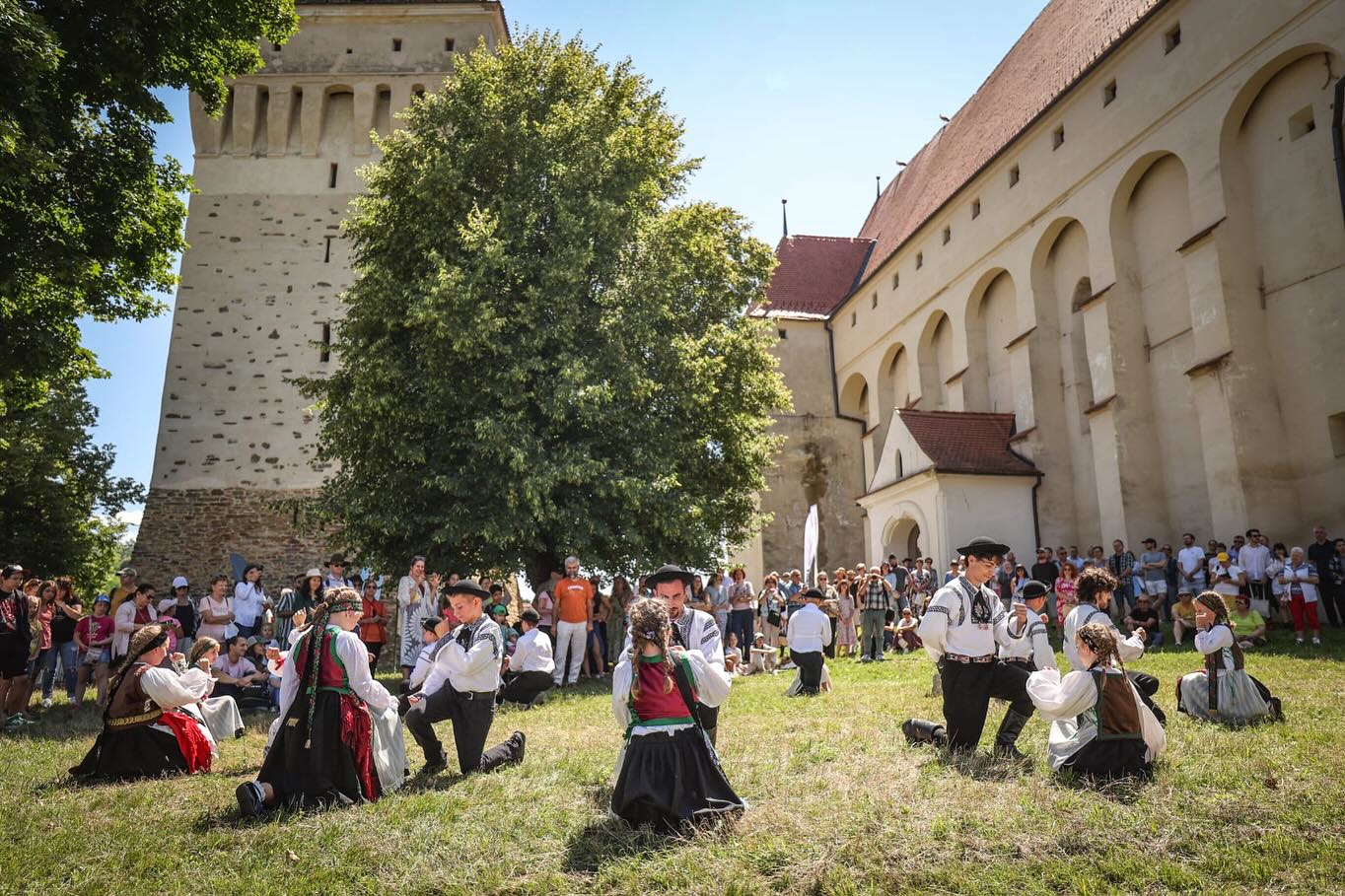
At the opening of the Saxon festival, dozens of guests and visitors were brought to the foot of the fortified church by the traditional horse carts driven by the village’s Roma coachmen.
They were greeted by choirs from neighboring villages and towns, such as Saschitz, often featuring children and teenagers dressed in Saxon costumes.
Another surprise! As you get closer, you discover that most of these young people, who are born in Romania, speak German among themselves!
Invited since the very first edition of the Haferland Festival, the Ambassador of Israel was present during the three days thus year. As a testimony of resilience for Romania, which has struggled to heal the wounds of the horrific 1941 pogrom in Iasi and in neighboring Moldova, with the death of some 15,000 Jews.
Did you say reconciliation?
It is as necessary as it ever was. Thank you Mr. Schmidt!
