










The tragedy of a reality show at the highest global level
At the beginning of January, Donald Trump warned the regime in Tehran that if it started killing protesters it will be hit hard.
In the following days, the regime in Tehran began to kill innocent people on a conveyor belt. We know today that on January 8 and 9, immediately after Trump’s warning, there were unimaginable peaks of repression and the internet was cut off nationwide so the slaughter could take place in peace.
The week after, the US president gave new hope to the protesters, saying help was “on the way”.
Now, from Trump’s perspective, “on the way” could mean 2-3 three weeks (that’s how long it took the American naval group, deployed in the Middle East to reach its destination). But from the perspective of those who took to the streets, pursued and crippled relentlessly by the goons of the theocratic regime, “on the ay” should have come sooner. It is tragic how these people were misled, some paying the ultimate price, daring to continuing to take to the streets because they trusted that help was “on the way.”
But when you sit in the White House and Mar-a-Lago, time passes in a completely different way to the way it passes when you are on the street faced with killer troops.
In fact, before help could be “on the way”, the protests in Iran were drowned in blood (officially in the thousands, but the estimates are in the tens of thousands). Reza Pahlavi, the son of the former shah, expressed some perplexity about the seriousness of Trump’s warnings (whispered, it’s true, but clear enough), especially since he had urged the Iranians to stay on the streets, arguing it was worth the risk, since Trump had categorically promised them help.
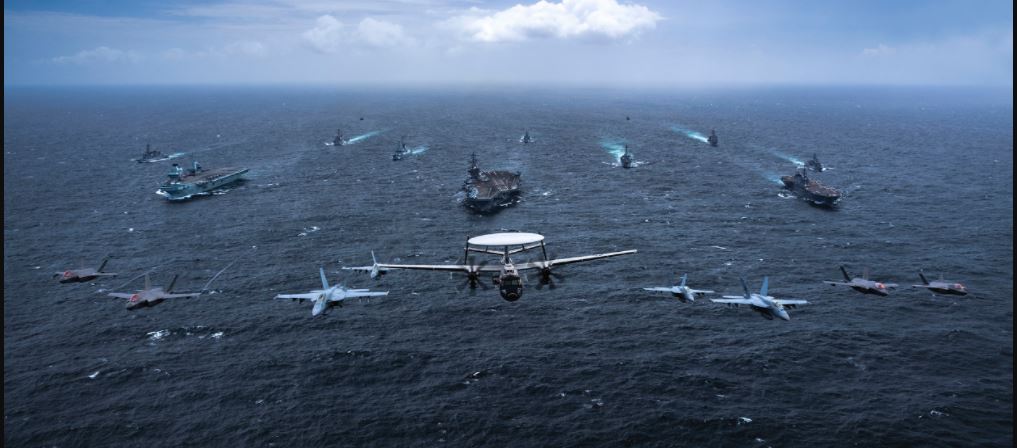
Now, three weeks after the peak of the repression in Iran, the only concrete element we have is that the naval battle group, which was moved by the Trump administration to the region and has reached its destination.
And yet, it’s not clear what kind of support the U.S. president had in mind when he said help was “on the way.”
It can’t be excluded that he believed Iran was a mere stone’s throw away, because geography is not his strong point; and at the same time, it can’t be excluded that Trump initially believed that it was possible to act without the support of that naval group because in strategic thinking he is profoundly ignorant about the details and has a Hollywood approach that the American army can do anything, anywhere, anytime, against anyone and under any conditions.
It can’t be ruled out that when he uttered the famous “on the way”, Trump thought that he could quickly use the US bases in the Arab states, only to come to his senses learning that he no state would allow him. And these states are wealthy and have money the Trump family is counting on, for their own businesses, and the Trump government, to increase investment in the US.
At the same time, we can’t rule out that in Trump’s mind, when he used the words “on the way, it was actually just that: the naval group, including the aircraft carrier, necessary for the strikes on the regime in Iran was “on the way”. In which case, let’s go back to what I said: in the White House today there is a head of state with a precarious understanding of what it time means depending on the context.
In the past three weeks, the way Trump has dealt with Iran shows a lack of connection with reality.
It reveals the toxicity involved in not doing what you say; likewise, not having to go through with what you say even as the president of the US.
Trump spits out verbs, promises and threats, praises and criticism just as Iran-type dictatorships machine gun their population: lightly, loudly, without discrimination, without discernment.
What could happen now after Trump’s erratic performance in the first three weeks? Probably something bad.
Because one thing is clear: the way he has behaved as president so far shows that Donald Trump is interested in exploiting various international files depending on how they can benefit him personally and politically.
One certainty is that some action will follow: it has to look good on TV, after so many categorical promises and dubious hesitations (as the slogan is all that matters, and the Iranian and regional reality is not a priority). In the meantime, there are new critical domestic situations for Trump” the criminal debauchery of ICE in Minneapolis is already costing him politically, and the risk of the Supreme Court blocking or diluting tariffs probably gives him sleepless nights, so more political costs.
The Iran issue will be defining Trump’s second terms as will the Russian-Ukrainian war, and the ICE-immigration problem, and the tariffs, as will the rift created by Trump in relation to the traditional US allies on all continents.
The problem raised by Iran hurts from the top to the bottom.
It hurts, because Trump didn’t know what to do and didn’t have an action plan for the “soft” phase, the short-term one. He failed miserably to deal with the immediate.
And it also hurts, as he has demonstrated that he knows what to do, nor that he has any plan for the “hard” phase, the long-term one, the one that involves “tomorrow” and the years that follow.
Theoretically and practically, this stage is much more complex than the first. And since the the “easiest” one was a total failure, it is hard to imagine that the second, infinitely harder, can be a fantastic success.
In approaching the Iranian file, Donald Trump now seems ready: ready to ignore objective reality; prepared to defy the concerns, advice and know-how of US allies; prepared not to give a dime about the effects of actions animated by a seriously inflated ego and massive ignorance can have on Iranians and regional implications.
