











Since taking power a year ago, the American president has put himself, and the US, in an increasingly delicate situation internationally.
But after the successful operation in Caracas, which resulted in the capture of dictator Nicolas Maduro, Trump increased the stakes of his role, without necessarily having all the cards to do so.
Thanks to his PR machine, Donald Trump has practically imposed the narrative that Donald Trump is like God: he can’t help it. Anywhere, anytime, anything and against anyone, Donald can intervene, and if he intervenes, he cannot fail.
This narrative is on the verge of being brutally tested, immediately, and not just anywhere, but in Iran.
Trump’s problem is that, intoxicated by the Venezuela episode, he has made categorical public commitments on several occasions that the US will intervene spectacularly and effectively on the side of protesting Iranians. Certainly, in doing so, he has created vast expectations among the protesters, as well as the Iranian diaspora. If he deceives their hopes – by failing to act or acting badly – he will add drama to the tragedy already underway.
So far, Trump has not yet kept his word, although the number of victims of the criminal regime in Tehran has only increased day by day, and he warned the regime not to kill people.
Certainly, Donald Trump’s delay in getting involved in what is happening in Iran is connected to the other big problem: Iran is not Venezuela, but an infinitely more complex story.
Iran is not within the range of the American armed forces as Venezuela was, the regime there is significantly more solid – it is older than that of Maduro-Chavez and, among other things, there is a religious dimension that Venezuela did not have, pushing things in a fanatical direction. And, of course, the Iranian regime has a vast mafia network that prevented regime overthrow at least twice in the last seven years (and even more, if we count the last 15 years).
On top of all this, unlike Venezuela, Iran is significantly more important for Russia, including the fact that, for four years , Iran has been a vital participant in Putin’s war efforts in Ukraine.
Just as Iran is a major partner for Beijing as well, and instability in Iran and even the prospect of regime change means it creates problems for the Gulf monarchies where the memories of the Arab Spring a decade and a half ago complicated the preservation of the social contract between the regime and the population.
These monarchies, which are intensely courted today by the Trump administration (for investment in the US, trade, the Trump family’s personal business, oil and US influence in the region), naturally have a horror of sudden American maneuvers in Iran, not so much because of their short-term impact, but especially because of their long-term impact and the fallout.
Trump has promised action in Iran, but he cannot promise that it will be successful. He cannot define its success by a formula that reconciles all sides and even less can he promise that, after a quick strike in the immediate future, Washington will be capable of optimal control over the shaping of developments inside Iran and the region.
It is not surprising, therefore, that there are differing optics in the approach to the Iranian problem, even around Donald Trump, including Vice President JD Vance, not just a handful of close advisers, as the Wall Street Journal recently reported.
The Iranian story is complex for Trump, even if, morally, civilized countries must stand with the Iranian population, impoverished for decades by the theocratic mafia, and now hunted like animals by the savage militias of Ayatollah Khamenei’s regime, his Securitate and his military.
At the same time, it is hard to believe that Trump is the most suitable US president to take the most appropriate short-term measures in Iran and adequately assess the long-term implications.
And yet, Trump has single-handedly raised the stakes, put himself in the spotlight and will have to deliver something.
The fact that he has the habit of conceiving his initiatives and moves with his eyes glued to the television and his ears tuned to people’s personal views about him is not an insurance for Americans, nor for the rest of the world, nor for the Iranians who are taking unimaginable risks protesting on the streets.
Moreover, it happens that precisely in this period, maybe even this week, there is an event in the US with potential earthshattering consequences on prime time for Donald Trump personally, for American consumers and US companies and world trade.
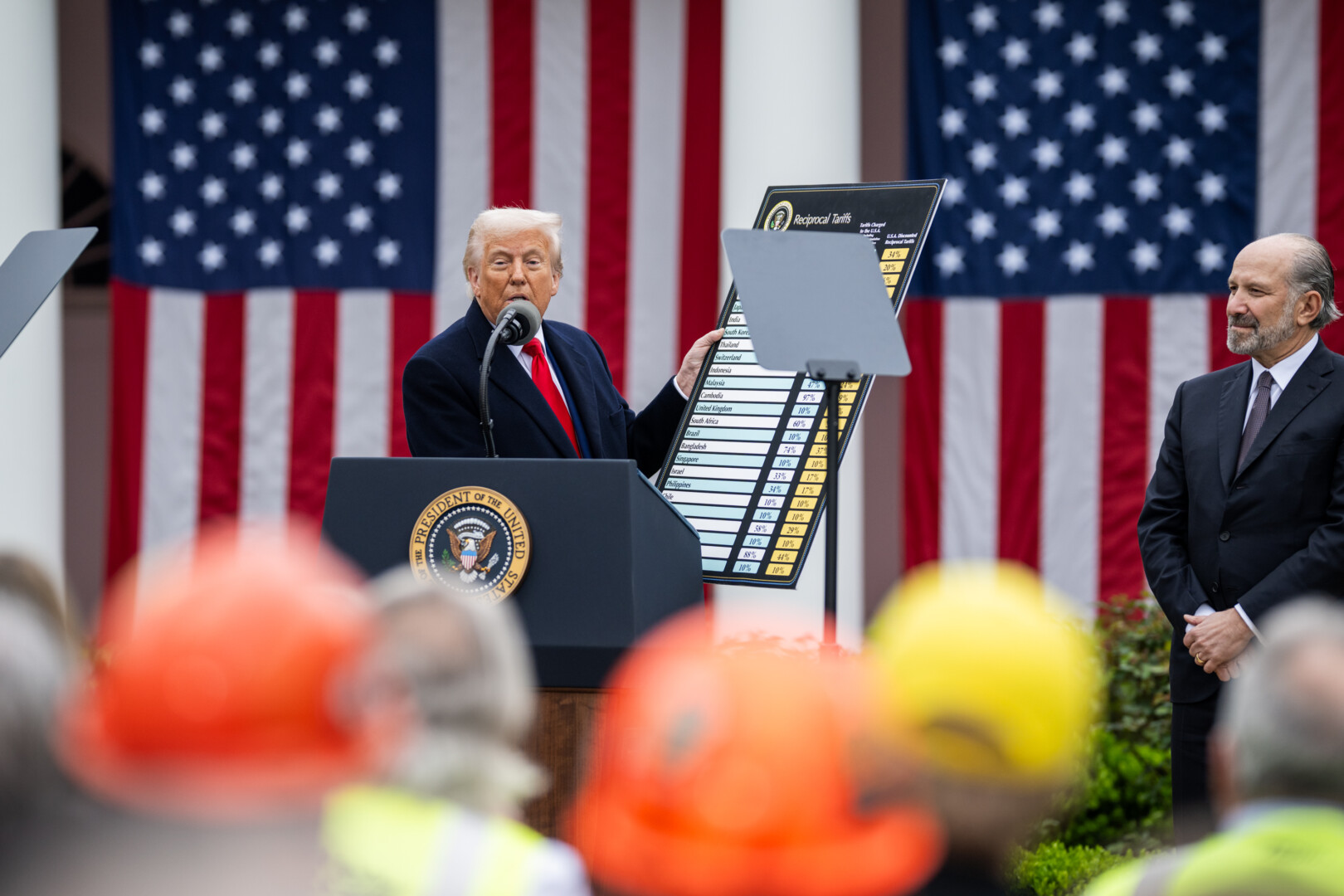
The US Supreme Court is expected to rule on the validity of Trump’s legislation imposing tariffs which practically triggered trade wars around the world which were unprecedented in almost a century.
Despite a Court that is generally friendly to the Trump administration, there still remains the probability, not just a possibility, that the decision will be bad at some level for Trump.
A blow dealt by the Supreme Court would be, for the US president, an image problem and one likely to reset the administration’s policy on trade and international relations. A bad decision for Trump, however, would be immensely good for ordinary Americans and for American companies doing foreign trade. And at the same time, it would be immensely good for the wider world.
But the very fact that it is possible and even probable that the US Supreme Court justices will turn the Trumpist madness on tariffs upside down in such a way also increases the likelihood of Trump acting strictly impulsively on Iran, with a total lack of wisdom, without taking into account the effects of the immediate approach to long-term strategic imperatives.
The testimonies of some who worked closely with President Trump in his first term painted him as a non-stop self-obsessed guy perennially unable to distinguish between his personal interest and the interest of the country (let alone the broader interest of the world).
The portrait in question is of a fundamental and obsessive person preoccupied with anything and anyone in the media – events or people who would steal his spotlight or who would simply put him in a negative light.
The deliberation process, in the White House led by Trump, is generally deficient. This time, if the tariff issue is blown up by the Supreme Court, things could get infinitely crazier.
That is why I expect that Trump’s decision on Iran, where he promised interventions, will be rather influenced, maybe even one hundred percent dictated, less by considerations related to the situation of Iranians who took to the streets and considerations related to the complex regional equation. A tough Supreme Court decision on tariffs will rather lead to immediate attacks by the U.S. military on Iran, and then, God help us.
With Donald Trump at the helm of the US, logic is profoundly inverted: it would be more logical to act driven by the thought of “burying” bad news about a possible unfavorable decision given by the Supreme Court in Washington than to act driven by the thought of the situation in Tehran and the associated strategic imperatives in the regional equation.
Even if Trump were to proceed like this, if the Supreme Court’s decision shakes tariffs partially or entirely, it would be too hard for him to deflect this by any spectacular personal PR and political marketing operation on Iran.
The Maduro case may have encouraged Trump to feel he’s leading the charge but the situation in Venezuela and Iran are not identical and whoever ignores this reality risks “riding” under the belly of the horse, not on its back.
.
Obvious signs that Trump will lose. And America will pay the price
