





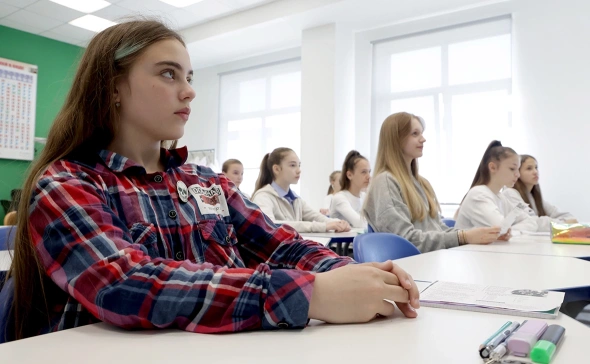
Schoolchildren are learning about sexual abstinence before marriage and a patriotic commitment to having as many children as possible once wed, in an optional new subject that has appeared on the Russian school curriculum.
The course which is designed to instil ‘family values’ is euphemistically named Family Studies and was introduced at the beginning of the academic year earlier this month, Novaya Gazeta said in a report.
All happy families are alike
Family Studies appeared on the school curriculum for the 2024 school year, and is being taught in some Russian schools. The course aims to “introduce young people to the traditional system of family values” and to “create pro-family attitudes around marriage, child-rearing and chastity”.
The course is 34 hours long and figures as an extracurricular activity. Important Conversations, another optional course was introduced by the Russian government in September 2022 to “boost patriotism” among Russian school children.
There’s no standard textbook for the course, so it falls to individual teachers to decide how to structure the lessons. There are general guidelines covering why and how to have a family, and family in-laws and other family-related matters.
Novaya Europe said that the lessons resemble propaganda far more than education in the schools where it is taught. Teachers in one school in the republic of Chuvashia, in the Volga region, said pupils had discussed the “spiritual and moral values of the family”, while another school in the republic said its pupils had drawn up a “code for a happy family”.
However, teachers in Moscow schools who spoke to Novaya Europe on condition of anonymity said it was unlikely there would be Family Studies lessons in the city’s schools this school year.
Russia’s birthrate has been steadily declining since 2016, prompting authorities to promote the idea that “large Russian families should become the norm and a key value for society”.
Sociologists say the reason is connected to a decrease in the number of women of reproductive age, which led to a sharp drop in fertility that began in 1987 compounded by high mortality rates in the early 1990s.
Demographers called it the “Russian cross”: the phenomenon when the number of deaths exceeded the number of births between 1992 and 2013.
Just under 600,000 children were born in the first half of 2024, the lowest figure since 1999. Some 325,100 people died, 49,000 more than in the first six months of 2023.
Deputy Justice Minister Vsevolod Vukolov last year said one of the ministry’s priorities was “to protect traditional values” from “alien propaganda” which he said was as troublesome as alcohol and drugs.
Not surprisingly, he warned about so-called threats coming from “the spread of LGBT ideology, gender reassignment, a new feminist culture, and childlessness, all of which have an impact on young people and lead to the degradation of the population.”
“Sex reassignment via hormone therapy is allowed in many European countries and is available to minors in the US already. Germany has several genders. It is extremely important for us to maintain our own approach,” Vukolov continued.
Voluntary-compulsory Orthodoxy
The first attempt to introduce ‘traditional’ values into Russia’s school curriculum was in 2010, when a textbook called ‘The Fundamentals of Religious Cultures and Secular Ethics’ appeared in schools across Russia as a pilot scheme. It was met with widespread criticism.
“The textbook aims to impose a religious ideology on pupils in an aggressive, evangelistic and coarse way …which is in flagrant opposition to the concept of a secular state,” Andrey Smirnov, a philosophy professor at the Russian Academy of Sciences, said at the time.
Nevertheless, the subject was introduced nationwide in 2012, broken up into six optional modules: Fundamentals of Orthodox Culture, Fundamentals of Islamic Culture, Fundamentals of Buddhist Culture, Fundamentals of Jewish Culture, Fundamentals of World Religious Cultures and Fundamentals of Secular Ethics.
In practice, there was rarely any choice for pupils, with their teachers making the decision to select Fundamentals of Orthodox Culture themselves. Even in schools where there technically had been a choice, and Secular Ethics had been selected, the module ended up being replaced by Orthodox Culture anyway, parents said in online forums where they shared their experiences.
“When the Fundamentals of Orthodox Culture was suddenly brought in, parents whose children were Muslims, say, rebelled,” one schoolboy, Igor, recalls. “We had children from various backgrounds: Tatar, Tajik. Atheist parents also rebelled, because their children now had to sit through 45 minutes of a compulsory subject when they weren’t religious at all.”
The science of morality and virginity
Once religion became part of the curriculum, there was discussion about the need to teach Family Studies too.
Schools in 60 Russian regions introduced an optional high school subject, Moral Basics of Family Life, in 2017. The course, which was drawn up by a priest and a nun, aimed to “introduce high school students to the fatherland’s traditional system of family values and prepare them to create strong and happy families”.
Sex education barely got a mention, though there was a passing reference to contraception, noting that it “killed love, making it sterile and unreal”.
The textbook had a chapter called The Science of Virginity, which promoted abstinence, which included claims such as men had a broader “mental range” than women.
Family Studies became part of the social studies curriculum in 2021. According to the chair of the Union of Orthodox Women, Natalia Dmitrievskaya, the change in the curriculum has had a positive effect on schoolchildren in the Volga region city of Samara.
“The situation has improved. The number of 10th-graders not wanting to start a family has halved. The number of those wishing to create a large family has more than doubled. The number of people wanting to marry once and for life has increased from 49% to 85%,” she said.
Surveys carried out by the Russian Public Opinion Research Centre however show that marriage and a family, come third on the list of youngsters’ priorities after buying an apartment and buying a car.
VIDEO | Conservative Christians turn against Vladimir Putin after Russian invasion of Ukraine
