












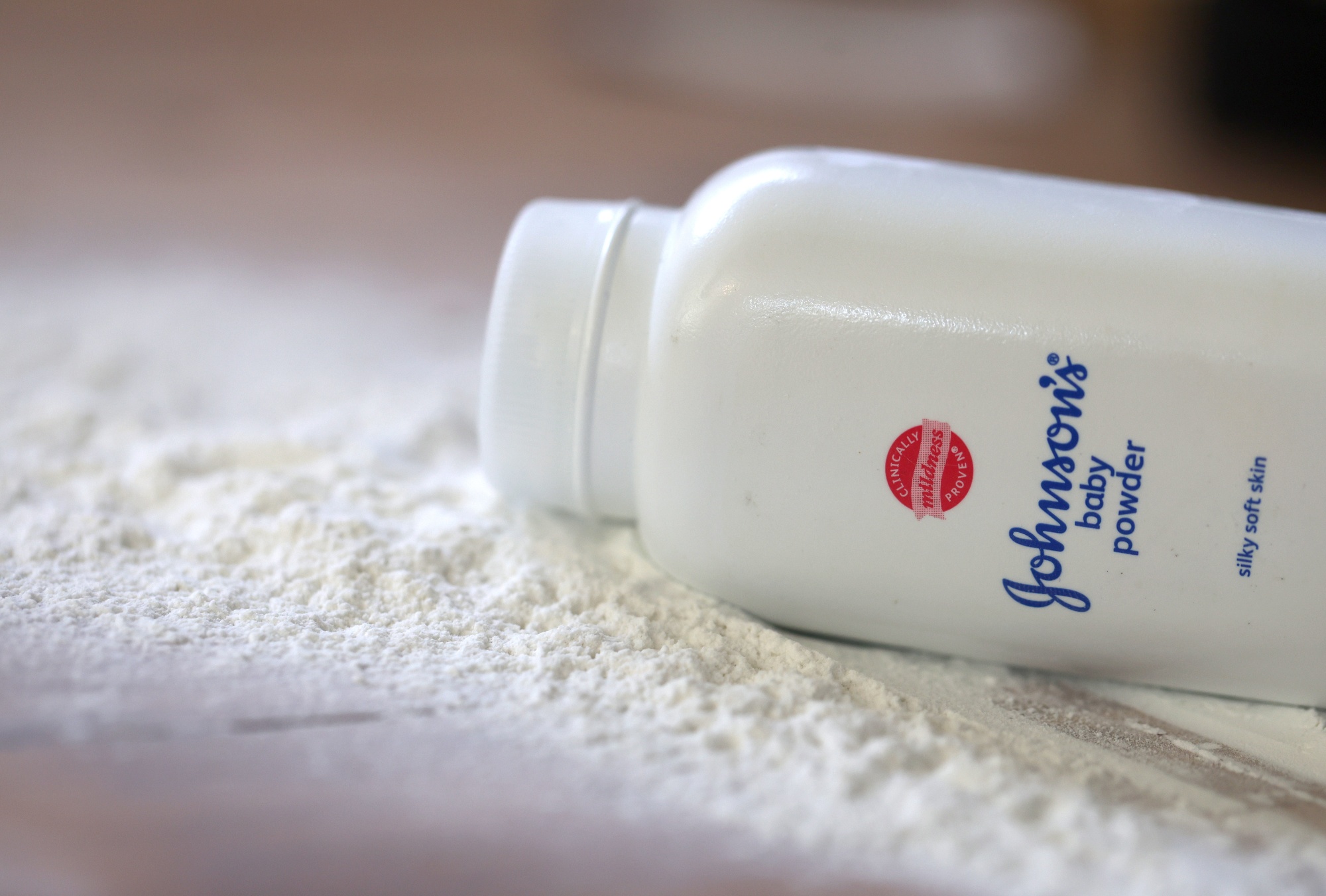
A huge lawsuit has been filed in the UK against Johnson & Johnson.
3,000 people have accused the firm of knowingly selling baby powder contaminated with asbestos.
The lawsuit alleges that Johnson & Johnson has been aware since the 1960s that its mineral-based talcum powder, used for babies around the world, contained fibrous forms of talc, as well as tremolite and actinolite.
Both minerals are classified as asbestos and linked to cancers in their fibrous forms.
Court papers allege that J&J neglected to issue warnings on its packaging.
This is especially serious given the fact that these are products notoriously marketed towards infant use.
J&J denies the allegation, denying that it sold baby powder contaminated with asbestos. Instead, it insists that its baby powder “was compliant with any required regulatory standards, did not contain asbestos, and does not cause cancer”.
The sale of baby powder containing talc stopped in the US in 2020 and the UK in 2023. Talc is a naturally occurring mineral that is often mined in close proximity to deposits of asbestos — a known cause of cancer.
The current lawsuit, in the UK, follows extensive battles in the US, where claimants have already received billions of dollars in damages.
Lawyers say this could become the largest product liability case in British history.
However, there have also been successful appeals on the company’s behalf.
An internal document from as early as 1973 allegedly says: “Our baby powder contains talc fragments classifiable as fiber. Occasionally sub-trace quantities of tremolite or actinolite are identifiable…”
In 1973, executives discussed the value of a possible patent for a method that aimed to remove asbestos fibres from talc. At the end of the letter comes the shocking statement: “We may wish to keep the whole thing confidential rather than allow it to be published in patent form and thus let the whole world know.”
J&J defends itself now by claiming that these discussions were confidential because a new patent could have been extremely valuable if the new method had been effective, which was ultimately not the case.
Also in the early 1970s J&J executives exerted pressure on the FDA to accept lower sensitivity standards for talc testing.
Internal email from 2008, as discovered by the BBC, reveals qualms: “The reality that talc is unsafe for use on/around babies is disturbing…” It went on to say: “I don’t think we can continue to call it baby powder and keep it in the baby aisle.”
J&J now claims this conversation was in reference to risk of asphyxiation and not cancer.
Many of the claimants have sued as they suffer from cancer. Many are sick with ovarian cancer, or mesothelioma, which is often caused by exposure to asbestos.
All the claimants say they used J&J’s baby powder over an extended period of time.
“The female reproductive tract is open to the external environment so that women can get pregnant,” says Prof Christina Fotopoulou, a leading gynaecological oncology surgeon at Imperial College London and a leader in the field of ovarian cancer. Therefore, “Cancer is usually an accumulation of mistakes in the reproduction cycle of the cells and so any harmful factors – internal or external – that disrupt the balance of the cells may contribute to these mistakes that eventually may lead to cancer”, she informs.
Common symptoms of ovarian cancer are persistent bloating, persistent pelvic or abdominal pain, feeling full quickly or an inability to eat, and an increased or urgent need to urinate.
But it can also be asymptomatic up to the moment of diagnosis.
