








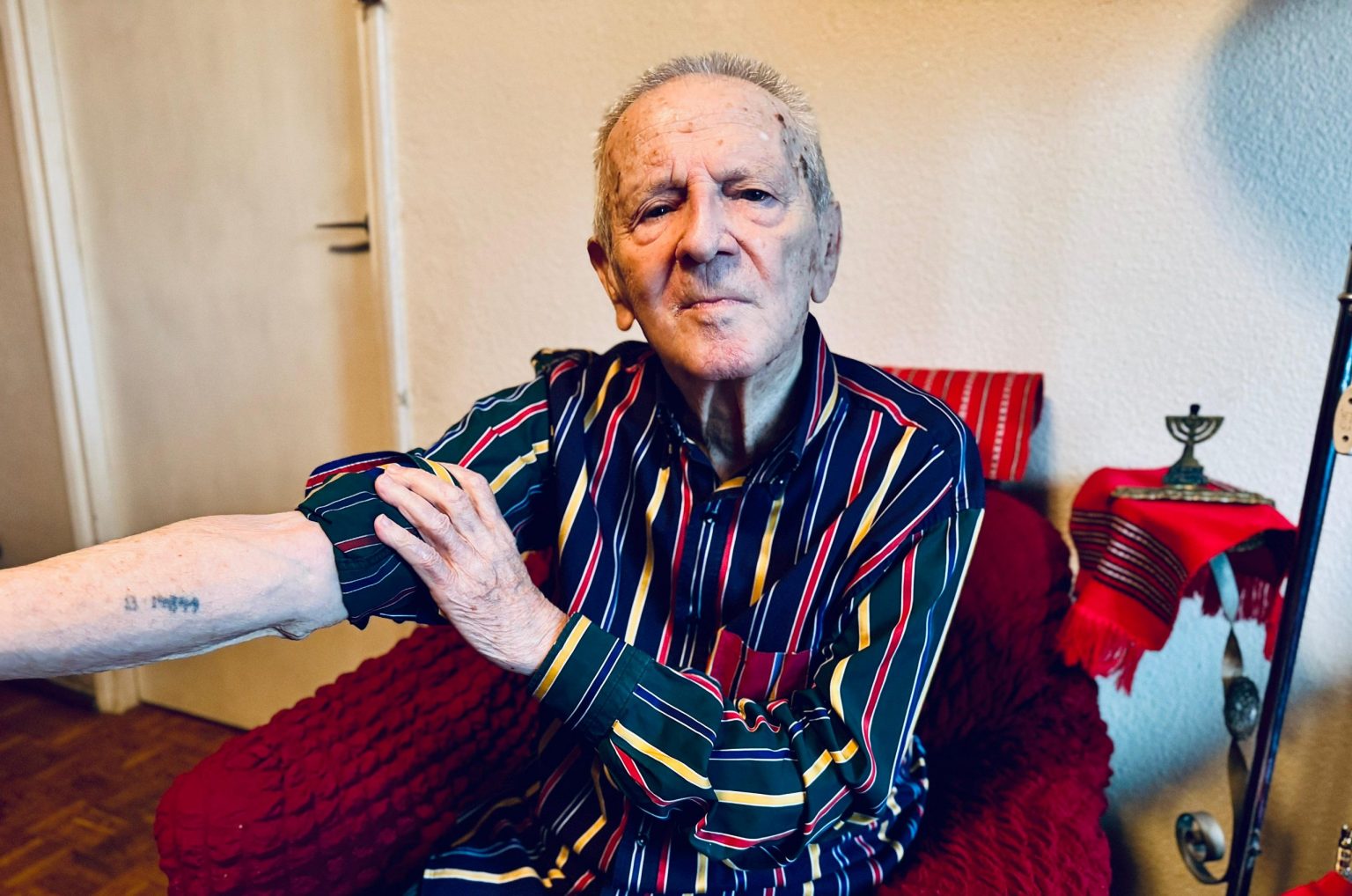
The last Holocaust survivor in Bucharest fears the rise of far-right in Romania and called on Romanians to vote for pro-European centrist mayor in a presidential runoff this weekend.
Octavian Fulop recalled the “horrors of extremism, the Legionnaires and the Holocaust did not begin with camps, but with words, and from these, later, they moved on to violence and extermination.”
Mr. Fulop, the last survivor of the Holocaust in Bucharest_one of five survivors nationally_ was sent to Auschwitz. He spoke to Romanian journalists greeting them with a confession: “After 80 years (since the Holocaust ended) I never thought that in Romania, ever, such things would ever be discussed again and we would be worried about them happening again”.
In an interview with CaleaEuropeană.ro, Octavian Fulop relived the terror he went through: restrictions on the Jewish community, deportation to Auschwitz as well as people’s silence, and manipulation by others. He witnessed the extermination of Roma who were “forced by dogs and beaten with sticks and clubs into trucks to be taken to the crematorium.”
“In today’s Romania there are other historical conditions. We are in NATO, in the European Union. Other values, for now,” he says, in a clear voice which resonates with optimism and concern.
But, Fulop points out, the history of the Holocaust in Romania did not begin with the camps.” It was the Legionnaires uprising when people were hung on hooks and set alight , even before the Holocaust,” he said. He was just 13 ½ when he was deported, along with his entire family, to the Nazi camps which were eventually liberated by the American army.
The 94-year-old also has a message for politicians, criticizing them for not reacting firmly and unequivocally against the Legionnaires’ commemoration in Tâncăbești, just one week before the presidential runoff.
Romania is facing an existential moment: a choice between remaining a country of freedom or a collapse into toxic isolation and a dark past.
“For me, the most precious thing is freedom. I cannot describe to you what the opening of the Gunskirchen camp meant. This moment – what freedom meant – I cannot describe. From my own experience, I can say that without freedom there is no democracy, there are no careers, you cannot travel.
“Without freedom there is nothing. I speak for the youth: our path is to the West. I lived through Horthy’s (Hungarian) regime, the Soviet regime and the communist regime and I am still alive now,” he says.
He urged Romanians to go out to vote.
“If there are demonstrations on the streets, despite my frailty, my son will take me by the arm and I will go out with me and demonstrate for the West.”
He urged Romanians to vote for pro-European mayor, Elena Lasconi in the runoff and said those who opted for the anti-NATO and anti-EU ultra-nationalist Calin Georgescu should have a guilty conscience.
Octavian Fulop is the last survivor of the Holocaust in Bucharest and just five survivors left in the entire country from that period
Octavian Fulop: I’m worried about what is happening in Romania. Soon we will mark 80 years since the liberation of the Auschwitz camp, World Holocaust Day. I was in several camps. I went to Birkenau, Auschwitz II as they call it, an extermination camp. I was also in transit at Auschwitz I. I was in Mauthausen, a very difficult camp. I went to Melk – a branch of the Mauthausen camp, also a tough camp. I was liberated in 1944 in Gunskirchen by American troops. … I was 32 kg when they admitted me to a sanatorium. I put on weight and recovered. Let’s get back to the subject. After 80 years, I didn’t think that in Romania, such things could ever be discussed and you would be worried about the danger of such events.
I want to draw a parallel about what happened then and what is happening now. I am from Northern Transylvania, born in Miercurea Nirajului on October 2, 1930. My name is Fulop Octavian. Although I was deported when I was 13 and a half years old, I know something about how it happened.
At first there were articles in the press: the culprits are the Jews, the Roma, us and them, they and us.At the beginning it was just words. Later, words turned to violence. They broke the windows of Jews and there were restrictions on certain trades. When I was about to go to high school, they introduced restrictions. Jewish children could not attend state high schools. A Jewish high school was created in Târgu Mureș, but there were problems there too. When we left school, we were attacked by thugs, and no measures were taken against them. My father, who could no longer work as a grain trader because of the restrictions, was on the front lines in Ukraine. Without weapons, but at work. It was a tough material situation and our grandparents were modest. I did the second year remotely; I couldn’t go to school anymore. When my father returned from the front in Ukraine… he was not allowed to do his job. In April 1944, Hungary was occupied by Hitler’s Germany. That’s when the deportations began. I was deported from the ghetto of Târgu Mureș with my family – parents, grandparents, relatives – to Auschwitz – Birkenau.
At Birkenau there was an extermination camp. I found those deported before me and Gypsies. I witnessed their total extermination – children, the elderly. I witnessed these events. We, the Jews, were condemned.
Haaretz: A Far-right President in Romania Would Be Putin’s Proxy of Chaos in NATO and the EU
