












On the strategic drift in the US-Israeli war against Iran’s regime
This is a two-birds-with-one-stone AQL weekend update. Call it Iran War meets AI.
As discussed in recent articles and on the Critical Conditions podcast, we appear to be at a moment when momentum in the war may be shifting. The early exuberance (among opponents of the Iranian regime, which include every Iranian expat I know) following the rapid strategic successes by Israel and the United States on the first day is weakening, perhaps even dissipating.
Instead, we seem to be entering a dangerous, costly, unsustainable and possibly pointless war of attrition – in which Iran is determined to outlast the patience of the West by unsettling oil markets and rattling the nerves of Israelis and Gulf states alike with continuing missile and drone attacks (as discussed below with intelligent humans on NewsNation).
If nothing changes, if there are no more astounding surprises, this may well work for the Iranian regime. What does that look like? Trump declaring victory and forcing a pause on Netanyahu, and the Iranians declaring victory as well. And if the Iranian regime does not fall in a clear and convincing way, gullible people (and maybe even some intelligent people) will buy their claims of victory.
Whether they will thereafter actually be chastened – or instead be emboldened – is unclear, and you will hear predictions of both. Either way, already many are losing patience and accusing Trump in particular of lacking a strategy. It is very easy to accuse Trump – who possibly cannot find Iran on a map, and who this week was forcing Marco Rubio to wear oversize shoes – of such a thing.
Yet it is also fair to note that the expectation that the regime would collapse in less than two weeks was, from the start, infantile and probably unrealistic.
I have been saying all along, since January and before, two basic things:
- First, that a regime change effort is legitimate (which is rare) in the case of Iran, because the Islamic Republic is extraordinarily repressive and murderously brutal to its own people, and has done too much damage to the Middle East with its outrageous proxy militia project (which has impoverished Iranians to boot). There is absolutely no way it can be allowed to have nuclear weapons, which would guarantee its survival. For this I have been pilloried by the usual suspects in the naive global left, on top of some isolationist types in the American far right. I can live with that.
- The second matter involves plausibility. The more reasonable critics have argued that regime change is not realistic and the effort will come to tears. That’s a very legitimate concern. For regime change to happen you need boots on the ground, and since these cannot be American or Israeli – as Iran is too big and such an effort would be too costly and unpopular – those need to on the feet of Iranian security forces. There needed to be below-the-radar talks with elements in the Iranian army especially, which has not historically been tight with the regime, for them to step in once the despots have been sufficiently weakened. This would benefit from the regime being in shock, and that seemed to be the case in the first two days; that momentum has been lost and would now need to be recreated with a new wave of assassinations and destruction of key, visible regime symbols. Unfortunately, it is looking like this critical second aspect, prep work with the military, was not done. This is the type of thing that has caused America to be unable to really win a war for some decades now.
It’s possible that the most attainable goal now is to so suffice with weakening the regime that it will be less able to do mischief and more amenable in future talks (certainly this time truly “obliterating,” as Trump likes to say, its missiles and nukes). I’ve spoken and written about what the offer needs to be (in exchange for terms the world can live with, a massive economic incentive – see the details here, and also it is mentioned in the interview with NewsNation above).
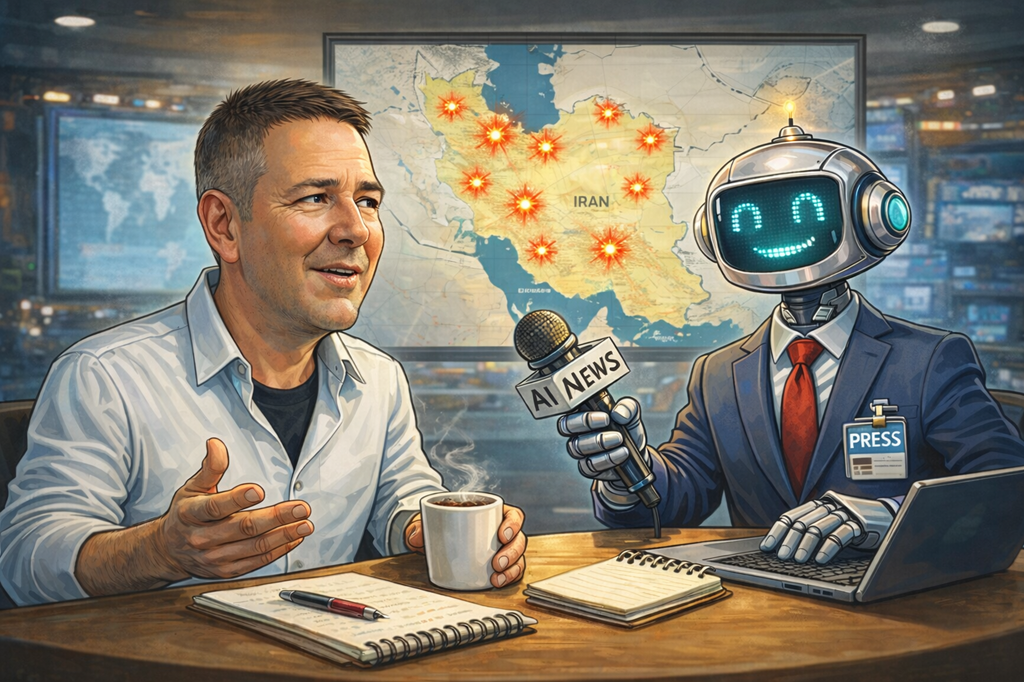
Which brings us to the AI element of today’s offering: my interview with a new product that uses artificial intelligence to conduct interviews with so-called experts. The potential applications of this technology in business, media, and culture should be obvious. The questions it raises are obvious as well. Indeed, we have explored, here at AQL, the potential ramifications, for society, of AI supplanting too many human functions too fast. This is already becoming a massive political issue, and the agitation can safely be expected to increase.
I will say this: having been interviewed on multiple global TV stations over the past two weeks, the AI interviewer pretty much held his or her own. That, in itself, is food for thought for the news industry. Journobot, unlike my perhaps-more-charismatic human interviews, need not be paid, or fed. In a way.
