














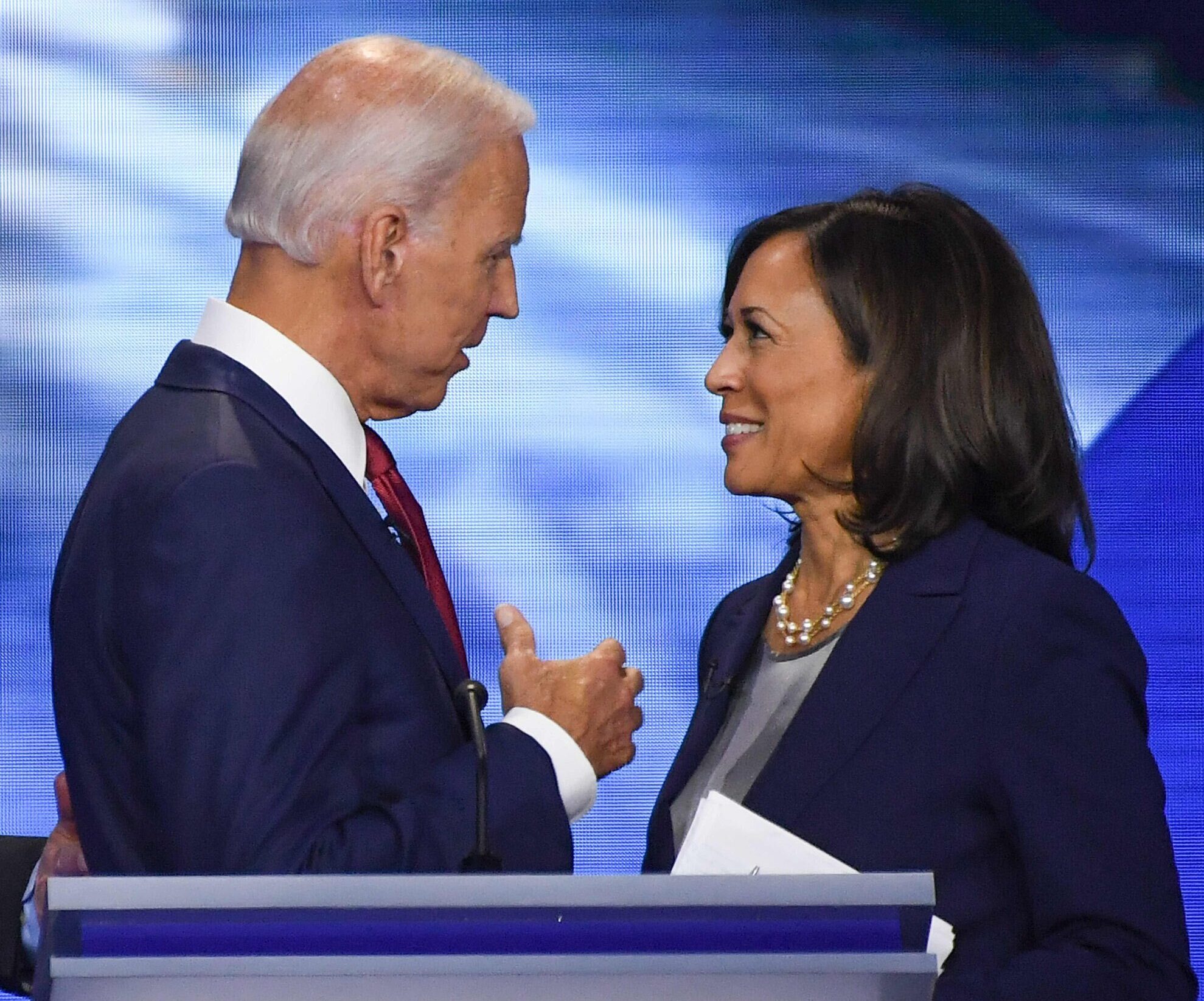
So, knowing the politically hapless Democrats, expect the latter.

The first part was relatively easy, if nerve-wracking. The Democratic nominee should not and could not have been President Joe Biden, for reasons by this point so obvious that it would be vulgar to spell them out. The second part is far less clear: Is it imperative that Vice President Kamala Harris be the one to replace him?
There is one scenario in which the answer is yes, and that’s if Biden resigns the presidency as well, making Harris the incumbent on Election Day. It would be far more unnatural for the party to skip over the actual incumbent, and she would, moreover, gain a chance to achieve the gravitas that attaches to the office (well, in some case attaches to the office).
For Biden to do that would be magnanimous indeed, because unlike his withdrawal from the race on Sunday, a resignation would forever attach an asterisk to his name, in that he did not complete the term. President Lyndon Johnson declined to run in 1968, but he did complete the term; no asterisk.
But it would also not be outlandish, because it would be justifiable on exactly the same grounds as his withdrawal from the race. The lack of mental acuity, attention and focus, and the overall frailness so abundantly on recent display, did not suggest a problem in four years’ time but a problem today.
Some are already calling for this (including some surprisingly patriotic Republicans – if they understand, that is, that it could harm their man). Either way it seems unlikely to occur – something of a bridge too far. Instead Biden endorsed Harris, and at the moment key Democrats seem to be rallying around her.
Is Harris a great candidate? The picture is mixed, and the answer not so clear.
Her main advantage is simply that she is not Biden, who most people have concluded simply could not win the race because he had become as implausible as the outrageous Trump, just in a different way. Harris can once more apply the successful Biden message from 2020: I am plausible while my opponent over there is, obviously, simply not.
She is also far younger than Trump, who now becomes the oldest nominee of a major party in the history of US presidential politics. Trump’s own mental stumbles might start to receive the attention they deserve.
But her identity, which some see as a major advantage, could cut both ways. She is a woman who is not white. The former category has never made it to the White House for a reason (multitudes of sexists) and the latter succeeded only once similarly for a reason (multitudes of racists). The prospect would electrify many people and please many more, myself included – but whoever sees clear advantages here has not been reading history.
Moreover, Harris unfortunately does not enjoy the critical quality that enabled the last half-black candidate to bulldoze his way to the presidency – she is not an orator on the level of Barack Obama (or even of Biden on his much-missed good days). This may seem odd for a former prosecutor, but her communications skills are nowhere near those of other potential nominees, from Mich. Gov. Gretchen Whitmer to Cal. Gov. Gavin Newsom to the extremely articulate preacher, Sen. Raphael Warnock. Silver tongues win the gold medal when it comes to elections. If there are exceptions they happen with acid tongues – which applies, of course, to her opponent.
This failure to communicate attaches directly to perhaps her worst vulnerability, which is that she cannot detach herself from an administration that is somehow unpopular.
Biden and his team achieved some excellent things – stabilizing the country after Covid, passing the CHIPS act and an infrastructure bill – but much of the public is surly. People remember the shambolic pullout from Afghanistan (negotiated by Trump), inflation (which was mostly global and has muchly been reduced), and the porous border with Mexico (which is a very old problem and one that Biden reached a compromise bill on with Republicans, only to have it scuttled by Trump). They think Biden leave behind a world on fire – but it is not Biden who invaded Ukraine or invaded Israel on Oct. 7.
Moreover, the failure to achieve more is largely a function of a dysfunctional system built for gridlock. The Democrats at least aspire to policies and outcomes on key issues that align with the will of most Americans – gun control, healthcare guarantees, abortion rights, reducing inequality and more.
So while the unpopularity is unfair, it happened in large part because the White House could not find a way to communicate to Americans how it was helping improve their lives, and how if not for the Republicans it could do much more.
Lastly, if the Republicans succeed in drumming up public anger at a coverup of Biden’s true state — that too will attach to Harris, much more than to some senator or governor.
So let’s just say that Harris – who took direct part in either bad policies or a failure to explain good ones – is plausible but problematic.
In such a scenario, with all these complications and with the Democratic National Convention in Chicago fast approaching on Aug. 19, what are the tradeoffs in a contest versus a coronation?
A coronation, in which major party figures – the ones mentioned earlier or, say, Sen. Mark Kelly of Arizona or Gov. Roy Cooper or North Carolina, or Josh Shapiro of Pennsylvania – are strongly discouraged in back-door manipulations from throwing their hat in the right. That appears to be the default happening now – as opposed to encouraging them. Harris, who already has a pile of raised money, would then be nominated by some version of acclamation.
A contest, in which they are instead encouraged, would create at least the possibility of finding a better candidate. It would also give Harris far greater legitimacy in the public than she would presently enjoy. It may give her a chance to shine and prove me wrong about the oratorial skills. It would also rivet the country to the Democratic party and its machinations for weeks, which talented politicians should be able to turn into votes.
There are several negatives, to be sure.
If it becomes messy, the spectacle could backfire, and if it leads to enough rancor the party could even suffer electorally by seeming bitter and divided. And there’s not enough time left to really vet the candidates.
Mainly, though, it could lead to someone other than Harris. Even if that someone is a great candidate – heck, even if Harris stays on the ticket as VP – it could be a dangerous gamble to be seen as having pushed aside “a woman of color” who had somehow earned her shot.
Here’s the thing, though: I bet because of that reason Harris would prevail. But both she and others will be more familiar to the public, and she could run with one of them as the VP nominee at the helm of a UK-style shadow government that stands for fairness, competence, and if she’s smart centrism.
On balance, that’s the better way to go. So, knowing the politically hapless Democrats, expect the other way.
