











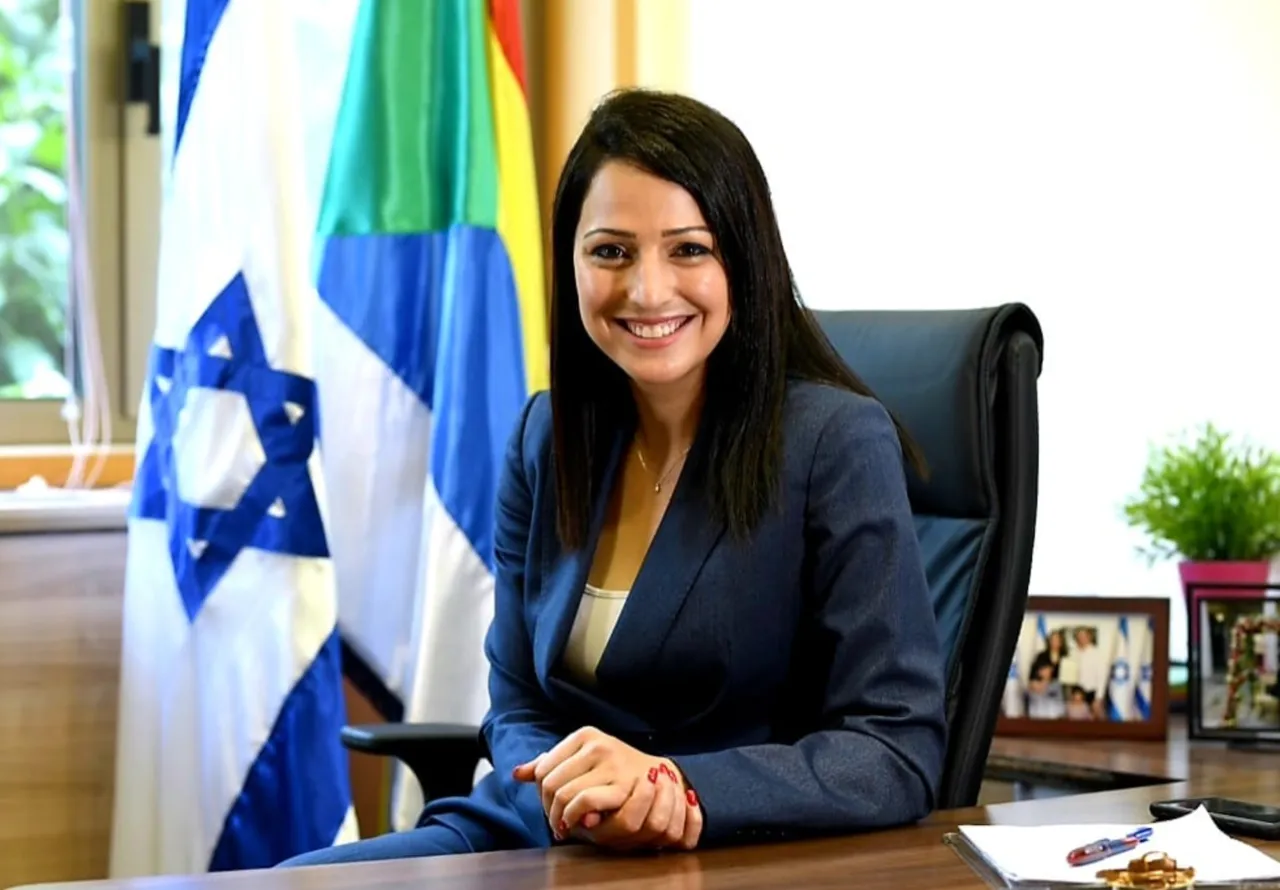
The interesting wrinkle – Gadeer Kamal-Mreeh, a Druze Arab, was also an Israeli envoy
Just weeks ago, optimistic pundits in the West mused about welcoming a newly democratic Syria into the Abraham Accords. Perhaps Israelis would eat hummus in Damascus. Trump called the new leader, Ahmed al-Sharaa, a “young, attractive guy.” That perspective is evaporating as Syria descends into new ethnic and religious bloodshed. So far, nearly 1,400 Syrians have been killed in the sectarian violence, which began July 13.
According to the UK-based Syrian Observatory for Human Rights, the Syrian death toll includes at least 300 Druze civilians, 196 of whom were reportedly executed by forces loyal to Syria’s al-Sharaa — often referenced by his nom de guerre, Abu Mohammed al-Jolani.
Prominent Druze official Gadeer Kamal-Mreeh says that she, for one, has no illusions. “We are dealing with Islamists who are trying to force Syria’s minorities to accept Islam. Some of these people come from Afghanistan or Chechnya; they don’t even speak Arabic,” she said.
Kamal, 41, is somewhat of a paradox. A prominent Israeli journalist and later politician, Kamal was born and raised in Daliyat al-Karmel, a Druze village southeast of Haifa. After earning degrees in medical imaging and social sciences from Bar-Ilan University and international relations from Haifa University, Kamal in 2017 became the first Druze woman to anchor a Hebrew-language news program on Israeli TV. Two years later, she made history as the first Druze woman to be elected to Israel’s Knesset, representing the centrist Blue and White party. In 2021 — making history yet again — Kamal was appointed by Israeli President Isaac Herzog as the first non-Jew ever to represent the Jewish Agency, a Zionist NGO, in Washington.
That three-year assignment ended in June 2024, and Kamal continues to live in the Maryland suburbs while running her own consulting firm. She also directs Eastern Mediterranean affairs at the Middle East Forum, a Philadelphia-based think tank founded by the historian Daniel Pipes. All that makes her almost certainly the most prominent Druze voice in the United States.
“I always introduce myself by saying I’m an Israeli, but not a Jew. I’m an Arab but not a Muslim. I’m a minority within the Arab minority,” said Kamal, who was recognized in 2021 as a World Economic Forum Young Global Leader.
“My mother tongue is Arabic, my religion is Druze, and I’m a proud Israeli citizen,” Kamal explained, discounting the notion that her longtime position as a representative of the State of Israel might somehow discredit her in the Arab world. On the contrary, she said, “Arabs see me as a reliable voice because I speak their language and understand the nuances of their culture. They trust me when I speak.”
Crucial to the uniqueness of the Druze community, she said, is that unlike the world’s 35 million or so Kurds — who inhabit parts of Syria, Turkey, Iraq and Iran, and lack a state of their own but seek one — “we have no territorial or national aspirations. That’s why we are loyal to the countries we were born in, and that’s why Israeli Druze are loyal to Israel.”
Of the world’s 1.5 million Druze, nearly half — about 700,000—live in Syria. Lebanon is home to another 180,000 Druze, Israel roughly 150,000, and Jordan about 20,000 (where its most prominent member is Ayman Safadi, Jordan’s foreign minister). In addition, about 20,000 live in the Golan Heights, occupied by Israel from Syria in 1967 and later annexed; they have the largely unused right to citizenship, but they are well integrated, mostly speak Hebrew, and are not in the slightest restive. The remainder are scattered across various other countries in the Middle East, Europe and the Americas.

In 1925, the iconic Druze leader Sultan al-Atrash — who a decade earlier had saved Armenians from the Ottoman genocide — led the Great Syrian Revolt against the French colonial administration that ruled Syria, ultimately leading to Syria’s independence in 1946. And his village of al-Qrayya is located about 20 kilometers from Suweida, focus of the current fighting and the central town of the Druze heartland in Syria.
“What started this instability in December was the fall of Bashar al-Assad,” she told AQL. “It rapidly became a campaign of terror against every minority in Syria. We saw that happening against the Alawites in March, against the Christian community in June, and now against the Druze in unprecedented dangerous and barbaric attacks.”
“These remnants of ISIS see the Druze as traitors. Every leader in the Middle East was enthusiastic to see Syria rebuild itself,” she added. “That’s why al-Jolani got this unprecedented support from everyone.”
Kamal watched in horror as the Oct. 7, 2023, Hamas massacre of 1,200 people in Israel replayed itself in Suweida with eerie similarity: “The same sick, barbaric methods — kidnapping women on motorcycles, raping 5-year-old girls, burning children alive, beheading people. This is Oct. 7, al-Jolani style. We have reliable sources in Syria who tell us they were guided by Damascus to say they are Bedouin fighters. But these people were sent by al-Jolani to make this massacre.”
At the urging of Israel’s Druze minority – loyal citizens who serve in the military – Israel sent troops into Syria to protect the Druze, attacked Syrian convoys and even bombed installations in Damascus. The result was a tense truce on the ground that is not exactly holding. Tensions are at a boil.
In assisting the Druze, she said, Israel is learning from past strategic mistakes.
“In 2000, we withdrew completely from Lebanon and saw Hezbollah growing over the next 23 years to acquire the eighth-largest missile arsenal in the world,” she said. “The same thing happened in Gaza. We withdrew in 2005 and for the next 18 years, Hamas built underground tunnels instead of investing in human capital.
‘Now we are implementing the doctrine of zero trust. When we see remnants of ISIS and al-Qaeda raising their heads again on our northern border, we will protect our citizens. It is crucial to enforce the buffer zone and not allow them to share borders with us.”
Kamal noted a “huge dissonance between al-Jolani’s beautiful speeches” and the current reality on the ground in Sweida.
“Al-Jolani went to the West wearing a business suit, buying legitimacy. Trump called him ‘handsome’ even though there were no specific plans to rebuild Syria as a pluralistic, democratic state,” she said. “I don’t see here a liberal, sophisticated open-minded leader. What I see is extremism and radicalism. Shaving the beards of religious leaders is not a sign of democracy.”
