









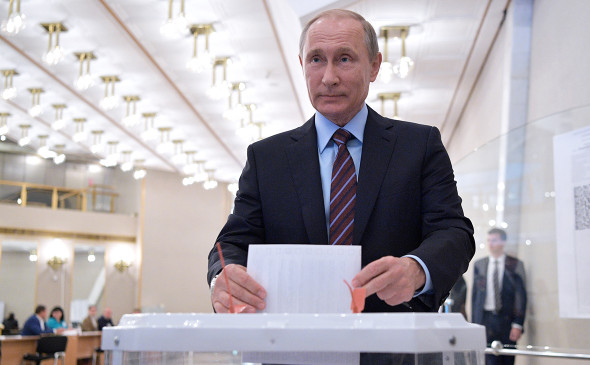
The “Noon Against Putin” protest, with voters forming queues outside polling stations in major cities including Moscow, St. Petersburg, Yekaterinburg, Chelyabinsk, Tomsk and Novosibirsk, was a striking — if pointless — display of solidarity and dissent designed to counteract the Kremlin’s main message: that Putin is a legitimate president commanding massive support.
Many polling stations in Moscow were deathly quiet on Sunday morning, but long lines appeared at exactly noon, even though authorities sent mass text messages warning people against participating in “extremist” actions.
Navalny, who had long crusaded for free and fair elections in Russia and was blocked from running for president in 2018, had urged Russians to vote against Putin at noon Sunday.
It turned out to be Navalny’s final political act before his death. His widow,Yulia Navalnya has accused Putin of ordering his killing, and many Western leaders have said they hold Putin responsible. The Kremlin rejects the allegations.
Many voters also posted photographs of their spoiled ballots with protest slogans such as “Navalny is my president,” “No to war, no to Putin,” and “Putin is a murderer.”
Voting took place over three days, beginning Friday, which some critics said would allow greater opportunity for ballot manipulation and other fraud.
Voting was also taking place in areas of Ukraine occupied by the Russian military, with reports of electoral teams accompanied by soldiers forcing people to vote at gunpoint.
At least 65 people were detained at polling stations in 16 Russian cities on Sunday, according to OVD-Info, a legal rights group. Among them were a Moscow couple arrested because the husband wore a scarf bearing the name Orwell, a reference to George Orwell, whose dystopian novel 1984 was about a repressive totalitarian state.
Moldova issues rebuke to Russia over voting stations in breakaway region
