




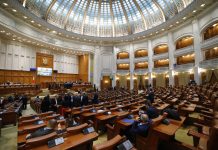










The Romania-Ukraine Chamber of Commerce organized its annual Rebuilding Ukraine Forum on Monday and Tuesday (14-15 October) in partnership with the Ukrainian Embassy in Romania.
The main topics of discussion included the main challenges of rebuilding Ukraine in the current context, options and challenges related to the financing process or considerations regarding the instruments that will be used to implement the peace formula proposed by President Zelensky.
The event was attended by government officials from Ukraine and Romania, the president of the Romania-Ukraine Bilateral Chamber of Commerce and foreign ambassadors accredited in Bucharest.
Romania will continue to provide emergency energy resources to Ukraine, but there is a problem of capacity and interconnectivity, because Europe, through its network of energy operators, has an export capacity to Ukraine of only 1, 7 GW, said Adrian Bazavan, advisor for international relations to the Minister of Energy, at a specialized event.
“Ukraine needs short-term emergency aid and long-term aid to rebuild a more resilient energy system. When we talk about rebuilding Ukraine, we’re not just talking about the energy system, making it the way it was before the damage, but we talk about how to rebuild it better. Romania will continue to provide emergency energy resources to Ukraine, but we have a capacity and interconnectivity problem with Ukraine, because Europe, through its network of energy operators, has an export capacity to Ukraine of 1.7 GW, and we are thinking of increasing it to 2 GW. We need to find solutions much faster,” specified Adrian Bazavan.
He mentioned that, before the war, it was not a priority for Romania or Ukraine to connect their energy systems, a vulnerability that everyone can see now.
“We have limited capacity when we talk about electricity and gas. In the long run, when we are looking at the reconstruction of Ukraine, we need to increase the interconnection capacity quickly. Ukraine is a candidate member of the European Union. We hope that it joins the Union as soon as possible and then the rules of the energy market will be the same for Ukraine,” he continued.
At the same time, he specified that, on December 31, 2024, the gas transport contract between Russia and Ukraine will expire and will not be renewed.
“That is why we and the Republic of Moldova must find ways to supply gas to Ukraine through the trans-Balkan gas pipeline that carries gas from the GNL terminals in Qatar and Western Europe to Ukraine. We must make efforts so that neither Ukraine nor the Republic of Moldova suffer from cold during the winter. We must remain optimistic about the future and act very quickly, because winter is coming,” added the official.
According to him, 11 million people in Ukraine could be displaced as a result of winter rather than war.
“It is our moral duty to support Ukraine. In addition to this moral duty that we have, we also have a pragmatic duty, from a national security point of view, to support and help Ukraine. We know that winter is coming and this news is important, especially when we talk about energy infrastructure, and Ukraine has an energy deficit because Russia has affected more than half of Ukraine’s energy infrastructure, both production and distribution. We are talking about gas, we are talking about electricity, we are talking about thermal energy and, as winter approaches, these needs of Ukraine increase. 11 million people in Ukraine may end up displaced because of the winter, not because of the war,” added Adrian Bazavan.
