











Judaism gets respect for elders right – but the rabbis are abusing it. TRIGGER WARNING: This contains some Yiddishkeit!
For some Jews religion is quite a burden, especially in the Jewish State. One cannot pass a week without encountering the exhausting debate over enforced Sabbath observance in the public domain – truly a scourge. One cannot have a war without revisiting the quarrel over religious youth who evade the military on account of a scam involving seminaries.
But I’m here to say that is not the whole story. Passover, which begins this weekend, is a time when the transcendent meets the practical — when God parted the Red Sea, if you will. It is therefore fitting that we now remember that Judaism offers some noble and useful things. One in particular has overpowering value – even for the heretic, and especially if a geezer.
Ageism may be the last prejudice still widely tolerated in modern society —yes, that same modern society that so often scorns our ancient sources. We rightly reject racism, sexism, and other forms of discrimination, yet the exclusion of the elderly remains commonplace—and is even lauded in the name of innovation.
On this matter, Jewish tradition offers both remedy and wisdom. “You shall rise before the aged” (Leviticus 19:32), the Torah commands. This is not mere etiquette — it is a foundational principle: Do not disregard the elderly, do not push them aside, and do not silence their voices. Honor them. Cherish their wisdom. Value their presence.
Passover itself, while a commemoration of freedom, reinforces this value through its structure and traditions. Central to the Seder meal is the transmission of the Exodus story from one generation to the next, with elders playing a key role as storytellers and keepers of memory. The narrative of the Four Sons highlights the elder’s responsibility to teach and guide according to each child’s understanding, underscoring the wisdom and patience expected from older generations. Rituals like opening the door for Elijah the Prophet and reciting “In every generation, one must see themselves as if they personally left Egypt” emphasize continuity and reverence for tradition.
In a world obsessed with youth, these notions remind us that age is not a burden — it is a virtue. If dementia has not struck, the elderly simply know more — because they have lived more. Beyond this logic, each of us has an interest in respect for the elders: Anyone who doesn’t die young will one day join their ranks. Think ahead, for God’s sake (or, more precisely, for your own)!
I spoke with Rabbi Heshy Grossman, a learned Jerusalem sage, and he put it best, as is his way: “In secular society, we witness the unfortunate state in which older people, at best, are tolerated—and more often considered a burden and a waste of resources. In a culture that exalts physical strength, external beauty, and material pleasures, those who have lost physical ability are deemed worthless. But in traditional Jewish society, wisdom is the highest value—and so it is only natural that our elders are our heroes.”
These are powerful words. Rather than fleeing from the past, we should learn from it. We should appreciate that prior generations — shaped by hardship and honed by learning — carry insights still valuable to society.
Of course, in some respects, the modern world is better than the one that came before: more equal, more tolerant, more attuned to reality through scientific advancement. And yet — as is written in Ecclesiastes — “There is nothing new under the sun.” The fundamentals of life must be relearned by each generation. Knowledge may come quickly; wisdom takes years.
Yet the modern job market continues to overlook candidates over 50. In the world of high-tech, even those in their 40s are considered relics. This may have made sense when employment was long-term and ended in a pension—but in a world where the average job lasts four years, the logic has collapsed.
Yes, youth has its advantages: new ideas, flexibility, lower cost, and sometimes physical energy. But youth also brings impatience, impulsiveness, and flawed judgment. Not every experience is of value—some are merely chains of failure. Still, must we discard even those whose experience is a success story, just because they’re older?
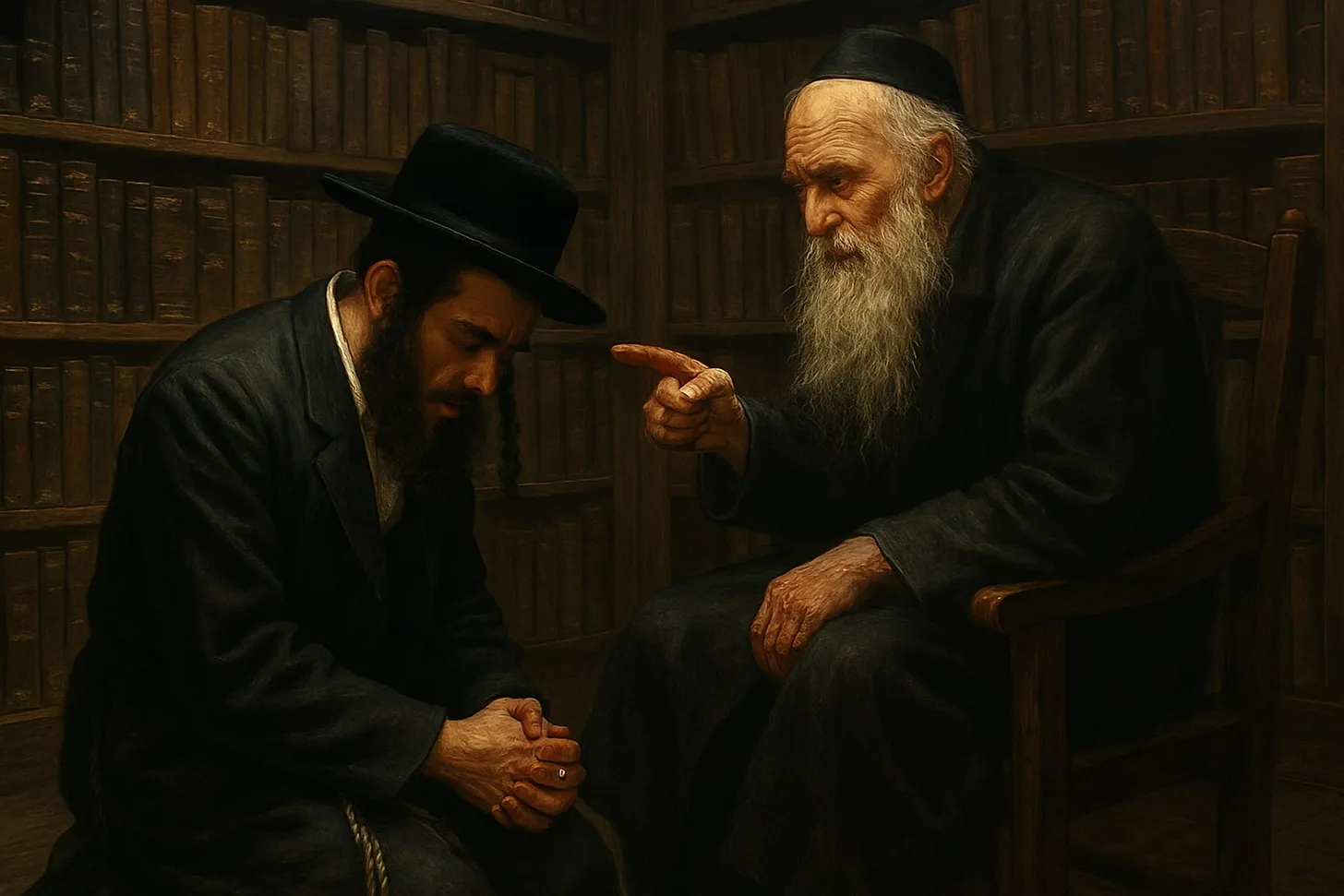
So on this matter at least, Judaism is right — and the Haredi community, the ultra-Orthodox, embodies this principle admirably, standing firm against the idiotic cult of youth. The evidence? Its great rabbis — often in their 80s and 90s — remain its uncontested leaders. Their wisdom is not considered expired with time — but deepened by it.
All well and good. But here — like any Talmudic tale — it gets complicated. Tradition does not let us rest on our laurels. And Jews, as ever, have a taste for pilpul — argument to exhaustion, until one side is driven mad.
Judaism, in its wisdom, knows to place boundaries even on cherished values. “Be not overly righteous” (Ecclesiastes 7:16) warns us against even noble excess; “Whoever adds, subtracts” (Sanhedrin 29a) reminds us that embellishment may undermine; and “Grasp too much, and you grasp nothing” (Rosh Hashanah 4a) teaches that more is sometimes less.
So too with honoring elders. There must be a limit.
But at this point, the Haredi world veers off the rails. That admirable reverence has been twisted, alas, into a tool of political control and societal stagnation. Rabbis, sometimes absurdly disconnected from modern life, block their community’s meaningful integration into modern society, and doubly so in Israel, where they are headed toward a veritable societal meltdown.
Let us speak plainly, which Jewish teaching also ordains: The elders are keeping their flock in a parasitic state.
Yes, some young Haredim choose Torah study sincerely. But many others wish to join society, gain independence, and live as productive citizens—yet fear ostracism. From whom? From our wise Rabbi Grossman and his stubborn colleagues.
Rather than leading a gradual and necessary transition, the rabbis wield their authority to preserve an immoral system. They sabotage educational reform, prevent core curriculum studies, and derail every effort toward equitable military service. Rather than encouraging civic responsibility, they urge even the unfit to remain in yeshiva—for the sake of draft exemptions and government funding. The result? A perverse economic incentive to shirk both army and workforce. This is not piety—it is disgrace. And it is intolerable.
So what is to be done? Let us speak not mince words. I know the sages are not waiting on advice from a heathen as myself, but nonetheless I offer this: You are abusing the great power you’ve been given—and in doing so, you undermine the very principle that elevated you: the belief that with age comes wisdom. Age may bring wisdom—but it does not guarantee it. When supposed reverence for tradition is used to obstruct education, economics, and equality — it ceases to be a virtue.
To the young Haredim, I offer practical advice: Honoring your parents is indeed one of the Ten Commandments — but it does not require you to forfeit your own moral and civic responsibility. Rise before the aged — yes. But do not bow. Honor the past, wholeheartedly — but do not let it rob you of your future. Otherwise, secular and religious alike are marching off a cliff.
The Passover Haggadah features, as said, four sons: The Wise, the Wicked, the Simple and the Son Who Does Not Know How to Ask. Haredi youth have been the last; become instead, I say, the first. Thus will you find the path from bondage unto freedom, and from darkness into light.

|
|
