






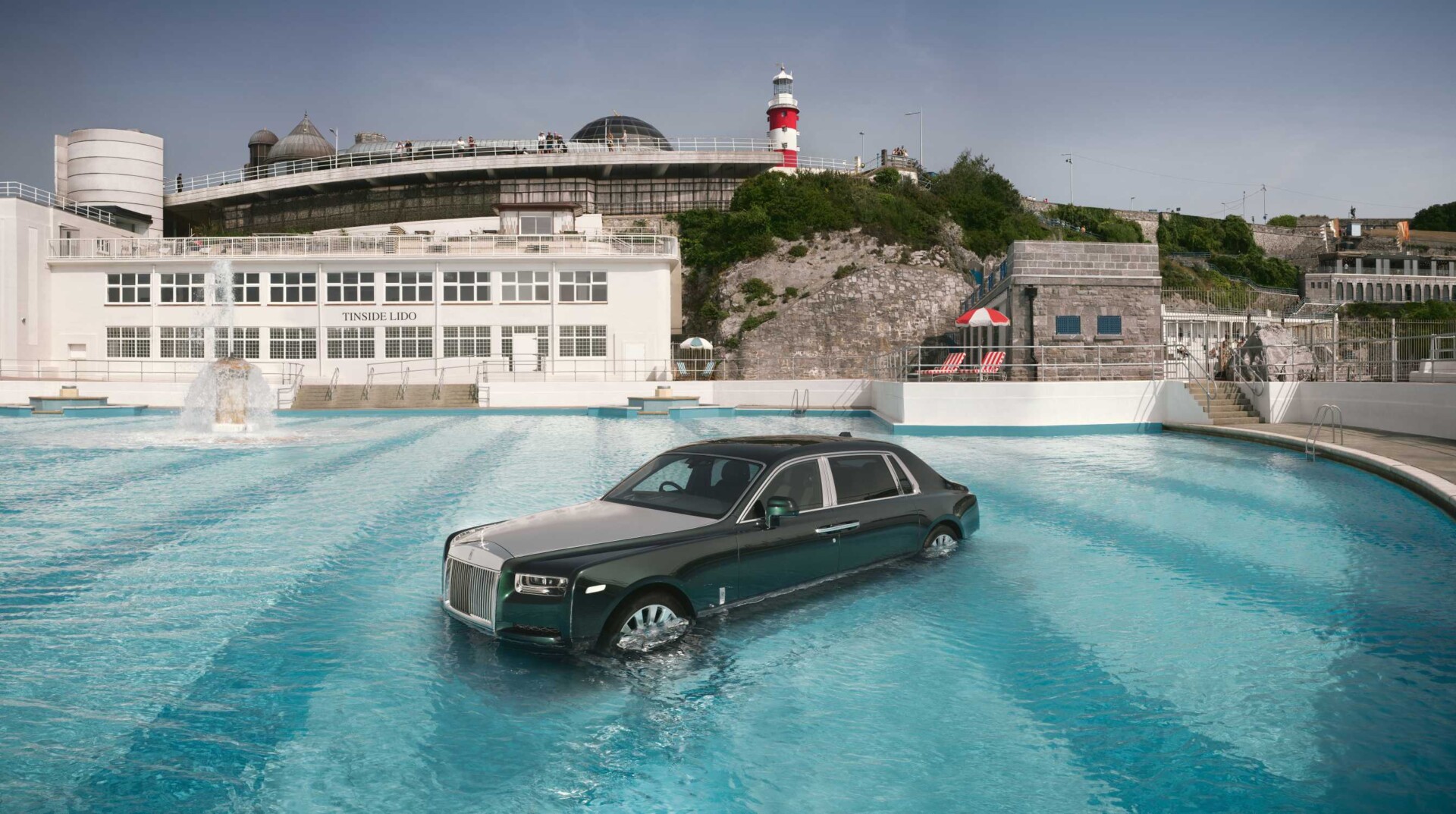
“From the Golden Age of Hollywood to the rise of hip-hop, over the last 100 years, music artists have used Phantom to project their identity and challenge convention. Their motor cars often became icons in their own right, with a lasting place in the history of modern music. This enduring connection reminds us that Rolls-Royce and the extraordinary people who are part of the marque’s story are united by one ambition: to make their presence felt,” said Chris Brownridge, Chief Executive, Rolls-Royce Motor Cars.
The connection between Rolls-Royce and the world of popular music is almost as old as the recording industry itself.
Long before, music icons such as John Lennon, Elvis Presley and Pharrell Williams wrote themselves into Phantom’s story, artists including Duke Ellington, Fred Astaire, Count Basie, Ravi Shankar, Edith Piaf and Sam Cooke all traveled by Rolls-Royce, recognizing the brand as the definitive symbol of success and artistry.
‘Music moguls’ including Brian Epstein, Berry Gordy and Ahmet Ertegun, were also among the brand’s ost notable owners. Across genres, geographies and generations, Rolls-Royce remains the ultimate reward for creative brilliance and a canvas for personal expression, a statement said.
THE HISTORY OF ROLLS ROYCE AND SOME OF ITS FAMOUS ROLL OWNERS
MARLENE DIETRICH
Most actors travel to Hollywood in search of stardom. Marlene Dietrich arrived already part of the constellation. Fresh from her breakout role in The Blue Angel, and having introduced the world to what would become her signature song, Falling in Love Again, she travelled to California in 1930 to begin filming Morocco. Her welcome was as dramatic as her screen presence: at Paramount Studios, she was greeted not only with flowers, but with the gift of a green Rolls-Royce Phantom I. Morocco earned Dietrich an Academy Award nomination – and her Phantom also took its share of the spotlight, appearing in the film’s closing scenes and publicity images.
ELVIS PRESLEY
In 1956, a self-titled album by a promising young singer named Elvis Presley became the first rock ‘n’ roll album to top the Billboard chart, where it remained for 10 weeks. In 1963, at the height of his fame, ‘The King’ bought a Midnight Blue Phantom V with a host of Bespoke features. In what may have been an early version of in-car karaoke, the features included a microphone, a writing pad in the rear armrest – ready for flashes of inspiration – along with a mirror and clothes brush to ensure Elvis was always ready to make an entrance. In a charming domestic detail, the original mirror-polished paint famously attracted the attention of Elvis’s mother’s chickens, which would peck at their reflection in the coachwork. The motor car was refinished in a lighter Silver Blue that did not show the chips.
JOHN LENNON
In December 1964, John Lennon rewarded himself for The Beatles’ A Hard Day’s Night by commissioning a Phantom V. The motor car was entirely black, including the windows, bumpers and hub caps; it also boasted a cocktail cabinet and a television, as well as a refrigerator in the boot. However, like Elvis’s Phantom V, Lennon’s would also undergo a complete transformation. In May 1967, just before Sgt Pepper’s Lonely Hearts Club Band was released, the motor car was resprayed yellow, then hand-painted with swirls of red, orange, green and blue, with floral side panels and Lennon’s star sign, Libra, completing the motor car’s new persona.
For the younger generation, Lennon’s Phantom perfectly captured the mood of the carefree ‘Summer of Love’ that year. To their elders, it was an outrage, memorably summed up by a woman who, on seeing the Phantom driving down London’s Piccadilly, shouted, “How dare you do that to a Rolls-Royce!” before swatting at the paintwork with her umbrella. When the motor car was sold in 1985, it reached $2,299,000, almost 10 times the reserve price. It was both the most expensive piece of rock ‘n’ roll memorabilia at the time, and the highest price ever achieved for a motor car sold by auction.
This Phantom is arguably the most famous Rolls-Royce connected with Lennon, but he owned another. Lennon purchased a white Rolls-Royce Phantom V in 1968 to coincide with the launch of the White Album and to mark a new phase of his life with Yoko Ono. This was characterised by his wearing white clothes, decorating the interior and exterior of his Berkshire home in bright white, and pursuing a distinctly minimalist aesthetic.
Originally commissioned in a two-tone black-over-green by Wing Commander Paddy Barthropp, a wartime Spitfire pilot turned chauffeur, Lennon individualised this motor car in line with his personal style at the time. He paid £12,000 – equivalent to the price of a sizeable house at the time – to have the motor car transformed to white inside and out, and had it fitted with a sunroof, Philips turntable, 8-track player, telephone and television. It would later appear in the Beatles film Let It Be, as well as Performance, which starred Rolling Stones frontman Mick Jagger. In September 1969, Lennon sold the car to Allen Klein, founder of ABKCO Records and The Beatles’ manager at the time, for a reported $50,000.
LIBERACE
Another musical iconoclast was Władziu Valentino Liberace. Flamboyant and multi-talented, Liberace was the world’s highest-paid entertainer in the 1950s and ‘60s thanks to his TV shows and long residencies in Las Vegas. Among the extravagances that earned him the soubriquet ‘Mr Showmanship’ was a 1961 Phantom V covered in tiny mirror pieces that he would use to drive on stage during his long-running residency at the Las Vegas Hilton. The motor car appeared in the award-winning Liberace biopic, Behind the Candelabra, in which Michael Douglas recreated its short but famous journey.
SIR ELTON JOHN
Liberace’s playing style influenced a generation of performers, including a budding pianist named Reginald Dwight, today known as Sir Elton John, who would later take inspiration from his hero by owning several Phantoms. In 1973, en route to a concert in Manchester in his white Phantom VI, Sir Elton saw a newer example in a showroom window. He instructed his chauffeur to stop, bought the car, and used it to complete his journey to the venue.
Later, he would update the Phantom with black paintwork, a black leather interior, tinted windows, a television, a video player, and even a fax machine. The most significant addition, however, was a bespoke audio system that was so powerful that the back windscreen had to be strengthened to prevent it from shattering when the volume was turned up.
Sir Elton also owned a Phantom V, for which he commissioned a striking pink-and-white exterior paint finish and matching interior. Following a tour of the USSR, where he was paid in coal, rather than cash, Sir Elton was unable to pay his musicians. Instead, he gave the Phantom to his percussionist, Ray Cooper, in lieu of a cash fee. Cooper later used the motor car to pick up a young Damon Albarn from school, who went on to find stardom of his own with Blur. History came full circle in 2020, when Albarn and his virtual band, Gorillaz, recorded The Pink Phantom, with Sir Elton appearing as a guest vocalist.
