












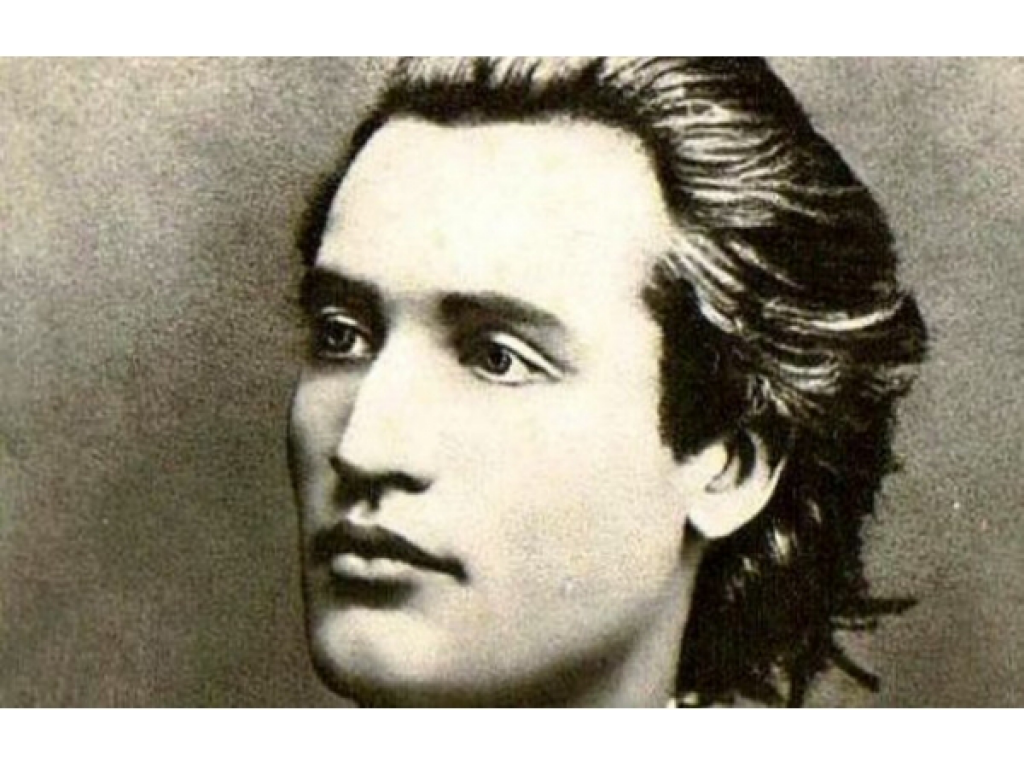
The 19th century romantic poet wrote about nature and love as well as social commentary, and was one of the most prolific and popular poets of his age, a time of great upheaval and changes in the national identity.
His life was brief, intense and ended tragically six months to the day shy of his 40th birthday. But his reputation as Romania’s greatest poet endures and his works have been translated into 60 languages.
Eminescu’s poetry and woks are not without controversy, however. His Doina poem, is which is expressly anti-Russian, is also considered anti Semitic and anti-Ukrainian and anti-Hungarian.
Four years later, German prince Karl of Hohenzollern (later, King Carol I) entered Bucharest by invitation giving the country the name of Romania and finally freedom from the Ottoman Empire in 1877 where it was a vassal state. On 10 May 1877, Romania proclaimed itself fully independent.
Following the poem dedicated to his teacher in 1866, Eminescu he produced If I Were to Have, that was published in the magazine Familia and began a constant stream of publications over his brief life.
He joined various theatrical groups, traveling over the country before settling in Bucharest and working as a copyist for the National Theater. He continued to produce poetry and also earned a living also by translating the work of German writer Heinrich Rotscher.
Aged 19, he moved to Vienna to study where he also wrote the poem Venus and Madonna that attracted the attention of the editor of the magazine Literary Conversations. During his studies he worked as a journalist and, in 1872, went to Berlin to further his education.
He returned to Romania and edited the newspaper Timpul (the Time) and write op-eds on Romanian independence.
His political articles for Timpul are guided by traditionalism, ethnic nationalism and anti-Semitism, to fit with his vision of Romanian society, which Eminescu developed during his studies in Germany and Austria.
He writes of the city leech,’ usually a Jewish or Greek merchant, or a Romanian who was superficially Westernized.’
In nineteenth-century Romanian popular imagery, the Jews and the Greeks came to be represented as parasitic groups, living on the ruthless exploitation of the Romanian rural masses. In his anti-Semitic arguments, Eminescu combined popular stereotypes with a modern rhetoric which he became familiar with in Austria and Germany, according to Central Europe Identity Press.
Some of his most well-known works include The Lake written in 1876 and Desire in 1884. He was said to be influenced by the style of philosopher Schopenhauer.
In 1883, Eminescu fell ill and was hospitalized and was diagnosed with a variety of different disorders. Scholars believe in hindsight, that the poet suffered from a bipolar disorder and is believed to have suffered from mercury poisoning which was used to treat syphilis.
He failed to recover and died in 1889, at the age of just 39, in a sanatorium in Bucharest.
Back in the distant time,
Of royal blood, which still prevails,
A girl sweet and sublime.
And fair and full of charms,
Shining like Mary among saints
And moon among the stars.She glides through the majestic halls
As if she slowly skates,
Goes to the window where befalls
That Evening Star awaits.Above the sea he always stays
For rises and shines bright,
Along the moving water trails
Guides all the ships at night.And seeing him, wish burns her cheeks,
She’s thrilled from head to toe;
He watches her for many weeks,
And love begins to grow.
