









Romania’s political crisis is deepening: the no-confidence motion on May 5 has a good chance of passing although it’s not certain.
The two biggest parties, the PSD and AUR, have the necessary votes and can collect more from other parties.
Three other facts make it likely that Ilie Bolojan’s government will fall:
- The signatures collected to submit the motion are higher than the minimum required.
- Within the Liberals (the PNL) there’s a minority who want Bolojan to go and for his position in the party to be weakened. Some have already publicly talked about the need to continue governing in the current coalition, without Bolojan as premier. This doesn’t mean that Liberal lawmakers would openly vote for the motion, but it may mean they would be willing to contribute to behind-the-scenes efforts to persuade lawmakers from smaller parties to support the motion. In a period of uncertainty, one thing is certain: some lawmakers are intensely negotiating to get rid of Bolojan, others to keep him, something that will go on until the day of the vote, May 5.
- President Nicușor Dan has already publicly shown he doesn’t have a problem if Ilie Bolojan goes; in fact at times it seemed it would suit him.
But it’s also true the the no-confidence motion has no 100 percent guarantee:
- For the Bolojan government to remain in office, he needs 22 votes from the lawmakers who have signed the motion, not impossible, but not insignificant either.
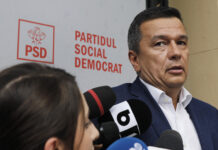
- A PSD-affiliated lawmaker has already announced he would not vote for the motion, and another PSD Senator resigned from the party.
- Lawmakers from the nationalist POT party announced they will not vote for the motion unless PSD-AUR offers a clear solution for governing the country afterwards. Of course, in the coming days, as intense negotiations continue, this group will either keep to its position or it will split – with some voting for the motion and others not. But this public position cannot be overlooked. Until now, the PSD considered AUR an extremist party and keeps insisting it has not made a deal with AUR to form a new government. If it turns out it has lied, it would be extremely problematic. It’s no easier for AUR to admit it has a plan to govern with the PSD – after all its public criticism of the PSD. Both the PSD and AUR have a mutual credibility problem: polls show that each party’s voters don’t like the other party. AUR MEP Gheorghe Piperea admitted in an interview on Digi24, that some AUR members were “turning up their nose” at collaborating with the PSD.
- Finally, Ilie Bolojan is more motivated than anyone else to seek support for his government. If Bolojan defeats the PSD-AUR motion he would get the upper hand over other political leaders – both in his party and outside, but especially in relation to Nicușor Dan. An eventual failure could be turned into a springboard for him as long as public opinion perceives him as the man who fought like a lion in the face of huge challenges.
Therefore, we still can’t predict how the motion will turn out. It’s true, it’s more likely Bolojan will be dismissed but there are still risks of PSD-AUR (and Nicușor Dan) failing. This last detail is important and it’s also an argument that adds fuel for the prime minister to fight until the end.
It remains interesting how President Dan keeps giving assurances that Romania will keep a pro-European direction even if the motion passes, meaning that AUR won’t be part of a future government.
For this to happen, however, it would mean that the centrist USR party would discredit itself in the eyes of its own electorate, by reversing its recent decision to go into opposition if Bolojan is removed.
It would also mean that the PNL would also reverse a recent identical decision. This would be a dangerous move because Ilie Bolojan is seen well in the public eyes.
The PNL is stone’s throw away from the period of the former PSD-Ciolacu government, a scheme imposed by former President Klaus Iohannis and a period which greatly weakened the Liberals.
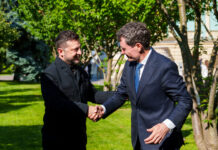
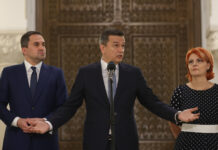
We notice that the odd couple of Nicușor Dan and Sorin Grindeanu are pushing the idea that things should be accepted as they are said: there will be no government with AUR, and if Bolojan falls, the “old” coalition has no reason not to get back together.
This is the essence of Dan’s and Grindeanu’s public messages. The question marks raised by their identical positions can be quite painful at times:
- What are they based on as both parties’ public positions do not seem to provide reasons for this? Because the ethnic Hungarian party, the UDMR won’t enter a government with AUR, and the PNL and USR have said publicly they will not enter the government without Bolojan.
- How did Nicușor Dan come to accept so easily Sorin Grindeanu’s position of evicting of Ilie Bolojan and continuing the wedding with a groom among the guests?
Personally, I don’t have an answer to the first question. I have, however, a reasonably good memory, which may suggest some clarification on the second question.
For that, we just have to go back in time.
When he was running for president, Nicușor Dan gave some clues about how he saw the future government if he was elected president.
In the light of recent developments, particularly focusing on last week, those clues from March 2025 begin to make sense in April 2026.
This is from a Dialogue between journalist Andreea Esca and Nicușor Dan, on Pro TV:
- Andreea Esca: Who would you like to be prime minister?
- Nicușor Dan: I want a lot of people. Obviously, there is a great popular, social pressure for Mr. Bolojan, a person I admire very much. But I’m not a populist and, as I said – I would like, obviously – it’s just a negotiation between the president and the pro-Western parties in Parliament.
- Andreea Esca: Do you have anyone else in mind?
- Nicușor Dan: There are people who are suitable for this position. Mr. Predoiu, for example, is a very suitable person.”
I humbly deduce that Nicușor Dan didn’t really want Bolojan to be premier even in March 2025.
It was a sort of “imposed” solution that came from “popular pressure”, even though he declared he wasn’t “populist”.
So, Nicușor Dan never really wanted Bolojan to be premier, but he probably saw it, tactically as way to win votes for the presidency.
On the other hand he considered Predoiu as a solution (it should said it was the only nomination he made in that dialogue) and someone who seemed more natural to him. Of course Predoiu’s name could have been just a generic name as he’s a politician who’s held a variety of roles, but this is also eloquent: It means Nicușor Dan was more attached to the Predoiu spirit than to the Bolojan spirit.
Why Predoiu rather and rather not Bolojan?
Well, for Nicușor Dan to specify “I am not a populist”, suggests that Predoiu was a rational choice based in the arithmetic of rational negotiations. While Bolojan is synonymous with emotion, therefore the irrational. And Nicușor Dan, is a mathematics Olympian and therefore has logic in his DNA, doesn’t he?
So many want Ilie Bolojan’s head: the PSD, AUR, by some from the PNL and (at least to the same extent) Nicușor Dan.
The president’s calculations – probably of an electoral nature, eying the next presidential elections – could be turned upside down: especially if Bolojan survives the motion, but even if he loses it.
Without a party behind him and with his own electorate already feeling disappointed, Nicușor Dan can hope, from his circumstantial alliance with Sorin Grindeanu, to secure a short-term victory, but he should fear the vulnerability he created in the medium-term.
Romanian president insists country will keep on pro-Western path as no confidence vote looms
