











The Shah fled Iran 47 years ago today. Tragedy ensued because of a series of mistakes. As Iranians are being murdered by the thousands, the world should help undo it.
Meanwhile, the regime began to export jihadism, calculating that regional instability would serve it well. It built influence through militias it trained, funded, armed and guided: Hezbollah in Lebanon, Shiite armed groups in Iraq, Hamas and Palestinian Islamic Jihad, the Houthis in Yemen, and unwavering military support for Bashar al-Assad in Syria. Each intervention weakened state sovereignty elsewhere while reinforcing Iran’s strategic depth.
The nuclear program served a similar dual purpose. It fear abroad and distraction at home, also summoned up a sort of national pride among the easily fooled (in any society, a not inconsiderable population). Negotiations rose and collapsed. Sanctions tightened and loosened. The population absorbed the economic damage, and occasionally tried to resist.
Such resistance is never easy when a regime is as fanatical and hellbent as the one in Iran. Their religious mania is such that the lives of the non-devout or disloyal count for nothing, and there is no protection under the law, which exists for the regime and not the people.
Nonetheless Iranians rose up in 1999, when students challenged the suffocating controls on thought. They rose in 2009, when some still believed their votes mattered (Iran held highly controlled “elections” for parliament and president – but only a few are allowed to run). They rose again in 2017 and 2019 against economic despair and political stagnation. They rose in 2022 after a young woman, Mahsa Amini, died in custody for the crime of showing her hair. Each time, the response was violence, imprisonment, execution, and digital silence. Each time, the world responded with statements, concern, and caution.
The West never did quite enough in what is admittedly a difficult situation. There was always fear of escalation, of terrorism, and of harming the population when going after the regime – whether with total economic sanctions or with a military assault. Such reasonable concerns are why despots survive.
There is also the argument that no country has the right to intervene in another’s affairs, even if that country is not democratic and thus is basically ruled by criminals. Indeed, Trump’s new National Security Strategy explicitly says that democracy is not for everyone and America should stop promoting it – a shocking departure from bipartisan consensus that got lost in the flood of daily outrages from the White House.
Yet the Islamic Republic has been intervening for decades. It has intervened in Lebanon, Syria, Iraq, Gaza, Palestine, Yemen, and more with its militias, terror networks, and nuclear brinkmanship. It is that – Iran’s meddling with the entire Middle East – which, on top of its unspeakable repression, constitutes the case for intervention.
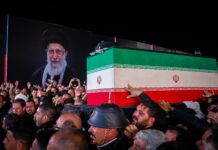
And that case is acute, because Iran once again stands at a moment of darkness. After about two weeks of protests which have spread nationwide, at least 3,000 people have been killed by the regime, and possible many times more. The internet is down. Communication is severed. Families cannot reach their loved ones. History is unfolding but it is hidden from our sight.
The regime is putting out a fake narrative: that the protesters are “terrorists” operated by the CIA and the Mossad. On a television program this week I debated with a thirtysomething Iranian woman – actually a senior executive in Iran’s Press TV – who was pushing this propaganda hard, and I did my best to debunk it, explaining that in any case she could not speak freely, sitting in Tehran.
A few days ago Trump urged Iranians to take over their institutions and keep protesting, promising that “HELP IS ON ITS WAY.” Now he claims that the killing has stopped, hinting that the credit is his and this is good enough.

Perhaps this is a misdirection, and help is really coming. We can hope. But Trump’s an unreliable ally for anyone in their right mind. He generally will claim credit for anything quick and easy and them move on, exaggerating the success and saying something nasty about a predecessor or a rival. He does not seem to have the stamina for a war.
Intervention does not necessarily mean invasion or occupation — models with a pretty bad history. But there are many things that can be done.
I would actually begin by issuing a warning – so as to not kill civilians – and then annihilating every major building or facility associated directly with the regime. That kind of violence risks backfiring, as the regime will try to rally opinion by presenting it as an attack on Iran. My sense is that it would fail in that regard, and the symbolic value would be great. It may also compel a palace coup and embolden the protests – that is the combination that brings a dictatorship down.
There should be quiet talks with the military on undoing its mistake of 1979, which it allowed the referendum, as well as with the Guards, who should be offered amnesty, and permission to keep some of their spoils, if they stand aside. At the very least this would weaken the regime by causing a split in the ranks of the security services.
Another powerful lever is legitimacy. Trump can rally much of the world behind a message that would make explicit, in diplomatic language and policy, that the Islamic Republic has forfeited political legitimacy by massacring its own people and destabilizing the region through proxy warfare. That means treating the regime not as a normal government but as a permanent human-rights violator: downgrading diplomatic relations, limiting access to international forums, and shifting rhetorical and symbolic recognition toward Iranian civil society rather than the state. Authoritarian systems depend on being treated as normal. Removing that status is a form of pressure.
Next is personal accountability. The regime survives because individuals believe repression carries no personal cost. Targeted sanctions, visa bans, asset freezes, and legal exposure against judges, IRGC commanders, intelligence officials, and prison administrators change that calculation. This does not punish Iran as a country; it isolates those who make violence possible. Over time, it creates fear inside the ruling elite, which is far more destabilizing than fear among the population. That also attaches to economic pressure focused upward: Broad sanctions tend to hurt ordinary people and entrench authoritarian systems, but precision pressure aimed at IRGC-controlled businesses, shipping networks, smuggling routes, and front companies might weaken the financial backbone of repression.
And then, of course, there is information and connectivity. Few actions would matter more than ensuring Iranians can communicate with each other and with the outside world. Satellite internet access and expanded broadcasting into Iran directly weaken the regime’s control.
Iran’s regime is weaker than it was because of the thrashing it took from Israel last June, the weakening of its proxy militias and the fall of its client dictator, Assad of Syria, about a year ago. The collapse of the currency isn’t helping.
It also has an emerging potential transition leader in exiled some of the Shah — Reza Pahlavi. I interviewed him a year ago (see story here and video below) and found him convincingly committed to returning whenever possible and offering himself as a transitional leader enroute to elections and a liberal democracy living in harmony with the West and the region (including Israel!). He has support.
So the case for a strategic intervention is strong, and it might succeed.
Iran’s tragedy has gone on too long, and its people need help. If this moment passes without action, the judgment will not fall only on the Islamic Republic but on a world that knew what was happening, understood why it mattered, and chose caution over conscience.
No one blames America for intervening in World War II against the Nazis. They blame it for waiting too long, and for not bombing the train tracks on which Jews and others were taken to Auschwitz to be murdered. Iranians are being murdered.
