













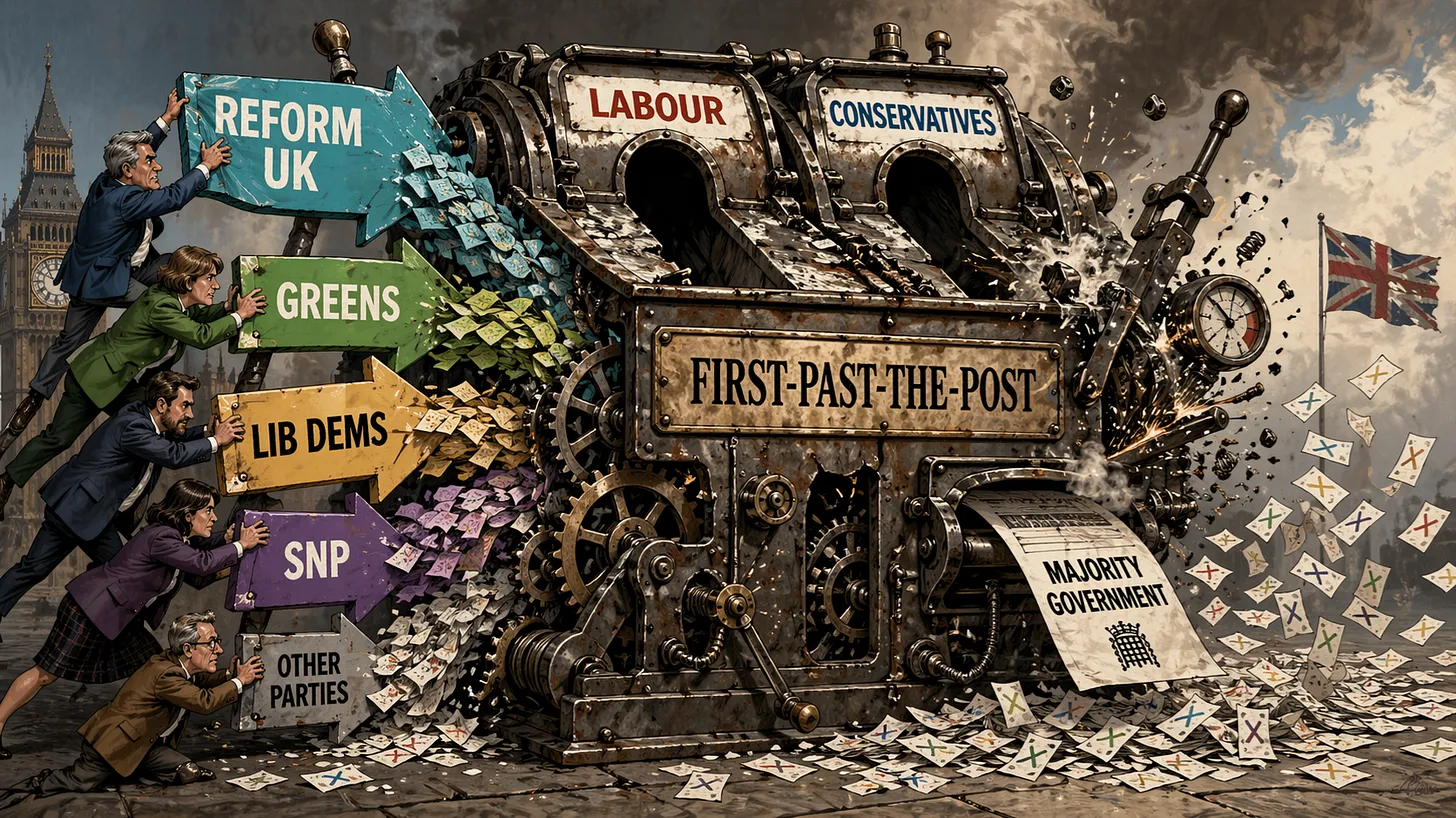
The UK now has five mid-size parties. They should run in two blocs.
By Alison Mutler and Dan Perry
“When the herd moves, it moves,” said Boris Johnson as he stepped down, realizing his party’s parliament members had turned against him. Keir Starmer is not quite the same wordsmith, but he seems well on his way to a similar fate. For it’s a strange British tradition: prime ministers are tossed out after huge screwups.
In Johnson’s case, it was a cascade of scandals. COVID lockdown breaches (“Partygate”) led to fines and findings he misled Parliament. Further controversy over appointing an official despite prior misconduct allegations triggered mass ministerial resignations. With party support collapsing and authority gone, he stepped down in July 2022.
The woman the Conservatives chose as his successor, Liz Truss, resigned after just 45 days, Her government’s radical tax-cutting “mini-budget” spooked markets, sent borrowing costs soaring, and crashed the pound. Party support evaporated, authority collapsed, and tabloids began compared her term to a head of lettuce, which they said would outlast her. Indeed, she ended up as the shortest-serving prime minister in British history.

The two previous Tory leaders also resigned: David Cameron after losing the Brexit referendum he called, which was a monumental miscalculation on par with The Charge of the Light Brigade — full speed, great confidence, and straight into disaster. And Theresa May was defenestrated after failing repeatedly to pass her Brexit deal.
And now comes Starmer, who has hardly known a moment of peace in his two years in the hot seat: dogged by rows over expenses and freebies, donor-funded perks, questions around his team’s use of passes and hospitality, on top of inflation, strikes, migration pressures, and the steady grind of governing a fractious, weary Britain. From the moment he stepped into Downing Street, he was unpopular: too left-wing for the right-wing media and not left enough for the liberal media and voters.
The potential coup-de-grace is the Peter Mandelson scandal. His decision to appoint this louche grandee as ambassador to Washington despite concerns he had not cleared vetting — and the subsequent revelations of his deep ties to Jeffrey Epstein – earned Starmer one of the most embarrassing parliament grillings in memory last week. How quaint when set against the US, where Trump’s more direct and deep Epstein ties seem to have little effect.
Typically for the stolid ex-prosecutor, awkwardness dogged him all the way back to the election he won: the supposedly Labour landslide was one in which the party won barely two percent more than it had under the shambolic Jeremy Corbyn. The parliament majority results purely from a splitting of the right-wing vote between the Conservatives and Nigel Farage’s Reform UK.
And that is relevant to the current situation, because such splits, which are brutally punished by Britain’s first-past-the-post district system, have spread across the entire political landscape.
Britain’s electoral system was built for a two-party world. Each constituency elects a single MP; the candidate with the most votes wins, even if opposed by the majority. For decades, that produced stable outcomes. Power alternated between Labour and the Conservatives, and even modest leads in vote share translated into clear parliamentary majorities. That world is gone.
Recent polling shows a country split across at least five meaningful political forces. Reform UK leads. The Greens are surging. Labour and the Conservatives are both reduced to the mid-teens. The Liberal Democrats remain competitive. Smaller parties still matter locally. This is not a temporary fluctuation; it is a structural fragmentation.

Under proportional representation, such a landscape would produce coalition politics. Under first-past-the-post, it produces distortion. . A party with a relatively modest share of the vote can dominate if its support is efficiently spread. A party with substantial backing can be marginalized if its vote is split or concentrated in the wrong places. At this level of fragmentation, the possible result is utter randomness.
If Starmer is replaced, Labour will face a choice. It can seek a new mandate, arguing that a new leader deserves public endorsement. Or it can follow recent precedent and govern on, relying on its existing parliamentary majority. Historically, parties have often chosen the latter. The risks of an election are always significant, and right now it would be suicidal.
Ah, but on the other hand, it would seem so very unsporting to hang on to power when the herd of the electorate has moved. Indeed, Truss’ successor Rishi Sunak called an early vote more or less for that reason. Again, this is Britain, where some things are still just not done.
There is, in theory, a way to make such an election less chaotic. When multiple parties compete within the same ideological space, they split the vote and hand victory to their opponents. The only way to prevent this is through tactical alignment — ensuring that, in each constituency, only one candidate represents a given political camp.
At a small scale, this already happens. Parties sometimes stand aside for one another in specific seats. Voters engage in informal tactical voting, choosing the candidate most likely to defeat a disliked rival. But the current level of fragmentation demands something far more systematic. To produce a coherent outcome, British politics would effectively need to reorganize itself into two blocs.
On one side, a Conservative–Reform alignment, uniting the traditional right with nationalist-populist forces. On the other, a Labour–Green–Liberal Democrat bloc, combining the center-left, environmentalists, and pro-European liberals. If such blocs operated with discipline—minimizing internal competition—they could recreate the two-sided contest the electoral system expects. The translation from votes to seats would become more stable, and outcomes would more closely reflect underlying political preferences.
Alas, it is unlikely. Parties exist to compete. Asking them to stand down in favor of allies means asking them to sacrifice identity, momentum, and future growth. For insurgent parties like Reform and the Greens, that is the opposite of their purpose.
On the right, a Conservative–Reform understanding would require a level of trust that does not exist. Reform’s rise depends on attacking the Conservatives as failed and compromised. The Conservatives, in turn, fear being overtaken entirely. Cooperation would blur the distinction both rely on.
On the left and center, the problem is even more complex. Labour, the Greens, and the Liberal Democrats overlap electorally but diverge ideologically. Their voters are not interchangeable, and their activists are often hostile to compromise. Even where tactical logic is clear, political will is weak.
There is also a structural problem. Coordination requires centralized decision-making and message discipline. British parties, especially in a moment of internal tension and leadership uncertainty, are not well positioned to deliver either.
So the likely outcome is that Labour will replace Starmer and try desperately to hang on for as long as it legally can.
Meanwhile, it may try to change the conversation. One way to do that requires bravery: it can openly call for renewed integration with the European Union – essentially undoing the huge lose-lose mistake known as Brexit. That is something most people in Britain want, but feel awkward and hesitant about. Squaring this circle is the path to renewed relevance.
Skeptics, Relax: Hungary’s Magyar is Not Just an Updated Orbán
