












Monday’s White House meeting with Zelensky and Western leaders will test not only Ukraine’s survival but America’s credibility as leader of the free world (which is on life support)
In February, the world witnessed something that had never before occurred in the annals of US diplomacy: a foreign leader was effectively defenestrated from the White House. Volodymyr Zelensky, the wartime president of Ukraine, was summoned to Washington only to be dressed down by Trump and a hectoring JD Vance for insufficient gratitude. The symbolism was brutal. The man leading the defense against tyranny in Europe’s bloodiest war since 1945 — a war for survival against a nuclear-armed aggressor — was humiliated by an unscrupulous American president.
That moment will be remembered not only as one of the defining spectacles of Trump’s second presidency, but also as a milestone in America’s descent from global leadership. The message to allies and adversaries alike was unmistakable: the United States is no longer a reliable anchor of the Western alliance, but a stage for the vanities of its president. Dictators and war criminals are welcome, as long as they flatter.
Now, Zelensky returns to Washington. The stakes could hardly be higher (and I would not use that cliche if it wasn’t actually true). And this time, everyone — from NATO Secretary-General Mark Rutte to the leaders of France, Germany, and Britain — is converging on the White House to ensure that the scene of February is not repeated. They fear another public shaming of Zelensky, and worse: that Trump might seek to impose on him a “take it or leave it” surrender deal to Russia.
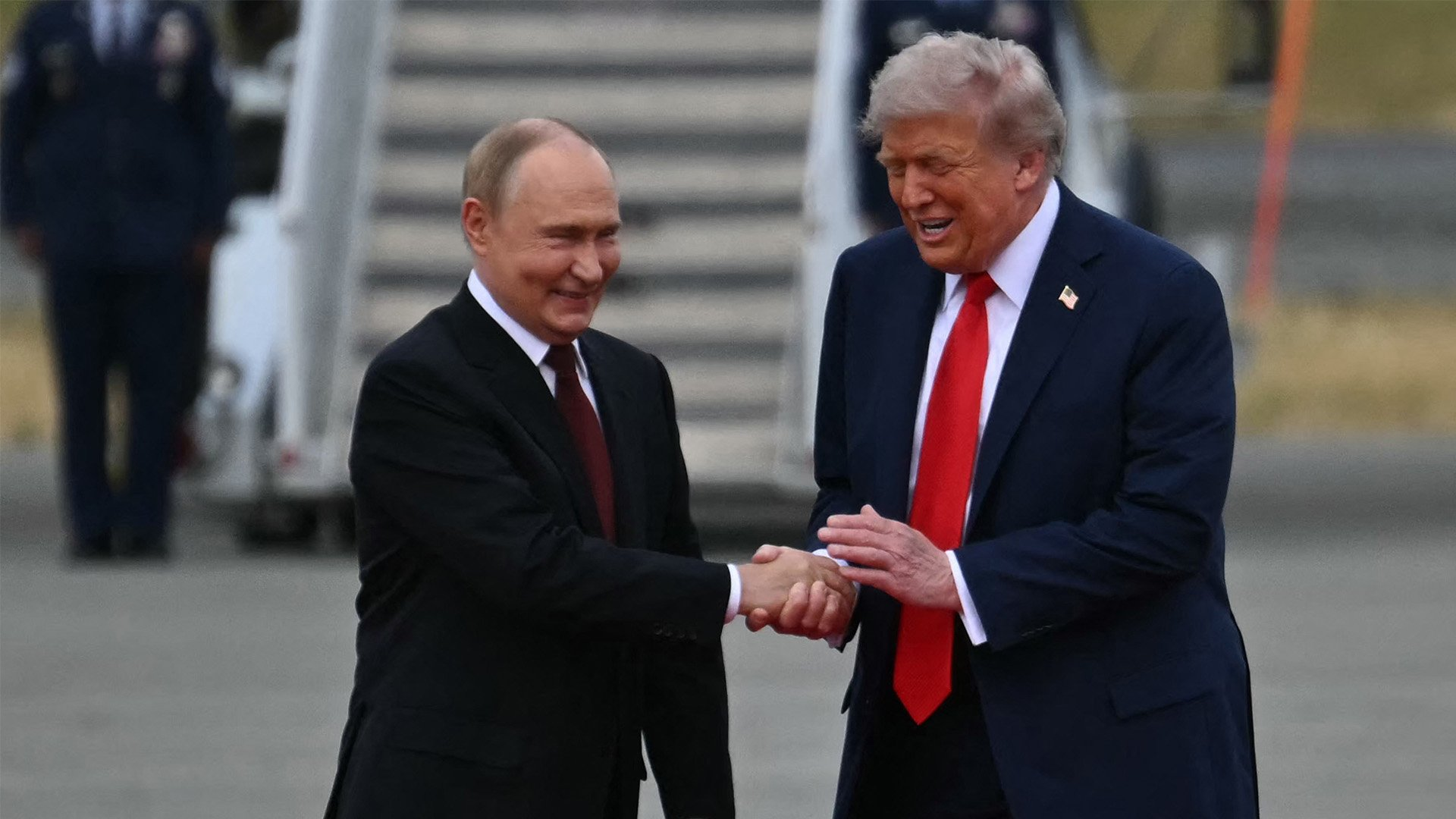
Just last Friday in Alaska, Trump staged a summit with Vladimir Putin that he billed as the moment he would end the war in Ukraine. Instead, it became a global embarrassment. Trump emerged from the meeting calling it “warm” and “very productive,” boasting that “many points were agreed to.” Putin offered nothing — no ceasefire, no gesture of compromise, not even vague nods toward future talks. He simply invited Trump to Moscow.
Trump was the supplicant; Putin the master. And Trump gave the Russian dictator precisely what he wanted: legitimacy, a photo-op on American soil, and the spectacle of an American president parroting Moscow’s talking points. Most astonishingly, Trump adopted Putin’s insistence that Ukraine should negotiate a peace deal even without a ceasefire. In other words: sit at the table while Russian missiles rain down, while Russian troops consolidate gains, while Ukrainian civilians die. It was a script that could have been written in the Kremlin.
Trump clearly thinks Ukraine should hand over the Donbas, its mineral-rich eastern provinces, in a “deal.” There is no reason to believe this is the end of Putin’s demands. Reports now suggest that the Russian leader wants not merely to keep the territories he has already seized, but more. It is a test: Should the world reward aggression and appease a dictator?
History has answered that question before, and the verdict is damning. The Munich surrender of Czechoslovakia’s Sudetenland to Germany showed appeasement does not work. Aggression rewarded only invites more aggression. Dictators cannot be trusted to keep deals. Yet Trump, like some tragic caricature of Neville Chamberlain, seems intent on relearning these lessons at Ukraine’s expense — and at America’s.
The Alliance at Risk
The danger is not only that Ukraine will be forced into an unjust peace that leaves it vulnerable to future attack, because Russia does not honor deals. It is that the United States, by indulging Putin and humiliating Zelensky, will rupture the Western alliance itself. The Europeans are not powerless: under the plan championed by NATO’s Mark Rutte, the US is anyway to sell weapons to Kyiv (because with Trump it must be profitable) while Europe foots the bill. That arrangement could keep Ukraine fighting even if Washington wavers.
But the symbolism of American retreat would be devastating. Since World War II, the international system has rested on the assumption that the United States, however flawed, stood as the backbone of the free world. If America now walks away — not because it cannot lead, but because its president prefers the company of authoritarians — the consequences will ripple far beyond Ukraine. From Tehran to Beijing, every aggressor will draw the same conclusion: persistence pays, and America cannot be trusted.
Choreographed Humiliation
The February meeting was not an accident. It had all the marks of choreography designed to degrade Zelensky. The “ingratitude” lecture, the posturing, the repeating of “you don’t have the cards,” the abrupt expulsion from the White House — these were not diplomatic stumbles but deliberate theater. The point was to send a message that Ukraine’s leader is a supplicant at Trump’s mercy.
Tomorrow’s meeting will probably be less theatrical. Trump probably doesn’t want to appear as if he is strong-arming Ukraine into surrender while the world is watching. He wants to preserve the illusion of statesmanship, to appear as the man who delivers “peace.” But the substance may be no less dangerous. Having dropped his earlier demand for a ceasefire, having abandoned the push for secondary sanctions that could have crippled Russia’s oil trade, Trump is leaving Ukraine in the position of negotiating under fire. This gives Putin precisely what he wants: time to consolidate his gains, to fortify his lines, to wait out Western fatigue.
Trump is proving, to anyone paying attention, that the United States under his rule is an unreliable ally. He has shown that his priority is not defending freedom, not upholding international law, protecting America’s strategic interests, or (obviously) doing the right thing — but basking in the approval of autocrats and doing deals that he can sell as accomplishments to gullible people. He continues to insist, with jaw-dropping naivete, that he and Putin “get along just great.”
Meanwhile, Ukraine’s economy has shrunk by a fifth since the invasion. The country bleeds $140 million each day to sustain its defense. Millions of people are displaced, tens of thousands dead, entire cities pulverized. Russia has also paid heavily — hundreds of thousands of soldiers killed and maimed, sanctions biting deep, hundreds of billions lost. And yet Putin presses on, willing to sacrifice endlessly for his imperial fantasy.
To reward such behavior with territory is very dangerous — and if that’s the way it has to be Ukraine must be very seriously compensated. We explained how last week — real security guarantees, a fast track to EU membership for Ukraine, continued punishment of Russia. We urged Trump to approach Putin with a very big stick. Instead he brought kid gloves. He apparently did not even ask for a return of captured Ukrainians and kidnapped children. It is so pathetic as to verge on inexplicable.
The world is watching to see whether the United States still has the moral clarity, the strategic foresight, and the simple decency to stand with a nation fighting for its survival. Obviously, with Trump at the helm, the very idea seems absurd. This is the price America, the West and the world are paying for the Democrats’ stupendously incompetent 2024 presidential campaign. History will probably be merciless to everyone who had a hand in all of this.
Then again, we will know more tomorrow.
FM confirms Russia interfered in Romania’s presidential ballot, cites NATO report
