



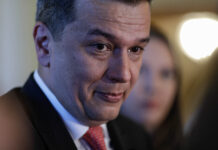

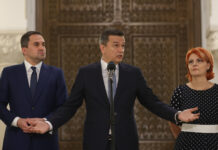

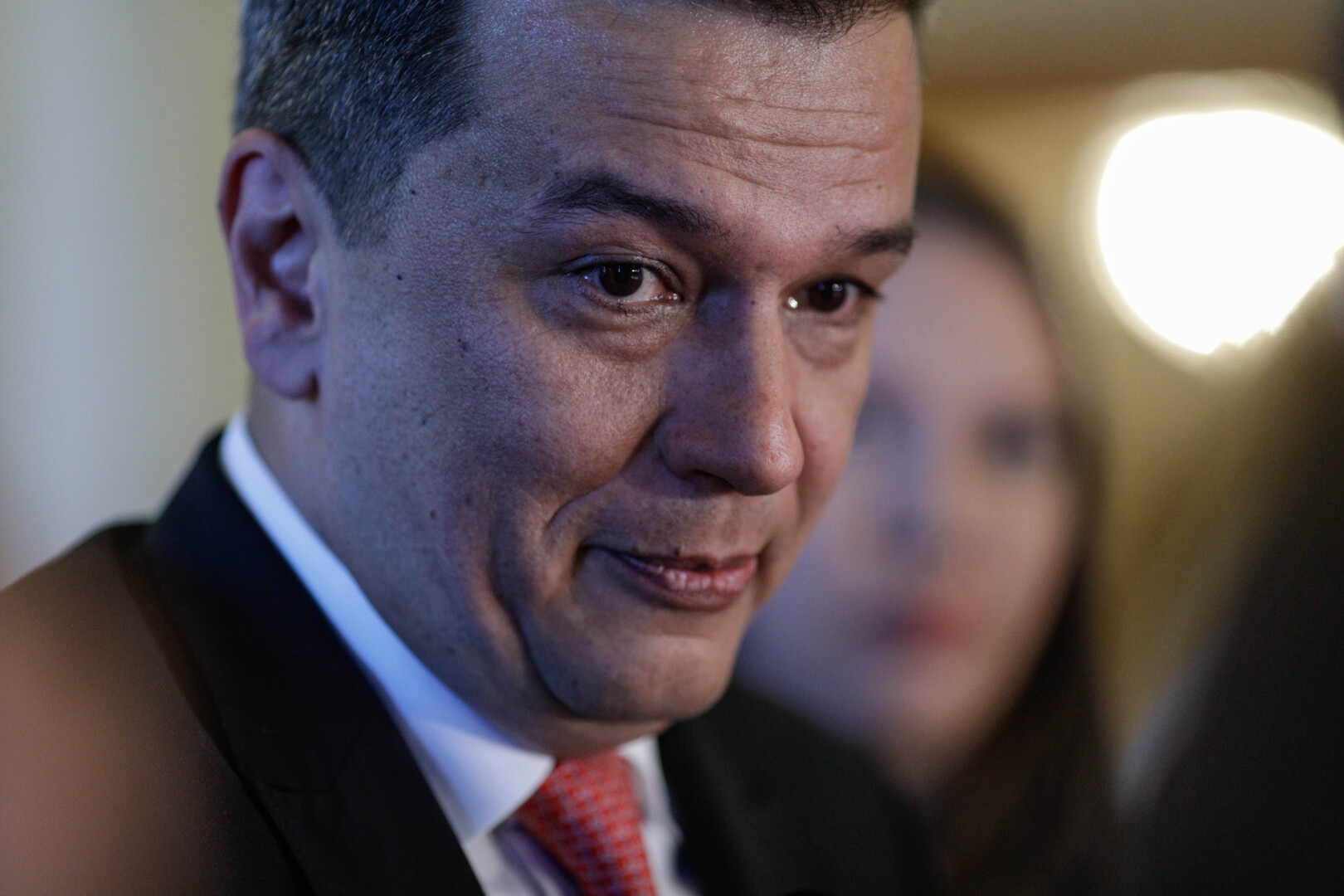
In 2017, Sorin Grindeanu, who had just become Prime Minister, was fussing like a mother hen over the country’s budget deficit:
- He accused the previous government of going over the maximum threshold agreed with the EU: “(…) The deficit of 3% was exceeded in 2016. It is an extremely serious matter (…)”. Details HERE
- He then assured Romanian citizens nd the country’s internal and external creditors that the Grindeanu Government is treating the 2017 budget with “maximum responsibility” and its main objective was the implementing of measures assumed in the government program, within the limit of the budget deficit of 3%”. Details HERE
But exactly nine years later, and now PSD leader, the same Sorin Grindeanu has withdrawn support for the Prime Minister Ilie Bolojan just when he had successfully begun to reduce a budget deficit three times higher than the incriminating one a decade earlier. The budget deficit is moreover the heavy legacy of another PSD government, led by former Prime Minister Marcel Ciolacu.
Sorin Grindeanu’s flagrant hypocrisy on the deficit issue undermines his rhetoric, logic, morality and politics in the light of PSD’s decision to withdraw support for Bolojan.
Toppling Bolojan will generate serious economic and political consequences.
- Economically, it has the potential to weaken the leu and borrowing costs.
- Politically, it’s an open game and nothing can be ruled out– from a minority government, to a no-confidence vote to an eventual coalition with AUR, to the suspension of the president, and even early elections. Some of these possible scenarios are more likely than others depending on what happens in negotiations and in the individual parties and of course the ability of President Nicusor Dan to avoid strategic errors. It also depends on how long the political crisis triggered on Monday by the PSD (led by a weak leader and lacking a compass) goes on.
Undoubtedly, we have reached a new turning point.
If President Dan, the (still) incumbent Prime Minister, PNL and USR treat this moment in the proper historic context and with intelligence, the PSD risks being hit with a boomerang.
In the end, perhaps the moment has come for Romania to naturally dissolve the former Romanian Communist Party and its successor, the PSD, as happened in other ex-communist countries such as Hungary and Bulgaria.
PSD which is surrounded by obscure interest groups is blowing up the coalition just when this coalition, led by the determined prime minister, had begun to attack the most delicate strongholds of the obscure interest groups: state-owned companies, the state’s unsustainable public spending and good boy privileges – such as special pensions.
The PSD has a long experience in terms of “coincidences” of this type: it has twice suspended a president just as fundamental reforms were on the table, and assaulted the rule of law and Romania’s pro-Western strategic orientation with the aim of saving, through specially created laws the obscure interest groups the PSD represents.
For Dan, the president-mathematician, the equation he faces isn’t simple, but it’s not impossible either. This time, everything depends less on his academic talents and more on his moral backbone, his long-term political vision, and correctly identifying good allies (ones which are first of all good for the country).
The shadow of former President Klaus Iohannis is not far and President Dan should not make the same mistakes.
For Nicușor Dan, one of the lessons worth studying from Iohannis, is quite simple in a tragic and paradoxical way: how quickly you can transform yourself from a reformist hope into a failed player and harshly condemned by your supporters that have been by your side for a long time.
Another lesson, also from Iohannis, for Dan, and no less valuable is that PSD remains the PSD – it does not change, does not evolve and everything it touches turns to dust.
On Monday, at the PSD’s anti-Bolojan rally, the atmosphere was trident and inappropriately festive one, although the event was dedicated to a demolition on multiple levels: economic stability, political stability, and both in an unprecedentedly disastrous and even dangerous international context.
The PSD is demolishing itself, howeever much festivity it invested in its anti-Bolojan party:
- Blowing up the coalition would make sense for the PSD ‘barons’, wired to the state’s resources and panicked by Bolojan’s reforms. But I find it hard to believe that this demolition is shared with ordinary PSD voters (fewer and fewer from year to year, as the party has half the support it had a decade ago).
- Breaking up the coalition forces the PSD to get closer to AUR. It’s a trap both if it does and if it doesn’t. If it does, it will discredit itself internally and externally. If if not it will be totally discredited anyway, because it will be perceived as the author of this political crisis having failed to provide a solution. In any case, the AUR, which was already taking votes from the PSD is the big winner of the PSD’s actions on Monday. As I wrote on other occasions, the Social Democrats are turning into AUR’s poor relative and Monday’s vote reinforced this for the party still led by Grindeanu.
- Finally, the PSD’s anti-Bolojan offensive has the potential to strengthen Bolojan as a year after he took office and began to implement tough economic measures, during which his reputation has not really changed. Like any crisis in its early stages, there is a broader horizon for uncertainties, but it does force all the protagonists to take clear positions and will punish those who hesitate, and try to choose the deceptive “middle way” and/or resort to disappearing from public view.
The crisis generated by the PSD can either cause a political crisis but it can also bring new political constructions; it can fuel a more realistic and honest vision of the country; It can unleash energies which have so far been blocked.
At the same time, the crisis is a litmus test for the political class.
Rare are the moments in history when crucial leaps forward have been made without a major domestic or international crisis.
