













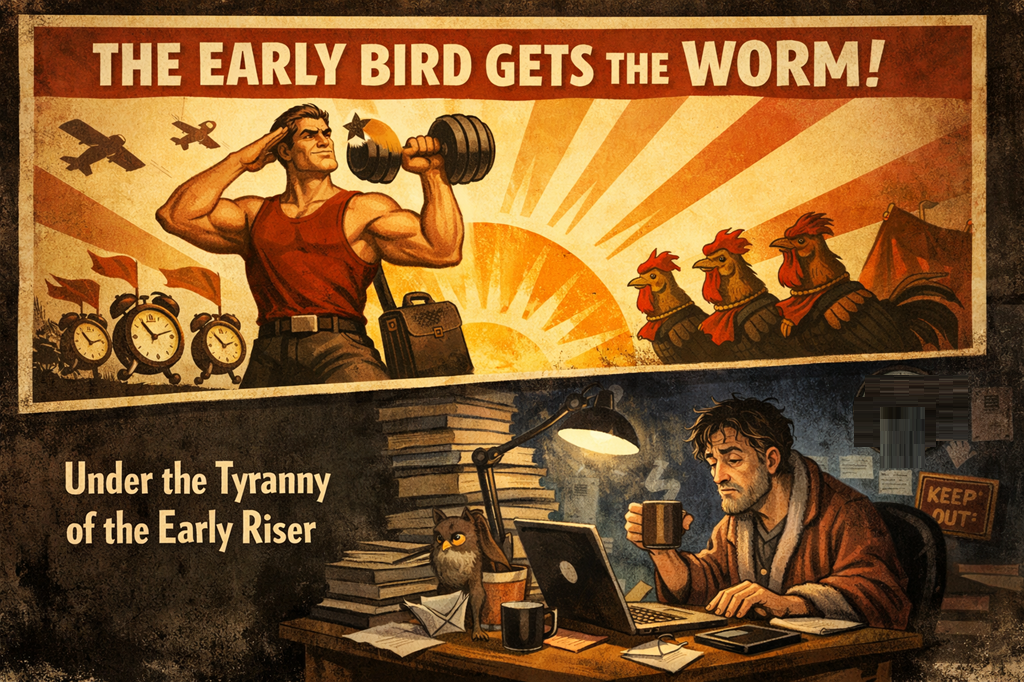
On World Sleep Day, we reoffer our cri de coeur on behalf of night owls everywhere
Are you losing sleep over the state of the world these days? Who knows — it might be darkest before the dawn.
Which is reassuring, unless you are a night owl. For us, dawn arrives at an unholy hour, making the cliche yet another example of the Tyranny of the Early Riser. Night owls, who must wait until midday to discover whether the world has improved, are among the most oppressed demographics on Earth — second perhaps only to people over fifty. In a spirit of solidarity, on this World Sleep Day — March 13, 2026 — we reoffer this 2024 essay on their drowsy behalf.
Let me tell you about my buddies Jules and Jim. Jules awakes with the roosters, concludes his cross-fit by 6:30 a.m. and leaps to his eight-hour workday at 7:30 a.m. sharp. Jim stumbles to the shower by 10 a.m., in the best-case scenario, is still clearing cobwebs at 11 a.m., and at noon begins a workday that might take him well past midnight. Which of the two is widely deemed the more industrious?
I think every reader knows that by and large, it’s Jules. Few will factor in Jim’s longer hours, and some will consider him downright bizarre. The assumption that mornings equal industriousness is so widespread that it can only be the result of an international conspiracy. After years of study I have discovered it: the Tyranny of the Early Riser. The evidence for its existence is clear as day, if you will.
In its quest for world domination, the Tyranny deploys jackhammer agitprop in the form of cliches drummed into our skulls from birth. “The early bird gets the worm.” “Early to bed and early to rise keeps a man healthy, wealthy and wise.” Culture and tradition, ancient and new, brim with the Tyranny’s propaganda.
In Homer’s Ilead, the early morning was the only time Odysseus and his men held their ground in the battles. Jane Austen’s Pride and Prejudice subtly favors characters who rise early, such as Mr. Darcy, who enjoy the tranquility of the morning hours for reflection and walks.
In the modern era, the song “Morning Has Broken” celebrates the beauty and promise of a new day. “Here Comes the Sun” by The Beatles expresses joy and optimism as the morning sun rises, symbolizing hope and positivity. In the film Rocky, the titular character’s preposterously early morning (and odd liquid-egg breakfasts) are key to his success.
Philosophy’s Stoics, such as Epictetus, emphasized the importance of starting the day with purpose and intention, advocating for early rising as a way to cultivate self-discipline and resilience.
As for religion, well, sometimes it seems like the cult of the matutinal is the only thing Jews and Muslims can agree on — both insist on prayer at the ungodliest of hours. Christianity, more forgiving than either, nonetheless gets in on the act: Mark 1:35 seems to delight in emphasizing that Jesus was up to pray “very early in the morning, while it was still dark.” Of course, inevitably, the eastern philosophies like Taoism and Buddhism promote the early morning hours as a sacred time for meditation and self-reflection.
It is as if everyone from Krishna to Cat Stevens is in the pay and pocket of a nefarious secret priesthood — the Tyranny of the Early Riser.
And it has worked!
Look into your heart, dear reader: is it not true that you, yourself, have been made to assume that people who hate mornings are lazy — even if they’ve been reading “War and Peace” till 4 a.m.? You mock them as semi-retired, don’t you? And if they are even able to find work, they endure scowls, scoffs and sneers for being surly at the accursed 9 a.m. morning meeting. Are you not among the scoffers?
Fine — I’ll admit it! This systemic historical injustice is not solely because of the conspiracy I have discovered. It is possible that in addition to the conspiracy, societal norms, religious practices, and the demands of various occupations have over time shaped routines and expectations. It is conceivable that early rising became a cultural norm in many societies due to practical considerations related to agricultural (and, later, industrial) lifestyles. Farmers needed to make the most of daylight hours for their work. These trifles as well might have ingrained early rising as a virtuous thing in some cultures.
Yet it is remains unfair. The world has early birds and night owls — Juleses and Jims, if you will — and neither can control their tendency. Like sexual orientation, it is not a choice. Yet from Korea to California, humans have a bias favoring morning people.
So I’m here to represent the Jims of the world. I will never initiate an 8 a.m. encounter, and the best (and perhaps only) way to offend me is to schedule a working breakfast — a scourge, if ever one there was. Somewhere around 11 a.m. is when I’ll take a call. But on the other hand, I am available pretty much 16 hours a day and I’ve been known to work at 3 a.m. Call me lazy and we’re going to have words. Call me unproductive, and history will prove you wrong!
Yet when I say I am offended by a power breakfast, most will disrespect it. When morning people say they’d rather not take a 10 p.m. call, that’s work-life balance. Are you starting to see the picture? Is the conspiracy coming into view?
In an egalitarian society, all individuals should have an equal opportunity to thrive without discrimination based on biological inclinations like chronotype. Pressure to conform to circadian rhythms that are not natural creates an environment in which night people are disadvantaged and may suffer stress, sleep deprivation, and reduced well-being.
Diversity, Equity and Inclusion programs are now under attack — but even the Trumpiest must admit that night people should enjoy protections. We are a group whose identity is as unchosen as is race, whose oppression on the basis of that identity is equally foul. A group that deserves not just respect but representation.
Employers should adopt flexible work hours that accommodate both morning and night people. Such flexibility can enhance overall productivity by allowing individuals to work during their peak hours, ultimately benefiting both employees and employers.
That’s because beyond fairness, I believe their productivity assumptions are wrong. There’s no doubt that some excel in the early hours and others later in the day. Night people tend to be more creative and alert during evening hours, which can translate into higher productivity. I have written two books that you will find and should definitely purchase on Amazon; not a word of either was written before midnight.
I sense there is a bit of pushback at last. I was delighted to find an article in the sometimes-contrarian Wall Street Journal entitled “Is it ever OK to have an 8 a.m. meeting?” The piece explored the reasons to be wary of the scourge, and that is certainly progress, but it refrained from taking a strong position. We can do better.
I ask everyone to join me in daring to imagine a world where your worth is measured not by the hour of your waking but the content of your character! In such an ideal society, everyone would have an equal shot, regardless of their prospective hour of awakening. The Tyranny of the Early Riser has for too long trampled on this ideal.
Therefore I mark World SleepDay, organized by the World Sleep Society, which aims to advance knowledge about sleep health and circadian rhythms. I bet you’ve never even heard of this wonderful commemoration. If you think about it carefully, or at least conspiratorially, you’ll see in its very suppression the ultimate evidence for my theory. The Tyranny of the Early Riser is as real as it is wicked!
