













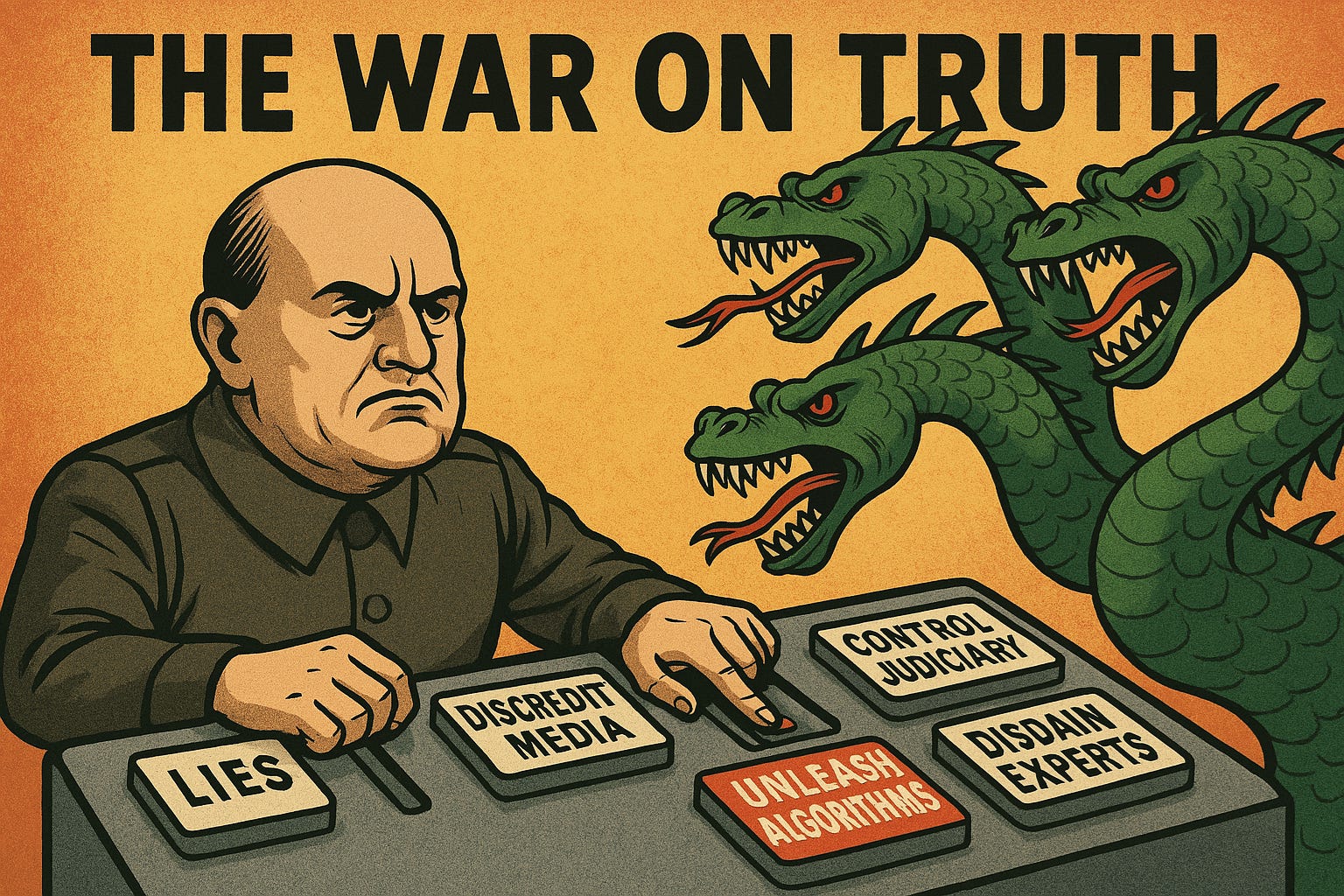
Summing up our five-part series on the ways in which authoritarians spread and weaponize idiocy. This is your handy guide for resisting.
Authoritarianism is on the rise again, as if we learned nothing from the 20th Century. It doesn’t necessarily arrive with tanks or uniforms. In today’s world, it often marches forward in slogans, memes, and confidently stated lies. It spreads not through censorship, but through noise; not by eliminating dissent outright, but by flooding the public square with contradiction, confusion, division and bullshit.
In a series of recent articles, we’ve explored how this modern authoritarianism wages a war on truth itself — strategically, cynically, and with increasing success. This assault is not accidental. It’s a multipronged campaign to neutralize expertise, undermine the rule of law, discredit journalism, manipulate information systems, and ultimately elevate emotion over evidence. The goal is to blur the line between reality and narrative — to make facts negotiable and compel people to just give up and let the rulers do what they want. Including, of course, to shamelessly profiteer.
What emerges is a new kind of control: one that exploits democratic freedoms to make them meaningless. Courts are repackaged as political actors. Journalists are not watchdogs but poodles or “enemies.” And technology platforms, instead of uniting the world, have become delivery systems for anger and misinformation. It’s a crisis of reality itself.
What follows is a five-part examination of this phenomenon. We call it the War on Truth.
The Aggressively Presented Nonsense

In Part I, we examined the tactic of Aggressively Presented Nonsense, using Trump’s disastrous tariff tirade as a case study. Although tariffs are self-inflicted price hikes on consumers (aimed, at best, at protecting local industry and therefore perhaps employment), White House Press Secretary Katherine Leavitt insisted with a straight face that they were a “tax cut” for the American people. The message is an extreme case of an insult to the intelligence — suggesting nothing needs to make sense in the face of loyalty.
In this case, in other endeavors by autocrats, the justification of nonsense and malfeasance is less about the policy than about emotion — a performative blow against imaginary enemies to galvanize support. The sheer confidence with which a flawed approach is sold is what gives it force; it’s not logic, it’s theater. And yet that theater has consequences: rattled markets, damaged alliances, and a weakened global order that once powered prosperity.
The War on Expertise (and Education)

The disregard for economic consensus in the case of the tariffs is no accident; it’s part of a broader populist strategy that thrives on rejecting expertise. Around the world — from Brexit Britain to Bolsonaro’s Brazil — right-wing leaders have weaponized anti-intellectualism, turning expert warnings into political assets. In this worldview, scientists, professors, economists, and journalists aren’t guides to truth — they’re elitist enemies of the people. When trust in knowledge collapses, people turn instead to demagogues and “influencers” who confirm their biases.
The defiance of “elites” attaches to class warfare and aims to signal some version of authenticity. This erosion of expert authority is also deployed to undermine institutional checks, enabling rule by decree. And it opens the door to disinformation, these days often aided by Russia, which has perfected this while its people fester in poverty. The result isn’t just bad policy — it’s a dismantling of the structures that make good policy possible.
The Witch Hunt Playbook

A growing number of populist leaders across democracies are embracing a dangerous playbook: breaking the law, attacking institutions tasked with enforcement, and framing legal accountability as persecution by “elites.” From Trump in the U.S. to Le Pen in France and Netanyahu in Israel, his narrative transforms criminal indictments into political capital. It undermines trust in courts, prosecutors, and the rule of law, presenting them not as guardians of democracy but as tools of a conspiratorial “deep state.”
This erosion of the system’s legitimacy is strategic — a way to shift power from institutions to individuals, replacing accountability with grievance-driven autocracy. This is why the right — which once stood for law and order — now snarls at the FBI. It helps the populists, of course, when some of the grievances are real — failures of liberal governance and genuine economic dislocation. But the result is catastrophic: it teaches that law is partisan and loyalty is all. It is corrosive to all the progress made since the Enlightenment.
The Vilifying of the Media as “Enemies of the People”

Authoritarianism often begins with lies and ends with silencing those who expose them. Leaders like Trump, Netanyahu, Erdogan and Orban follow a clear playbook: delegitimize the media, flood the public with disinformation, and portray truth-tellers as enemies of the people. Trump’s war on journalism mirrors tactics used by Mussolini and other fascists, aiming to confuse the public and replace objective reporting with loyalist propaganda. Legal harassment, media consolidation, and today’s algorithm-driven outrage on platforms like X and TikTok reinforce the strategy.
As traditional media is undermined, disinformation spreads unchecked and experts are silenced. The goal isn’t to persuade — it’s to disorient. When facts are fuzzy, power becomes unaccountable. Elections may continue, but without informed voters, they become shams. The free press, despite its flaws, is essential: It is not the enemy of the people — it is the people.
The Tyranny of the Feed

Social media, once seen as a force for connection, has become a global engine of disinformation and division, driven by algorithms that amplify outrage and radicalism for profit. In this warped digital space, expert consensus is drowned out by conspiracy theories and lies, creating fertile ground for populists like Trump. These platforms aren’t neutral — they make editorial choices that prioritize engagement, often at the expense of truth and societal cohesion.
Romania and Australia have recently taken steps: Romania cracked down on foreign election interference tied to TikTok, while Australia banned under-16s from social media to protect youth mental health. Both efforts highlight the urgent need for algorithm transparency and regulation. The real threat to freedom isn’t oversight — it’s the unchecked manipulation of reality. If democracies want to preserve truth and informed discourse, they must insist on transparency, enforce accountability, and treat purposeful algorithmic distortion, driven by greed only, as the major public hazard that it is.
France rejects accusations of interference in Romania’s presidential elections
