

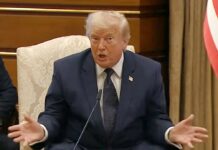






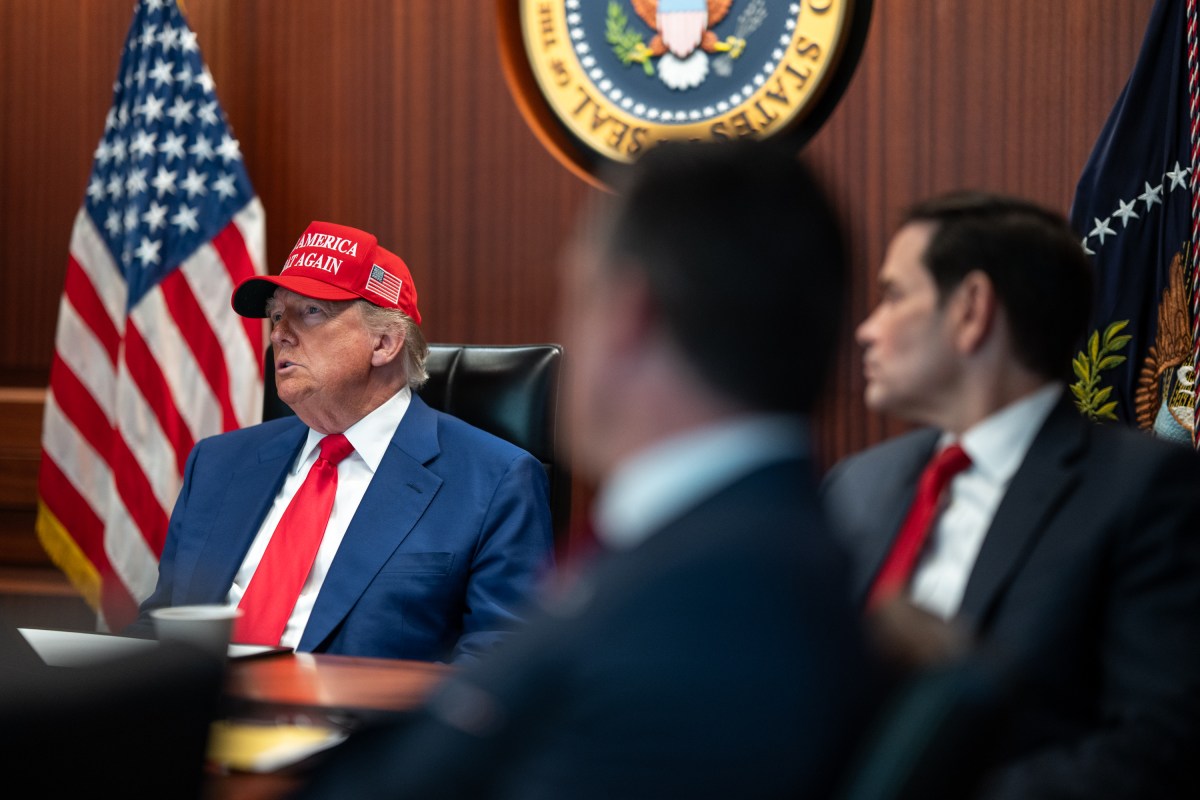
Donald Trump, Friday, February 13: “Russia wants to make a deal, and Zelensky will have to move. Otherwise, he will miss out on a great opportunity. He has to move.”
Marco Rubio, Saturday, February 14: “We don’t know if the Russians are serious about ending the war. They say they are.
Within only 24 hours, the US president and the US Secretary of State achieved something probably unprecedented in the history of diplomacy and foreign policy: they issued diametrically opposed points of view on the hottest international issue – the Russian-Ukrainian war.
The fact that Donald Trump is convinced (again) that Putin would (again) sincerely want to agree to peace was further reinforced by the fact that, in his statement, the American president (again) put pressure (only) on his Ukrainian counterpart. And it did so in a way that suggests (again) that American peace efforts would be seized (only) by Kiev, and not (only) by Moscow.
The fact that Marco Rubio is convinced that Putin is not sincere when it comes to peace is easy to decipher from the fact that he introduced the diplomatic “we don’t know”, as well as from the fact that he made this statement aware of the fact that his boss had stated the opposite the day before (and he did it on the open stage, precisely at the Munich Security Conference).
Presumably to increase his chances of winning the Republican nomination in the 2028 presidential primaries, Secretary of State Rubio sold his anti-Trumpist soul by joining Trump’s government team. Perhaps he did it at the insistence of some Republicans who wanted to make sure that there would be at least one adult in Trump’s room. Or maybe each of these two arguments counted in Rubio’s calculation.
What is certain, however, is that Marco Rubio’s performance so far signals that he is running on both courts – both promoting Trump’s agenda and sometimes putting the brakes on the excesses of a president who easily loses control of the steering wheel.
Rubio has been the firefighter on duty several times so far when arsonist Trump set fire to Ukraine’s house and more than once he appeared to be the one with the hose when arsonist Trump acted like the arsonist and more broadly, with the Europe house.
No one knows how effective this double game that Rubio is playing will ultimately prove, as it is not necessarily clear how long he will last in the position that allows him such interventions.
But one thing is certain: after a year and a bit of a Trump 2 mandate and after four years of total war unleashed by Russia, the moral, political and geopolitical chaos in the White House has only grown to proportions, and the head of the White House has only multiplied the opportunities for his Kremlin counterpart to exploit his weaknesses.
This very episode, which took place between February 13 and 14, in which the president and the secretary of state publicly exposed antagonistic perceptions about Russia, is also telling for the extent of the chaos shepherded by Trump, and for the complexity and fragility of the double game played by Rubio.
And above all this, that episode opens quite wide the window to the negotiations that, for several months, the Americans have been (only they) carrying out directly with the Russians.
The Trump-Rubio episode, of February 13-14, does not give us details of those negotiations, but allows us to see beyond the official statements of the two sides.
For the main role in those negotiations does not belong to Secretary of State Marco Rubio, but to the two lieutenants deeply impregnated by Trump’s influence, infinitely less prepared and less experienced than Rubio, in short, extremely convenient, as interlocutors, for the Russian side. We are talking about the real estate business friend of the American president, Steve Witkoff, and the son-in-law of the same president, Jared Kushner.
Therefore, regarding Putin’s state of mind regarding peace in Ukraine, Trump forms his opinion by corroborating the following elements: his own prejudices, his own lack of knowledge and preparation, respectively the prejudices, total obedience and lack of knowledge and preparation of the two businessmen today as chief negotiators – Witkoff and Kushner.
None of the three – Trump, Witkoff, Kushner – has a way or with what to detect Putin’s real mood or put into perspective the negotiating style of the Russian dictator and his emissaries, all incomparably more qualified.
At the same time, none of the three – Trump, Witkoff, Kushner – have shown (at least publicly) real interest in Ukraine’s perspective in this conflict.
At the same time, none of them really cares about the horizontal implications of a crooked peace.
And all three have shown, including publicly, to be deeply interested in a business-type peace, as they are salivating profusely at the post-war business, which they already imagine they could do with Putin’s Russia and the Russian dictator’s oligarchs (trillion-dollar deals, as President Zelensky himself recently revealed that it could be).
Secretary of State Rubio is, of course, also involved in the U.S.-Russian negotiations. However, his role does not compare to that of the more amateur Witkoff and Kushner, instead this role only gains weight when someone in Washington has to clean the floor after each round in which the nonsense done by the Witkoff-Kushner duo comes to the surface.
We have labeled as unprecedented, we can of course also add unspeakable, the fact that today the US president says that Putin wants peace and calls on Zelensky to “move” in the same direction, so that tomorrow the secretary of state will affirm the opposite.
But if we look at the Trump administration in the light of the above, we quickly come to the conclusion that it is normal and natural for things to happen this way, as in the Trump-Rubion episode of February 13-14. That it is to be expected, that it is even inevitable, that absurdity and schizophrenia will become the norm and represent the only realistic form of manifestation of the current White House.
Under the current conditions, peace negotiations for the Russian-Ukrainian conflict are shaped by a handful of “sick” American negotiators and fundamentally depend on the ability of Europeans to impose themselves as doctors and improvise a functioning “hospital” even if located on the edge of the field.
