


But a welcome outcome is also a very dangerous precedent
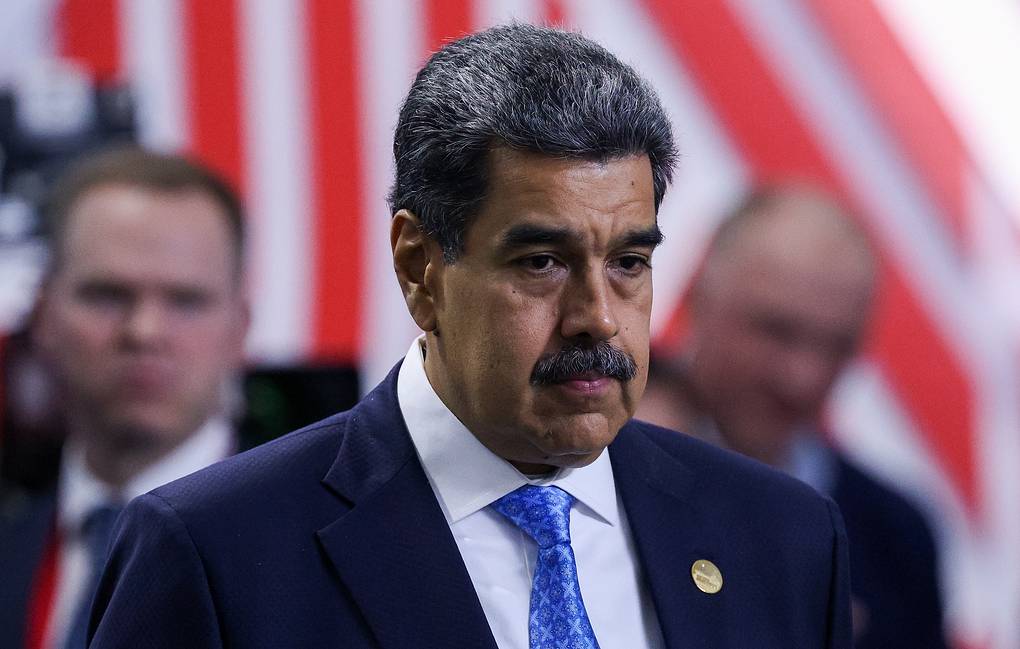
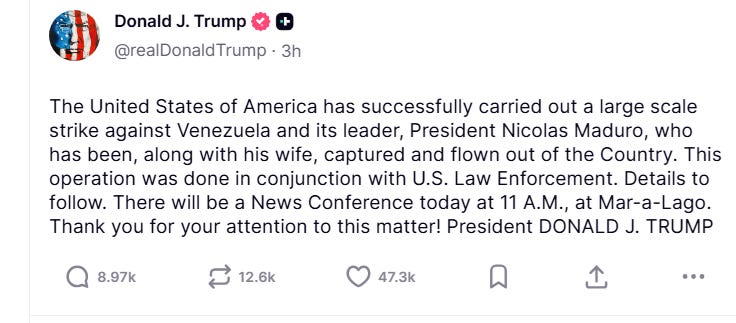
That era may have ended today with claims by Trump that the United States has seized Venezuela’s President Nicolas Maduro, along with his wife, and took them out of the country. Details are sketchy, but this appears to have been the work of Delta Force, and there were mysterious explosions in the morning around Caracas. Trumpily enough, Trump announced it on Truth Social, capitalizing “country” as proof of authenticity. A Floridian news conference will follow.
Let’s look at how we got here, where we are, and where this could go.
The Bolivarian Revolution first championed by Hugo Chávez and then carried forward by Nicolás Maduro, envisioned a 21st-century socialism rooted in anti-neoliberalism, Latin American independence from imperialism, popular and participatory democracy, and social justice guided by Simon Bolívar’s legacy, aiming for popular transformation from below and regional unity against US dominance. What actually followed? Venezuela’s independent courts, legislative checks, and free media were weakened or dismantled. The state became the exclusive domain of one party and its security apparatus that offered a template for the other fake democracies that followed (and in a way, ironically, may also inspire Trumpism in the US). Venezuela now ranks among the most corrupt countries on earth, with a Transparency International score in the bottom tier globally.
The human cost has been staggering. Once a middle-income society, Venezuela now faces widespread poverty and chronic shortages of food, medicine, and electricity, with malnutrition and weight loss widespread. Hundreds of thousands have died from preventable causes, and about eight million people fled the country, a third of the current population, constituting one of the largest displacement crises in the world.
Reliant on oil for more than 85 percent of exports, price collapses and mismanagement ravaged state finances. Hyperinflation — historically measured in the hundreds of thousands and even millions of percent — destroyed savings, wages, and basic market functioning. Even recent government figures showing modest GDP growth must be read against this backdrop of decades of contraction and dependency on informal dollarization and black markets.

Elections in Venezuela under Chavez and Maduro have been, increasingly, Putin-like shams. In 2024, opposition leader Maria Corina Machado’s movement organized independent vote tabulation showing its candidate won a decisive majority, only to have the regime and its allied electoral council refuse to recognize the result. Protests erupted nationwide; the government responded with mass arrests and repression. Legislative elections in 2025 saw the ruling party claim an improbable landslide amid opposition boycotts and contested turnout figures, reinforcing doubts about democratic legitimacy.
Machado’s 2025 Nobel Peace Prize reflects the international community’s understanding of Venezuela’s crisis: a long struggle for democratic renewal, rule of law, and peaceful transition amid authoritarian entrenchment and systemic abuse of state power. The Nobel Committee highlighted her courage in mobilizing millions under repression and her ongoing advocacy for human rights and democracy.
It’s not so clear what happens now. Does Delcy Rodriguez, the vice president, take over? Expect a power struggle and probably the military calling the shots. The cabal has a vested interest in continuing its corruption usurping, but dressing it up in nicer clothes. There could be a deal with the opposition; there could be violence and chaos.
Trump has been justifying the pressure on Maduro, which has been building since the summer, on the basis of “narco-terrorism” in the form of Venezuelan drug shipments to the US. But Venezuela is a transit country accounting for a tiny fraction of narcotics in the US — no match for Mexico or Colombia. It is more reasonable to suspect oil interests — perhaps American anger at Venezuelan oil reaching Iran. Or maybe a more direct desire to control it. Trump has been open about seeing the Americas as being in the US sphere of influence. Whatever it may be, almost no one with any sense would take Trump at his word.
Despite all this unpleasantness, if the Maduro regime were truly gone, humanity could breathe a sigh of relief. Political prisoners would be released, repression ended, and millions of exiles could begin to return. Fewer families would live in permanent anxiety, waiting for basic goods or safe passage abroad. That’s pretty clear – and it is the reason for the wishy-washy aspect of reactions coming from global leftists like Spain’s PM Pedro Sanchez. He called for international law to be respected – well, it was not – but stopped short of totally condemning the move. No one really wants to be seen as supporting the criminal regime of Maduro – except perhaps other absolute criminals, like the rulers of Iran.
What is not so clear, though, is what it would mean for the legal principles that underpin international order.
Modern international law rests on the idea that sovereign states are juridical equals and that no state may exercise coercive criminal authority over the sitting leadership of another. This doctrine is hard-won and designed to prevent the normalization of cross-border abduction and power politics. Even officials accused of grave crimes retain personal immunity from foreign criminal jurisdiction while in office. That is why international systems indict some leaders for atrocity yet refrain from seizing them by force.
Defenders of the seizure of Maduro might invoke Manuel Noriega, Panama’s military ruler (and US intelligence asset) who fell in 1989 when the United States invaded Panama after annulled elections and tensions. US forces captured him, flew him to Miami, and he was convicted on drug trafficking charges. He later served sentences in France and Panama, dying in 2017. But Noriega’s case occurred in a different legal era, during Panama’s collapse of sovereignty and before the current immunity framework was fully cemented. By contrast, Venezuela still exists as a functioning state under international law, with recognized institutions and a UN seat. Noriega is not a perfect precedent.
Many will argue that Maduro’s illegitimacy justifies extraordinary measures. There is no moral shortage of reasons: fraudulent elections, collapsed public services, and a humanitarian catastrophe. Yet legitimacy disputes do not dissolve head-of-state immunity nor authorize unilateral forcible removal. International instruments used to condemn anti-democratic breakdowns — such as regional democratic charters — explicitly bind such measures to consistency with international law. They do not license the abduction of sitting leaders.
Still, in the real world powerful states, including the United States, have grown accustomed to acting with a casual disregard for legal boundaries, both internationally and domestically. Basically, anyone could declare another illegitimate and stage kidnappings of leaders, including Americans. That would be seen as an act of war – so we come back to might makes right.
That is in fact the world order that is implicit in the Trump Administration’s new National Security Strategy, released last month. It views geopolitics as a question of interests and a function of power, with nary a thought accorded to values. It explicitly disdains the promotion of democracy and sanctifies state sovereignty.
It also claimed a sort of Monroe Doctrine-like dominion for the US over the Americas. That obviously contradicts sovereignty – but consistent is no more critical than legality for an administration blatantly upending global trade with tariffs that are illegal under US law.
That’s where we are as in 2026 – and the fun is just beginning. We may as well focus on the positive: Venezuela deserves a future in which its people enjoy dignity, opportunity, and the chance to rebuild their nation.
