












There is NO need to allow radical Islamism to fester unchallenged under the very freedoms meant to preserve open society.
Upon alighting from his plane in Scotland last weekend, Trump began tilting at windmills. He said the Europeans were ruining their beautiful countries by letting windmills exist, which we were happy to satirize. Trump went on to attack the Europeans over what he called an “invasion” of migrants: “On immigration, you better get your act together. You’re not going to have Europe any more.”
A day later he lectured Sir Keir Starmer on the both matters, and the stone-faced British PM looked like he would rather be having a colonoscopy.

As opposed to the windmill business (which Sir Keir robustly defended), the immigration matter is not entirely absurd. Of course Trump is overstating things and deploys his usual racist tones, and he is also behind the times because Europe is presently doing quite a bit to stem illegal immigration and in general to minimize the influx from the developing world. But at the risk of offending some leftist readers (as I did a few days ago while accepting some of the logic in Trump’s election integrity executive order), there is an actual concern here. And it is less a matter of demography than philosophy.
The numbers suggest takeover concerns are overblown. Muslims comprise only about 6% of the continent’s population of over 400 million, with projections reaching perhaps 8% by 2050 under zero migration (more under continuing migration, obviously, but that is coming down). Of course, certain cities tell a different story: Brussels’s Muslim population is almost a quarter. And there’s a far larger Muslim community in the wealthy countries of western Europe than in the east. But no takeover is imminent unless hundreds of millions more arrive. The far right will be elected everywhere before Europeans allow any such thing.
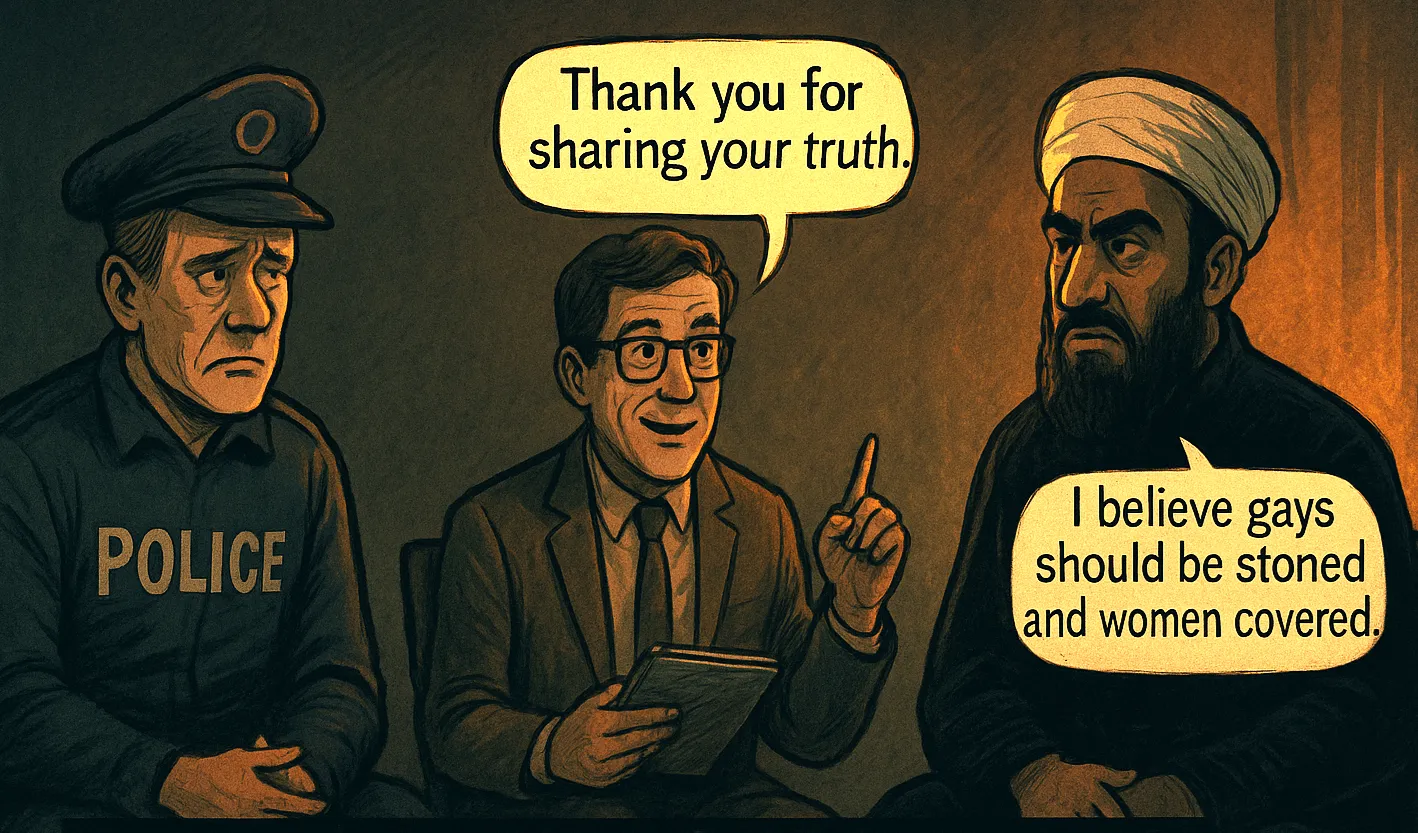
So why is the perception that Europe is in danger of losing its identity so strong? The answer lies in liberalism’s infuriating softness when confronted with the illiberal — and doubly so when “progressive” ideas begin to cloud people’s minds. This has led many people to fear that radical Islamist ideology – with its entrenched antisemitism and patriarchal, homophobic violence – is allowed to fester unchallenged under the very freedoms meant to preserve open society.
Let’s dive into this critically important issue.
Because so many Americans are confused by the word “liberal” — as in the US it has mutated into something barely recognizable that connotes the political hard left — it is important to define the term. Classical liberalism emerged in Europe from the Enlightenment as a rethinking of political authority and individual rights, grounded in the belief that human beings are rational, autonomous, and morally equal. Its philosophical roots lie with thinkers like John Locke, who in his Second Treatise of Government (1689) argued that individuals possess natural rights to “life, liberty, and property” and that governments must enjoy consent of the governed. Baron de Montesquieu advanced the idea of separating powers within government to prevent tyranny, while Adam Smith, in The Wealth of Nations (1776), articulated the principles of economic liberty, arguing that free markets and limited government interference lead to greater prosperity and social good. Together, these thinkers helped construct a worldview in which the individual, not a monarch or the collective, was at the center of political and economic life.
Classical liberalism and radical Islamism are fundamentally at odds. In contrast to Enlightenment principles of individual autonomy, secular government, and freedom of conscience, Islamism is grounded in the idea that divine authority trumps human reasoning, and that society must be governed according to a fixed interpretation of sacred texts. Many Islamic leaders reject liberal pluralism as a corrupting Western influence and call instead for a theocratic order in which shari’a law is sovereign and dissent is suppressed as heresy.
And these are not fringe voices — they have impact when allowed to spread freely. So polls find, for example, that half of British Muslims think homosexuality should be illegal and perhaps 40% want to implement at least some aspects of shari’a. Other studies show similar proportions of Muslims in various European countries believing women should obey men, opposing sex outside of marriage, and so on. Pew found that about a sixth of Muslims in France and the UK justified suicide bombings to “protect Islam.”
The good news — and it is important to note — is that the self-professed positions of Muslims on all these issues were far more illiberal in their origin countries, and they generally do feel integrated in and proud of host countries including the US. This strongly suggests that liberalism can be adopted — if host countries try. This is where the challenge lies.
In the past, and to a degree also today, European democracies once proud of their liberal traditions have been shockingly unwilling or unable to defend those very values when confronted by actors who despise them, especially when religious extremism cloaks itself in the garb of minority rights and protected speech. So liberal Europe protects those who would, given the chance, abolish those rights.
Perhaps the most famous case was that of Abu Hamza al-Masri, the former imam of London’s Finsbury Park Mosque, who was tolerated in the UK for years despite preaching violent jihad and praising terrorism. In public sermons, he described the 9/11 hijackers as “magnificent,” declared the attacks “a towering day in history,” belittled the killing of non-Muslims, defended suicide bombings as legitimate resistance, and so on. British authorities hesitated to act, citing legal protections for religious speech — but eventually, in 2012, he was extradited to the US, where he was sentenced to life in prison for terrorism-related offenses.
So, mainly, the issue at hand involves tolerating radical Islamic preachers and teachings in religious institutions, and also in the media and in politics around the continent.
Also problematic is the dismissing the critics of such tolerance as xenophobes even when they voice important truths — which, in turn, will feed the itself intolerant and often racist far right of European politics. Such critics today point to neighborhoods like Molenbeek, Belgium, as breeding grounds for extremism, noting the social isolation and proliferation of radical religious institutions. They warn of parallel societies persist with illiberal values reinforced by the very communities Europe hoped to uplift. They caution that Islamist influence (which is entirely different from the presence of Muslims) has seeped into public institutions, with local councils in places like Antwerp or Schaerbeek quietly dominated by community leaders who resist liberal norms.
Silencing pro-liberal free speech and false deeming it “hate” because of progressivism — and American wokeism — is actually the antithesis of liberalism. One result is that Jews are afraid to wear yarmulkes in public, women are pressured to cover up, and gay people face threats on the street.
Of course, the issue is not simple. Many of the obsessive critics of Muslim immigrants are plainly racists, even if Trump might claim he is the “least racist person” to ever exist. And the question of how liberals should deal with illiberalism contains a built-in paradox that is difficult to resolve: It is with annoying voices where tolerance is tested, yes — but does that extend to voices that annoyingly challenge tolerance?

There is a way to deal with religious-based illiberalism, and the best example may be in Denmark, where, 20 years ago, violent protests erupted by Muslims outraged at caricatures of the Prophet Muhammad in the Jyllands-Posten newspaper, which then spread to Muslim countries, where hundreds were killed.
Denmark has taken decisive steps to protect liberalism. Its “Aarhus model,” developed in the mid-2000s, treats radicalization not merely as a law enforcement issue but as a social pathology requiring early intervention. Police, social workers, educators, and psychologists collaborate to identify individuals at risk of ideological extremism. Even returnees from ISIS territory were de-radicalized and reintegrated by combining firmness with humanity.
Its parliament has drawn hard legal lines, banning full-face veils and outlawing forced marriage — which every single country in Europe should copy. The goal is not to stigmatize Muslims – in fact, many liberal Muslims support such measures – but to push back on radical ideologies. Liberal columnists, left-wing intellectuals, and secular Muslims all speak freely without fear.
What Denmark understands – and much of Europe still forgets – is that the defense of liberalism requires drawing firm lines against illiberal practices: against honor killings, forced modesty, and punishments for blasphemy. It requires recognizing that offense is not violence and insult is not assault.
What else must Europe do?
The continent needs to confront a sensitive truth: It cannot continue admitting illiberal individuals. Immigration is not a right, as some progressives would assert. Europe and North America should not be the only places on the planet that are obligated to let in the rest of the world. Immigration is a privilege for those who respect and share core civic values that are important to the receiving society.
So, it is justifiable to apply ideological screening to those seeking European refuge, residence or citizenship.
It’s okay to require applicants, credibly and unequivocally, to uphold the primacy of state law over any religious or tribal code, accept gender equality, respect freedom of speech – including the right to offend religion – understand that no tradition or belief justifies violence, and agree that gay rights are not negotiable.
Lie-detector tests, background checks, and extended interviews are all okay to protect liberal democracy. Those already residing legally in Europe are protected by social contract, but new entrants must meet the bar. Cultural preservation is no less vital than diversity.
Next, enforce hate speech laws consistently. Religious incitement to violence should be treated no more delicately than racial or ethnic hate speech. The fact that preachers wrap their bigotry in religious language must not absolve them of civic responsibility. Social services must work hand-in-hand with law enforcement to spot radicalization early.
Also, establish and defend the boundaries of public space. That means banning face coverings where identification matters, prosecuting “honor”-based violence without hesitation, insisting on equality for women, gays, and religious minorities, and doing so with the full force of the law. And, no less importantly, defend speech that offends religion. It is OK to offend.
Lastly, empower, celebrate and protect liberal Muslim voices – those who speak out for pluralism, civic integration, and modern values. These voices exist and deserve amplification.
The myth of an Islamizing Europe has been overstated, but the threat to Europe’s liberal soul is real. Moreover, it extends beyond the question of Muslim immigrants to include home-grown illiberalism coming from the extreme left and the extreme right. The choice is standing for liberal values or losing them in a tide of cowardice. Europeans need reassurance on a simple, basic point: It is not intolerant to reject intolerance.
