













THE WAR ON TRUTH, PART I: A handy explainer on how we’re being bamboozled.
President Trump’s “Liberation Day” global tariff tsunami, which went into effect on April 5, might be the single dumbest economic policy by a major country in memory – certainly since communism was imposed on parts of the globe. It’s stupider than the 1980s’ trickle-down economics, the last Republican flim-flammery. It reflects a complete misunderstanding of trade, of how prices and currencies work, and of basic economic cause and effect. It’s neither reciprocal, nor strategic, nor remotely beneficial to the American people.
Here’s why.
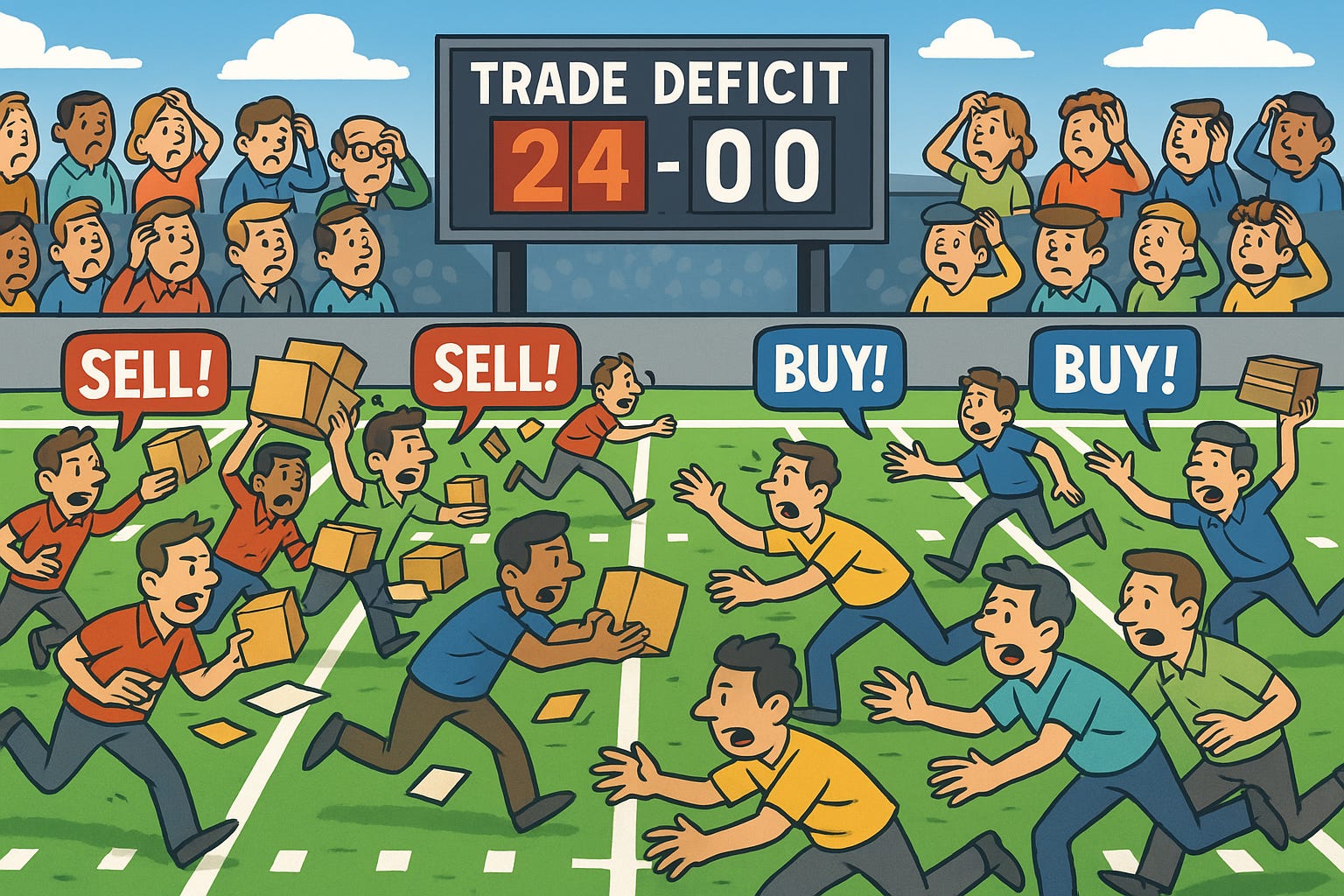
Trade deficits are not losses
Trump continues to paint trade deficits as evidence that other countries are cheating America. In his nuance-free world, if the US buys more than it sells, it’s somehow being robbed. But a trade deficit isn’t theft — it’s a sign of a strong economy with high consumer demand. Americans are buying so much from others because they are not poor.
The fundamental view of this as a zero-sum contest is flawed. Think of it this way: Most people have a massive trade deficit with Amazon — we buy things from them, and they don’t buy anything from us. That’s not unfair. It’s called commerce. The same principle applies to countries: Americans buy what they need or want from abroad, and other countries sell the stuff because, among other reasons, they value the dollars. A currency reflects, in a way, a country’s reputation and credibility (so smart countries protect these).
SUBSCRIBE TO DAN PERRY’S ASK QUESTIONS LATER
That has interesting self-correcting effects, which most people who studied at the Wharton School of Business would understand, even if that does not apply to the president. Importing more than you export can weaken your currency by increasing its supply; essentially, the US sells dollars for the currency – say, euros – with which to buy Audis. That increased supply of dollars (barring moves by the Fed to shore up the currency, or other factors) can suppress its exchange rate. A weaker currency in turn makes exports cheaper and imports more expensive — encouraging a pendulum effect that can narrow the deficit.
Either way, a trade deficit usually means the world wants to invest in you. Here’s why:
Foreign countries sell the US goods and then use the dollars gain to buy dollar-denominated American assets — everything from stocks and real estate to Treasury bonds. This dynamic keeps interest rates lower than they would otherwise be, which is good for consumers.

So yes, if you’re running a stall in the market, you want to sell as much as possible and that’s all you care about, sure. But if you’re running the world’s premier economy, the engine of global growth and prosperity, you had better see the bigger picture, lest you run it into the ground and citizens everywhere lose out.
Tariffs are taxes — on you
Here’s the most basic truth that Trump refuses to accept (or at least pretends convincingly not to understand): tariffs are taxes on a country’s consumers. They are not paid by foreign governments. They’re paid by US companies that import goods — and passed along in the form of higher prices.
A 10% tariff across the board — which is what took effect on April 5 — means everything from food to clothing to electronics will cost more. That will get worse on Wednesday, when additional tariffs (from 11% to 50%) go into effect. This isn’t theoretical. It happened during Trump’s first term, when Trump imposed tariffs on China. Prices rose, and companies restructured their supply chains not to bring jobs back, but to dodge the tariffs. America ended up importing from other countries instead of China, and Americans still paid more.
And yet, White House Press Secretary Katherine Leavitt recently claimed tariffs are “a tax cut” for the American people. That’s not just wrong — it’s economically illiterate. It’s downright comical (if you don’t believe it, watch below). Tariffs are the opposite of a tax cut. They are a tax increase, and they disproportionately hit lower- and middle-income families who spend a greater share of their income on goods.
It’s not reciprocal — it’s punitive
Trump claims this tariff is “reciprocal” — as if he’s just matching what other countries do. But that’s not the case. The formula the administration presented makes the tariffs a function of the trade deficit, not the other country’s tariffs, and it starts at 10% on everything. A blanket tariff on all imports, regardless of where they come from or what they are, is punitive and blunt-force economics.
It would apply even to goods that the US doesn’t produce in any meaningful quantity — bananas, affordable clothing, and consumer electronics. Do Americans want to grow their own pineapples or manufacture TV sets, tripling their cost for the consumer? No. Nor is it efficient to do so. Tariffs on these products serve no strategic interest — they just make life more expensive.
There’s a difference between targeted tariffs to support key industries — perhaps agriculture, for food security — and across-the-board tariffs. One is strategic. The other is a tantrum.
When a child throws a tantrum, you might end up with some toys broken or spaghetti on the floor. When a clueless US president does it, the mess is messier still: Trump’s announcement battered global stock markets, wiping out $5 trillion in stock market value for S&P 500 companies by Friday’s close, a record two-day decline and hammered oil and commodities prices. Anyone with a retirement plan had better just go watch baseball for a while.
The trade deficit did grow — but the solution makes no sense
It’s true that the US goods trade deficit has grown significantly. In fact, over the past five years, it increased by roughly 40%. That’s a big number. But it doesn’t mean what Trump thinks it means.
Much of that increase came from a strong post-pandemic rebound in consumer spending. When Americans are buying more, imports go up — and that’s what we saw. It’s not evidence that other countries are taking advantage of anyone. It’s evidence that Americans have money and confidence, and that the dollar, the world’s reserve currency, is attractive.
The United States has been down this road before, and the results were devastating. The Smoot-Hawley Tariff Act of 1930 raised tariffs on thousands of imports. More than a thousand economists begged President Hoover not to sign it. He ignored them. The outcome was swift and brutal: other countries retaliated, global trade collapsed, and the Great Depression deepened. What began as a protectionist fantasy turned into a global economic nightmare.
Trump’s reckless move springs from the same flawed logic: that you can isolate yourself from the global economy without consequence. You can’t.
What’s most astonishing is that this policy upends the very economic framework that made America rich. The liberal trade order created after World War II — grounded in open markets, global supply chains, and comparative advantage — enabled the single greatest accumulation of wealth in human history. Since the Great Depression, nothing has generated prosperity like this rules-based, interconnected economic model.
Trump is trying to blow it up — not reform it, not update it, but dismantle it entirely. In doing so, he threatens not just consumer prices and trade balances, but the foundation of global prosperity.
So, naturally, there is near-unanimous agreement among economists that blanket tariffs hurt more than they help. Left, right, center — doesn’t matter. The old Republican Party certainly understood this very well – even George W. Bush, an intellectual titan compared to Trump, who argues strongly against tariffs (see the below video). The current mutation of the party will just go with Trump, for fear of the MAGA cult.
So why is Trump doing it? Because it sounds good to people who don’t understand economics, who are not exactly rare. It’s emotionally satisfying. It plays well in campaign rallies. It feeds into the grievance narrative — that we’re being exploited, and Trump is the one man who will hit back. It’s grievance theater with real-world consequences.
The economic argument for the tariffs is so spectacularly wrong, that some believe that the goal is not economic. Under this theory, Trump actually does understand what’s going on, and his goal is to centralize executive power and gain leverage on other issues, essentially by driving everyone mad; he understands the economic consequences but doesn’t care, because a) he’s a billionaire and b) he assumes his supporters are imbeciles. I don’t discount this theory — but it’s an explanation, not a justification. Not even close.
The only way to stop this madness is for voters to reject it categorically. Every poll should reflect the public outrage. Conservative media that know better – like Fox News – need to stop pretending. Republicans, if they still care about conservative economics, need to stop enabling a man who is inflicting massive, unnecessary harm on the US and global economy.
If Trump is not made to back off, the Republicans must simply be crushed in the midterms. Until then, I advise battening the hatches and ignoring the stock market. After that, if American citizens don’t rebel, they’ll own the result: An economy kneecapped by ignorance and idiocy.
