













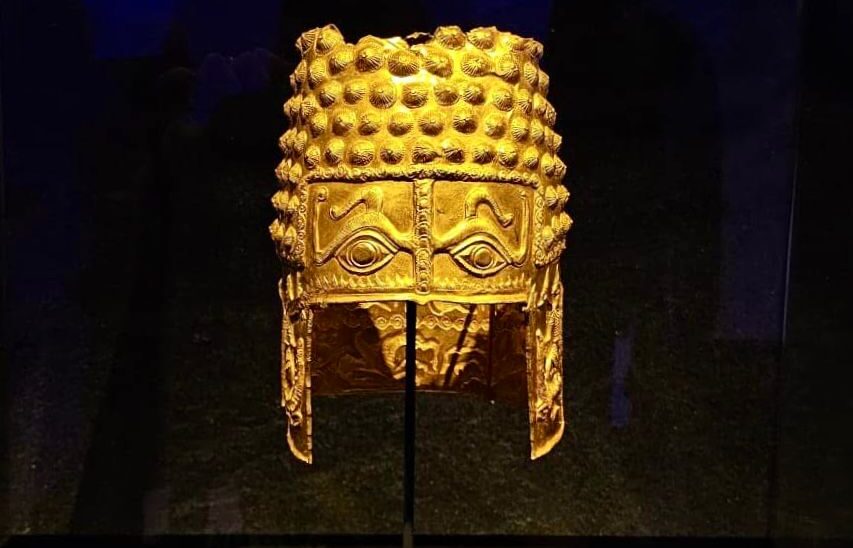
An ancient helmet stolen from a museum in the Netherlands has devastated Romanians and is causing embarrassment for the museum over loopholes in its security.
It sent shock waves across the art world about the safety of valuable works that are publicly displayed.
The intricate golden Cotofenesti helmet is 2,500 years old and is one Romania’s prized national treasures from the Dacia civilization that predated modern day Romanians.
For six months, it had stood proudly on display at the Drents Museum in eastern Netherlands, a loan from Romania’s National History Museum. Last weekend, with the aid of explosives, thieves blasted their way into the museum which houses the world’s oldest boat and an early Vincent van Gogh painting and snatched it along with three gold spiral bracelets which were part of the exhibition. Police currently have few leads.
Romanian Justice Minister Radu Marinescu on Monday called the incident a “crime against our state” and said recovering the artifacts “is an absolute priority.”
Romania’s Brukenthal Museum in Sibiu closed its doors for four days to raise awareness about cultural heritage following the heist.
It was a heist that “even in our most pessimistic dreams, we would not have believed possible,” said the director of Romania’s National History Museum, Ernest Oberlander-Tarnoveanu.
Romanian President Klaus Iohannis said the artifacts have “exceptional cultural and historical importance” for Romanian heritage and identity, and that their disappearance had “a strong emotional and symbolic impact on society.”
Foreign Minister Emil Hurezeanu spoke of the “profound emotional impact this incident generates in Romania.”
“This is a dark day,” said Harry Tupan, general director of the Drents Museum, in a statement. “We are intensely shocked by the events last night at the museum. In its 170-year existence, there has never been such a major incident. It also gives us enormous sadness towards our colleagues in Romania.” The Drent Museum remains closed.
The helmet’s distinctive fame and studded appearance means it would be hard to sell, raising fears the thieves were after the gold itself.
The value of the gold would be a fraction of its cultural and historical value. Gold is valued about 85,000 euros per kilo and the helmet weighs just under that.
The helmet,crafted in around 450 BCE, was unearthed by children in the 1920s after a heavy rain washed away part of a hillside in Prahova county. After playing with it, the children took it home, where the family used it as a water bowl for farm animals, according to the Drents Museum.
A merchant in the region bought the helmet from the family in 1929 and later donated it to the National Museum of Antiquities. It arrived at the National History Museum of Romania in the 1970s.
It’s not the first theft of Romanian national treasure from the Netherlands. In 2012, Romanian-owned seven paintings worth £100million by Picasso & Monet, were stolen from the Kunsthal Rotterdam.
‘Fast and Furious’ Romanian gang suspected of high speed heists in Spain and Europe busted
