











An architect dreams of eternity but tragedy strikes, his libertine son betrays him and the fashion moves on. His house becomes a mausoleum for memory, ambition, and unbearable loss.
He begins in soot and scaffolding, the son of a bricklayer in a city rebuilding itself from fire and plague. As a boy he draws domes in the dirt, copies cornices from crumbling buildings and teaches himself by candlelight. He manages to charm a patron, win a scholarship, and enter the academy.
The young architect rises with astonishing speed: He wins prizes, sketches ruins under the Roman sun, and becomes obsessed with how empires collapse. He returns to build monuments not to power but to memory. He develops a love for what might be termed minimalist classicism.

He marries Eliza, daughter of a wealthy brewer. She is generous, deeply intelligent, and his fiercest believer. They begin a family — but two infant sons die in quick succession. Grief etches itself into their marriage. Eliza carries the pain quietly. He buries it in work. A third son soon dies as well. But with the fourth, George, for a while, there is hope — family outings, dreams of a future in which he carries the name forward.
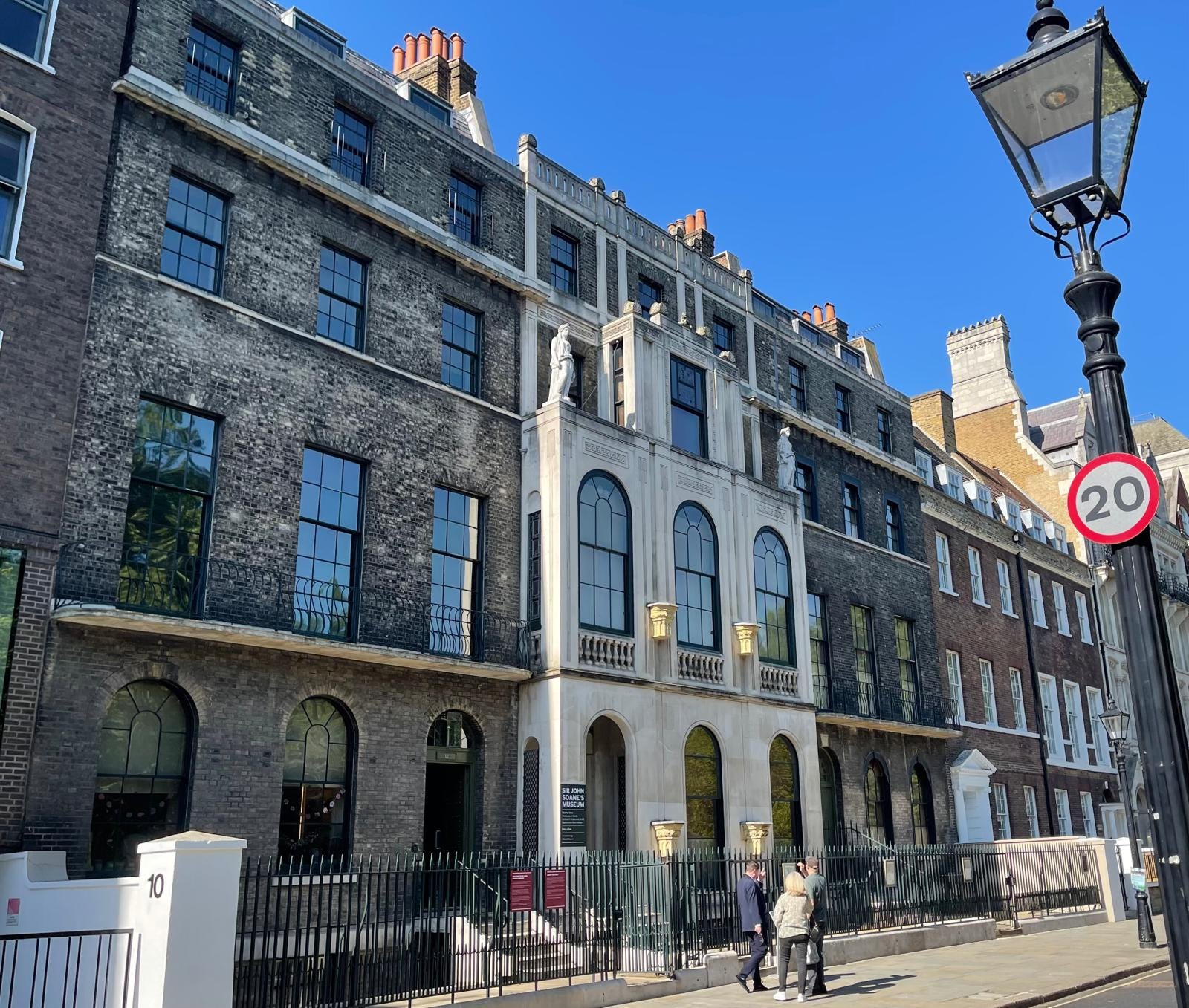
The middle-aged architect, now a man of reputation, wins major commissions that reimagine public architecture as both theatrical and serene. At home, he pours his heart into a more intimate masterpiece: a large, five story townhouse in the center of the city, near a famous park. And over the years, he amasses one of the most astonishing collections in private hands — a trove of priceless relics gathered from auctions, dealers, and travels abroad.

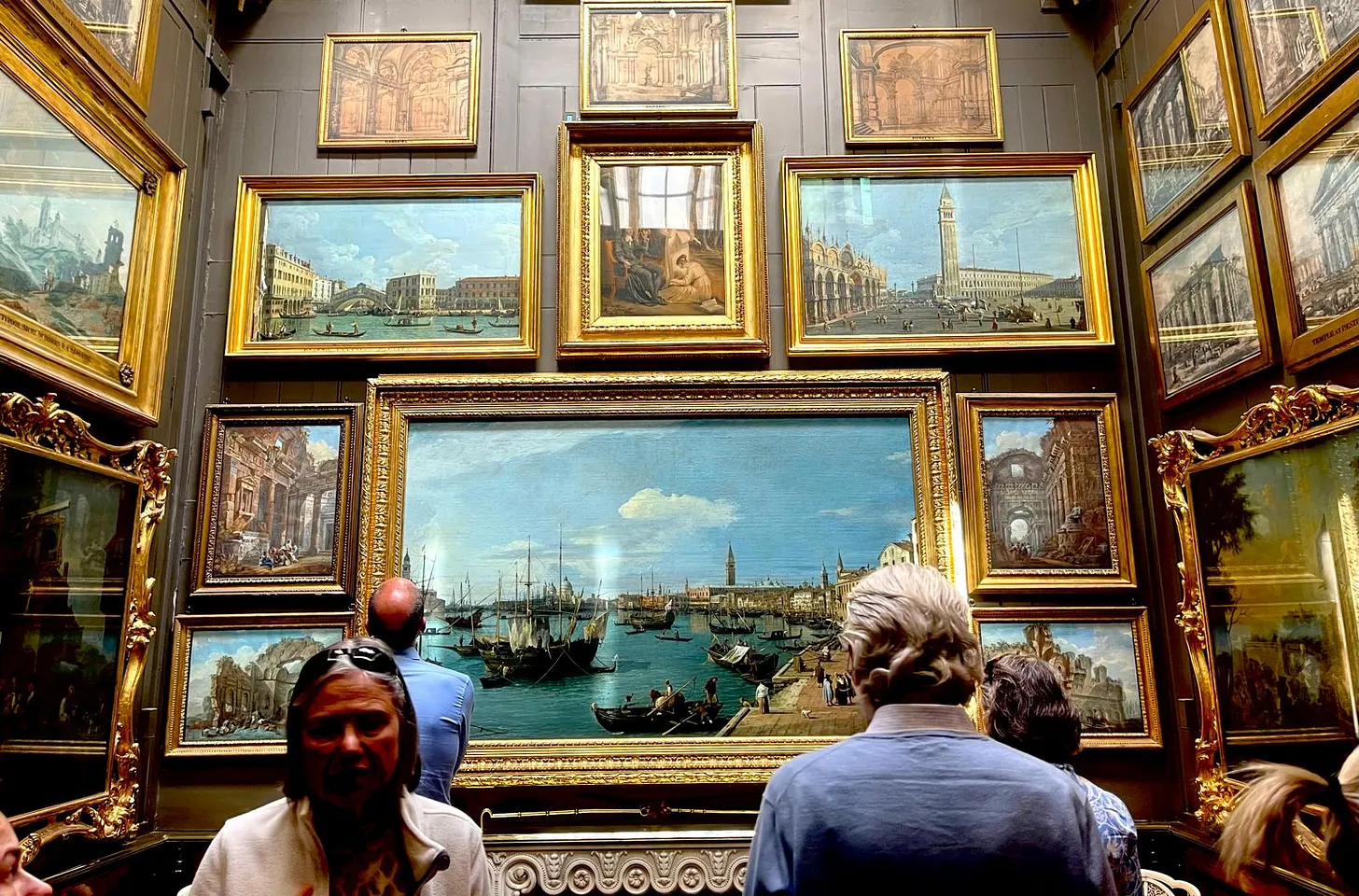
Roman mosaics, Greek vases, Gothic fragments, Renaissance paintings, and Egyptian antiquities filled every corner, none more spectacular than a 3,000-year-old alabaster sarcophagus hauled from the Valley of the Kings (below). Was it somehow looted? At the time it is not a big concern.

Each piece is embedded into the architecture itself — hidden doors, layered walls, carefully lit alcoves. Each room becomes a monument to an idea, or a memory, or a person he cannot bear to lose.

But as the aging architect’s public legacy expands, his private world begins to fall apart. George grows distant and becomes a source of tension. Charming, undisciplined, and increasingly bitter toward his father’s fame, George gambles, drinks, and accumulates debts. Worst perhaps of all: rather than seeking to join and emulate his father he seeks to be a writer, among the lowest of the low; he produces a play called The Innkeepers’ Daughter (one of several thusly named), Almost as bad, he frequents brothels, lives well beyond his means, and shows no sign of maturing. His father pays, pleads, scolds — in vain. Eventually the architect refuses to pay his son’s bill, and George ends up in a debtor’s prison.
After George is released there comes the final fracture.
An anonymous article appears in a leading newspaper of the day, mocking the old architect’s designs — calling them ponderous, lifeless, and irrelevant. The tone is cutting, and worse, informed. The architect storms the paper’s offices and demands to know the author. Rebuffed, he asks at least to see the manuscript. The handwriting is unmistakable. The vicious attack was written, and written rather well, by none other than his son George.
He returns home and tells Eliza. Already ill with gallstones, in constant pain, she is devastated. Such vulgar betrayal, by a son she had defended all her life, proves too much. Her decline is swift and she dies within weeks. The house changes after that. The silence grows heavier. The widower writes a beautiful epitaph to his wife, recalling their meeting “in that happier hour, when smiling youth upon the lap of life sprinkles her gayest flow’rs.”

He also writes George out of his will. That type of mistake, for George, proves tough to bounce back from.
The architect dies alone, surrounded by the ghosts he built into the walls. Their is no heir — no one to inherit a fortune whose value, with the artworks and artifacts included, is worth close to a billion dollars today.

And as for the house — it magically remains, preserved exactly as it was, for hundreds of years, as a monument to a lifelong stab at permanence. Through its narrow corridors one finds relics from ancient empires, classical art, even a pharaonic tomb, a meticulously arranged testimony to one man’s mighty effort, hopeless but riotously exuberant, to outlast time itself.
And the thing is this: The story is absolutely real. How a movie has not been made about Sir John Soane iis beyond my understanding. One day it will happen.
Trained at the UK’s Royal Academy and refined during his Grand Tour.
In Italy, Soane returned to London in the 1780s with a mind full of ruins and light. His early commissions — mostly country houses and minor urban projects —showed a refined, almost spare interpretation of neoclassicism. He stripped away ornament and used architecture to make a statement — somewhat nostalgically conservative, perhaps vainglorious, but impactful for a time.
His big break came in 1788, when he was appointed Architect and Surveyor to the Bank of England. Over the next 45 years, he transformed it into his masterwork: a vast, enclosed world of domed halls, curving corridors, and hidden courts — a building without windows in its outer walls, relying entirely on internal light. The Bank was Soane at his most radical: anti-monumental yet monumental, intimate yet public. It embodied his belief that architecture should shape how we feel, not just how we function.
He also designed: the Dulwich Picture Gallery (1811–17), the world’s first purpose-built public art gallery, where his innovation in lighting and circulation remains influential today; Royal Hospital Chelsea improvements and various state projects; a long list of country houses, many now lost or altered beyond recognition; and his personal obsession: No. 13 Lincoln’s Inn Fields, where he lived and worked, and which he transformed into a private museum and architectural laboratory.

But Soane’s architecture did not endure. The Bank of England was almost entirely demolished between 1925 and 1939. The new architect, Herbert Baker, found Soane’s idiosyncratic interiors impractical for modern banking. They were also deeply unfashionable — too intellectual, too reserved. The Gothic Revival and later the Victorian thirst for grandeur had no room for Soane’s minimalist classicism. Out went the domes, courtyards, and poetic light wells. In came stone bulk and symmetry.
His country houses, likewise, fell out of favor or were heavily altered. Many were demolished in the 20th century, victims of high upkeep costs, shifting tastes, and war-era austerity. Some were destroyed or altered during the Blitz of London in World War II.
So just as 200 years ago some in London complained that the city had been Soanified – so it has almost been totally de-Soanified since then. Soane had no formal school and left no disciples to carry the torch. He was a one-man movement — brilliant, but solitary. Only Dulwich Picture Gallery and his own house survive more or less intact. Given the wealth he amassed, it is odd.
In his final years, bitter from personal loss and professional decline, he successfully lobbied Parliament to protect his home as a museum. So the house — his reliquary — is preserved exactly as he left it. Nothing may ever be moved. He also insisted the public be allowed forever to visit it for free

And so this weekend that I did, dragged there by my wife who is a devoted patron of the arts, especially when free. It is truly one of the most amazing houses one can see, and the attendants who sit at the ready in every one of the countless rooms are extraordinarily eager to tell the story. They are aware of its power. There is a melancholy about the place.
“What fashion did not destroy, the Luftwaffe finished off,” said one. Quite a fine line! I imagine he’s used it before, but in his very British way he made it memorable nonetheless: Ironic but never bitter, a shade bemused perhaps, but reverential in a way.