














I was honored to take part in the interview series dedicated to the Romanian Academy, featured in the anniversary edition of Ambassador for Romania magazine, alongside distinguished figures from academia, diplomacy, science, and culture. The edition explores human values and knowledge from multiple perspectives, united by the same commitment to scientific ideas and cultural achievement.
The edition features reflections from distinguished figures including Acad. Prof. Marius Andruh, Acad. Prof. Ioan-Aurel Pop, Dr. Eng. Dumitru Prunariu, Acad. Prof. Klaus Mainzer, Acad. Prof. Leon Dănilă, PhD, and Prof. Livia Teodorescu-Ciocănea, PhD. This intellectual setting is further enriched by voices from diplomacy and culture, such as George Bologan, Giles Portman, and Victoria Milescu.
The anniversary edition is an elegant tribute to knowledge, honoring the Romanian Academy’s achievements and its essential role in upholding cultural values and strengthening national identity.
Within Romania’s state architecture, the National Bank of Romania shares objectives with the Romanian Academy in education and research, promoting values that cultivate and enrich the nation’s intellectual heritage. Founded only 14 years apart, both institutions emerged during a period of profound transformation, as Romania advanced toward modernity.
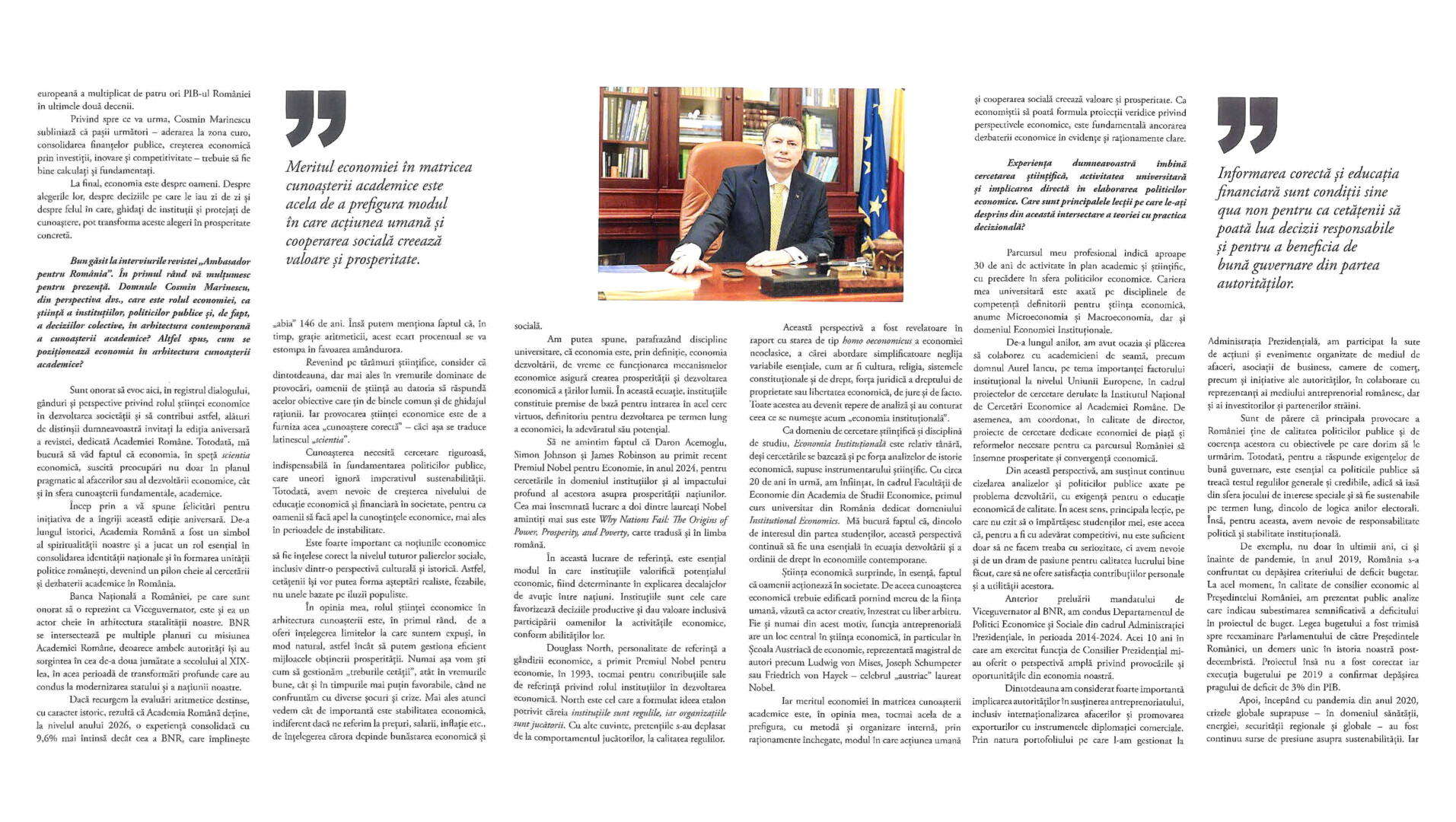
In the interview “Economic Science and Public Policy in the Sustainability Equation”, published in the special edition of Ambassador for Romania, I emphasized the need to improve analyses and public policies on development, supported by high-quality economic education. This is essential for responsible decision-making at both individual and policy levels.
Economics matters not only in business, institutions, and development, but also as a field of fundamental scientific knowledge that offers principled guidance, especially in difficult times. A key lesson is the importance of rigorous analysis in shaping public policy and steering choices beyond the appeal of easy solutions. Only a deep understanding of our vulnerabilities and opportunities can guide coherent public policies in the years ahead.
Sustainable development cannot be separated from the quality of institutions – as rules for economic life and political governance, rules of predictability and accountability in the sphere of public policies. They strengthen confidence in the economy, improve competitiveness, stimulate investment and long-term economic growth.
Below, the text of the interview published in the “Ambassador for Romania” Magazine, anniversary edition no. 12/2026 – production and editorial coordination Cristiana P. Bota:
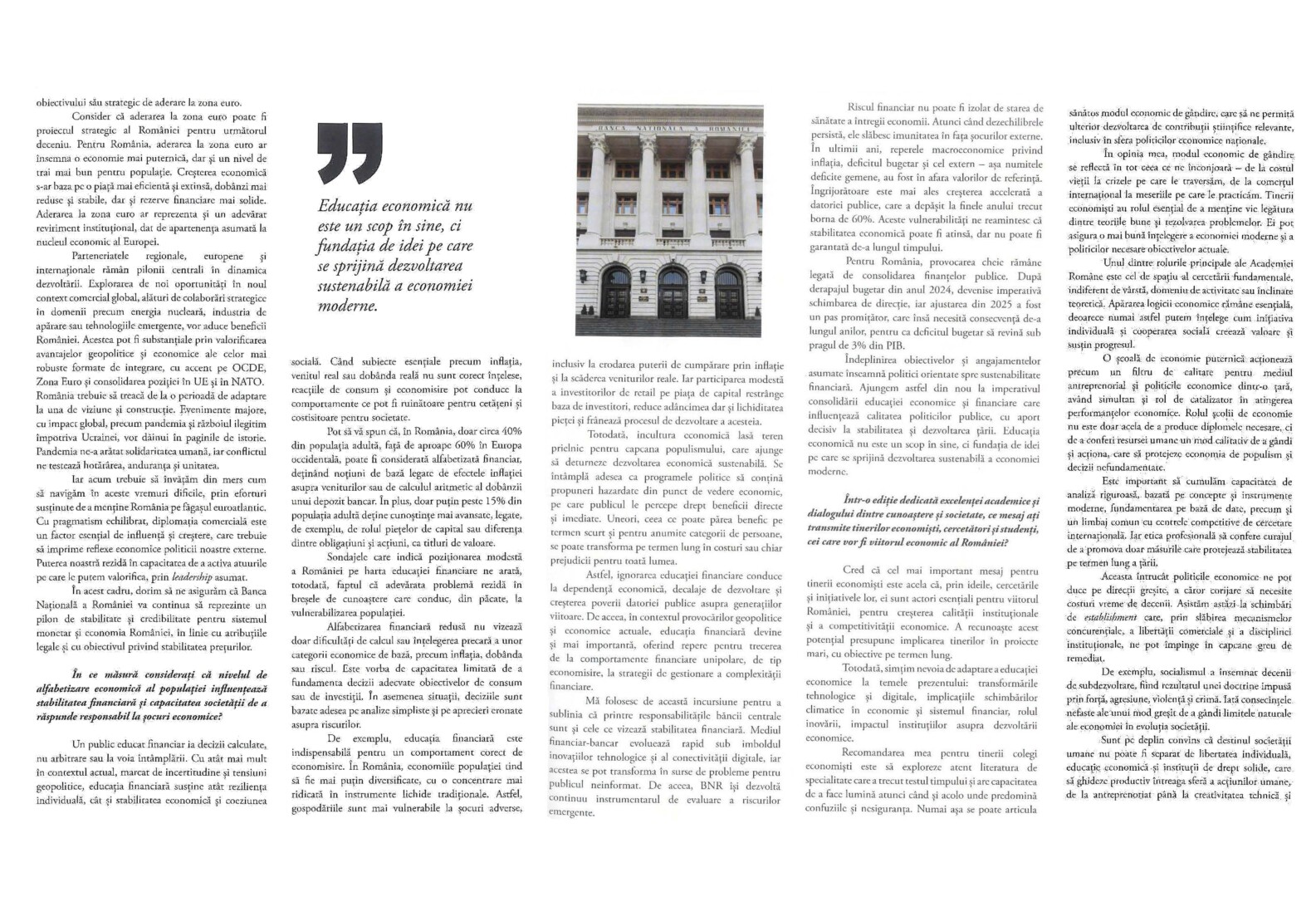
‘1. Welcome to “Ambassador for Romania” and first of all, thank you for agreeing to be interviewed, Mr. Cosmin Marinescu. From your perspective, what is the role of economics, as a science of institutions, public policies and, in fact, of collective decisions, in the contemporary architecture of academic knowledge? In other words, how is economics positioned in the architecture of academic knowledge?
I am honored to evoke here, in the register of dialogue, thoughts and perspectives on the role of economics in the development of society and to contribute, together with your distinguished guests, to the anniversary edition of the magazine, dedicated to the Romanian Academy. At the same time, I am glad to see that economics, in this case economic science, raises concerns not only in the pragmatic level of business or economic development, but also in the sphere of fundamental, academic knowledge.
I start by congratulating you for the initiative to take care of this anniversary edition. Throughout history, the Romanian Academy has been a symbol of our spirituality and has played an essential role in strengthening national identity and forming Romanian political unity, becoming a key pillar of academic research and debate in Romania.
The National Bank of Romania, which I am honored to represent as Deputy Governor, is also a key player in the architecture of our statehood. The NBR intersects on multiple levels with the mission of the Romanian Academy, because both authorities have their origin in the second half of the nineteenth century, in that period of profound transformations that led to the modernization of our state and nation.
If we resort to relaxed arithmetic assessments, of a historical nature, it follows that the Romanian Academy has, at the level of 2026, a consolidated experience that is 9.6% more extensive than that of the NBR, which is “only” 146 years old. But we can mention that, over time, thanks to arithmetic, this percentage difference will fade in favor of both.
Returning to the scientific sphere, I believe that scientists must always—and especially in challenging times—serve the common good and follow the guidance of reason. For economics, this means providing “correct knowledge,” which is the meaning of the Latin term scientia.
Knowledge depends on rigorous research, which is essential for grounding public policies that may otherwise overlook sustainability. At the same time, society must strengthen economic and financial education so people can rely on sound economic understanding, especially during periods of instability.
It is essential for economic concepts to be properly understood across all levels of society, including from cultural and historical perspectives. This enables citizens to form realistic, achievable expectations rather than expectations shaped by populist illusions.
In my view, economics contributes to the architecture of knowledge primarily by helping us understand the natural limits we face, so we can better manage the means of achieving prosperity. This understanding enables us to govern the “affairs of the fortress” in both favorable and difficult times, especially when shocks and crises arise. In such moments, the importance of economic stability—whether in prices, wages, inflation, or related areas—becomes especially clear, as economic and social well-being depends on understanding these realities.
Economics as development. Paraphrasing university disciplines, economics can be understood as the study of development: well-functioning economic mechanisms create prosperity and support countries’ long-term growth. In this process, institutions provide the essential foundation for entering a virtuous circle of development and enabling the economy to reach its full potential.
Daron Acemoglu, Simon Johnson, and James Robinson were awarded the 2024 Nobel Prize in Economics for their research on institutions and their deep influence on national prosperity. One of the most important works by two of these laureates is Why Nations Fail: The Origins of Power, Prosperity, and Poverty, which has also been translated into Romanian.
In this landmark work, the central question is how institutions unlock economic potential and explain disparities in wealth between nations. Institutions encourage productive decisions and give inclusive value to people’s participation in economic activity, according to their abilities.
Douglass North, a major figure in economic thought, received the 1993 Nobel Prize in Economics for his seminal work on the role of institutions in economic development. He famously argued that institutions are the rules, and organizations are the players, shifting attention from the behavior of actors to the quality of the rules that shape their actions.
This perspective was revealing in relation to the homo oeconomicus state of neoclassical economics, whose simplifying approach neglected essential variables, such as culture, religion, constitutional and legal systems, the legal force of the right to property or economic freedom, de jure and de facto. All these became benchmarks of analysis and shaped what is now called “institutional economics”.
As both a field of scientific research and an academic discipline, Institutional Economics is relatively young, though it draws on rigorous analyses of economic history. About 20 years ago, within the Faculty of Economics at the Academy of Economic Studies, we established Romania’s first university course dedicated to Institutional Economics. I am pleased that, beyond students’ interest, this perspective remains essential to understanding development and the rule of law in contemporary economies.
Economics fundamentally examines how people act within society. For this reason, economic knowledge must begin with the human being, understood as a creative actor endowed with free will. This also explains why entrepreneurship holds a central place in economic science, particularly in the Austrian School of Economics, represented by authors such as Ludwig von Mises, Joseph Schumpeter, and Friedrich von Hayek, the renowned “Austrian” Nobel laureate.
In my view, economics earns its place in academic knowledge by systematically explaining how human action and social cooperation generate value and prosperity. To make reliable projections about the economic outlook, economists must ground public debate in clear evidence and sound reasoning.
The rest of the interview can be found here:
