







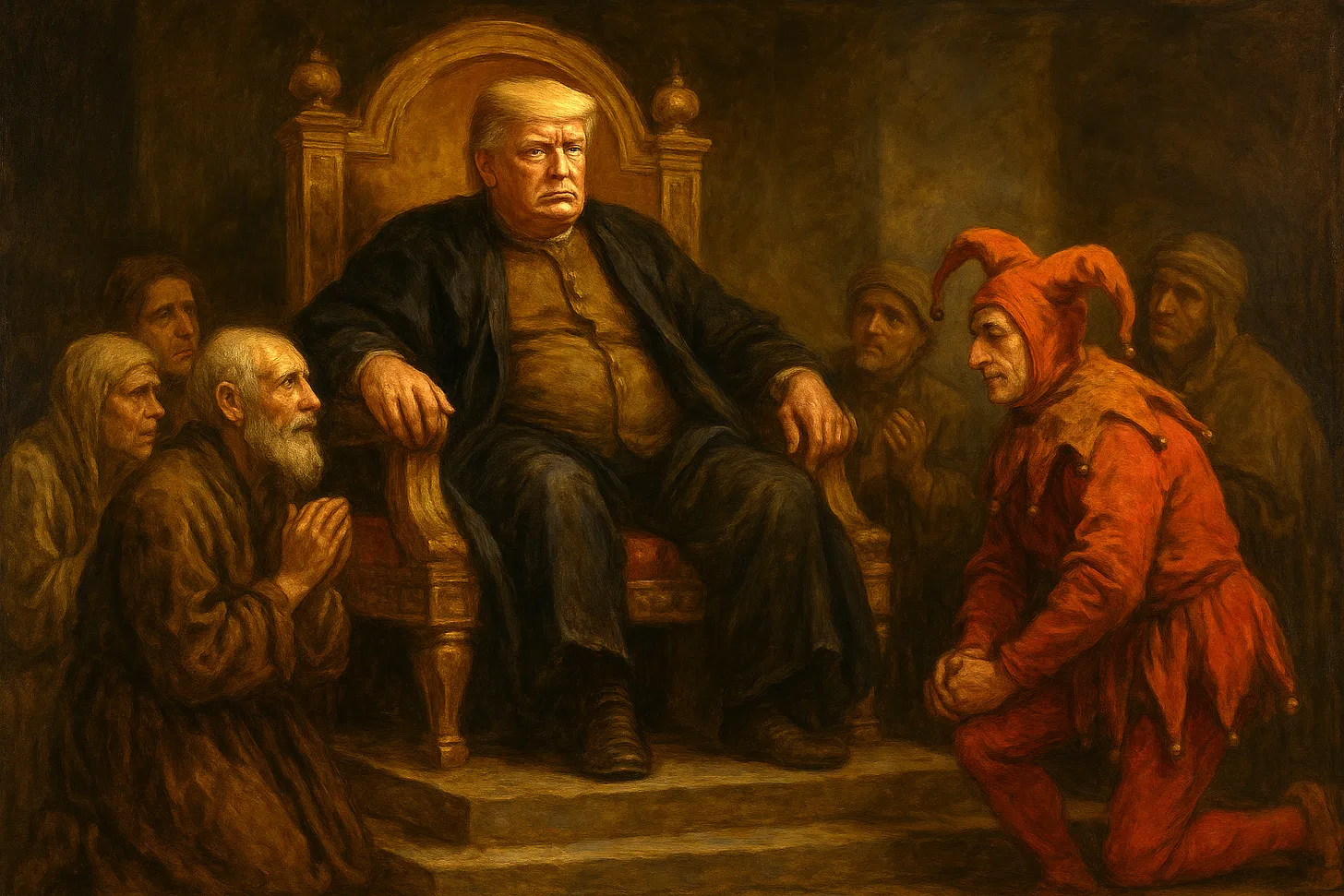
But the unhinged, un-American US Supreme Court gave us one anyway
One year ago this week the US Supreme Court handed down a decision so alien in spirit and corrosive in its implications that it can fairly be termed regime change. In Trump v. United States, the Court ruled that presidents enjoy absolute immunity from criminal prosecution for all “core official acts” and presumptive immunity for any other official conduct while in office.
It was a gift to Donald Trump, of course — delivered just in time to complicate or derail the criminal cases pending against him. But it was also a blueprint for authoritarianism in a country that was expressly created to prevent it. Words can hardly express the outrage and irony of it.
The United States has never seen anything like this – not even when Richard Nixon mused that “when the president does it, that means it’s not illegal.” The Court’s ruling does not merely protect the presidency — it elevates it well beyond what the Constitution and the early traditions of the Republic ever intended. What the Founders envisioned as a powerful but accountable executive has been reimagined as a sovereign immune from consequence.
I’m no fan of the idea that the Founders and Framers and so on were gods incapable of wrong – it is infantile, and itself un-American. Indeed, they were deeply flawed and (obviously) not representative and the system they set up has a built-in time bomb because entrenched nonsense is almost impossible to amend given the high bar and demographic distribution of the population. But one thing they got absolutely right was the need to limit executive power.
Having overthrown a king, they crafted a Constitution rejecting royal privilege with equality under the law. The president would be strong but constrained: No divine right or assumption of virtue, and definitely no immunity. As Alexander Hamilton wrote in Federalist 69, the president “would be liable to be impeached, tried, and upon conviction…removed from office; and would afterwards be liable to prosecution and punishment in the ordinary course of law.”
Indeed, one argument for a single executive rather than a ruling council was to concentrate responsibility so it could not be deflected. That’s what accountability meant — until last July 1. The majority opinion, written by Chief Justice John Roberts, argued that as a practical necessity a president must be free to take “bold and unhesitating action” without fear of exposure.
In practice, presidents had often acted boldly — and occasionally illegally — without such blanket immunity. Not even Nixon dared to claim the immunity the Court invented. Not Reagan during the Iran-Contra scandal. Not George W. Bush amid accusations of torture and illegal surveillance. The decision was a judicial power grab for the presidency cloaked in pretense of prudence.
And it was political, of course, tailored to the needs of Trump, whose good fortune and indifference to bipartisanship had resulted, during his first term in office, in the conservative court supermajority. That’s evident in the timing: By waiting until July 1, 2024 — the final day of the term — the Court effectively guaranteed that Trump would not face trial for his federal indictments before the 2024 election. The delay bought time.
This is, actually, how monarchies work. And in monarchies, as opposed to democracies, the courts serve the ruling class and not the people. That’s the regime upheaval being led by Trump, having harnessed and amplified the sentiments that bubbled to the surface after the election of Barack Obama under the aegis of the so-called “Tea Party.” That brand was historically absurd, given that the movement championed corporate interests, vilified government regulation enacted by elected representatives, and aligned itself with billionaire donors — in stark contrast to the original Boston Tea Partiers, who destroyed the property of a massive state-backed corporation to resist taxation without representation by a foreign empire.
Nonetheless, it reflected a genuine anti-democratic instinct in part of the US public. Trump understood this, because while he may be corrupt and ignorant, but he has undeniable political brilliance. So in the year since the ruling, given his victory in November, we have been saddled with a president who knows he is untouchable, acting accordingly. He thinks he is Napoleon.
Trump has redirected federal funds without authorization, refused to disburse legally mandated education budgets, and openly threatened to arrest elected officials who don’t comply with his immigration demands. He has stood before barbed-wire detention camps and joked about jailing political opponents. He has floated mass deportation plans that extend even to US citizens. He speaks of retribution as policy. He laughs about incarceration. He licenses fragrances and colognes – profiteering from the president in the most vulgar way imaginable – while slashing Voice of America and replacing state-funded public diplomacy with private propaganda machines.
This is the swagger of someone who believes — with good reason — that limits no longer apply. I have spent considerable time as a foreign correspondent in countries ruled by authoritarian regimes who were not accountable or transparent. This is how they behave – and so it is no mystery why Trump likes Vladimir Putin. Such regimes, by the way, are eventually overthrown because most people come to despise them. And they do not tend to be prosperous or placid.
Legal scholars have sounded the alarm, of course. A panel at NYU Law warned that the ruling all but invites presidents to use the instruments of the state to commit crimes. Georgetown Law professor Mary McCord, a former DOJ official, noted that a president could plausibly cite the ruling to justify a military strike on a political opponent. Justice Sonia Sotomayor’s dissent made the point starkly: under this ruling, a president could order the assassination of a rival and be immune from prosecution if it was deemed within his official authority.
This hardly matters, because when winning is the only measure of justice (the Trumpian zeitgeist) a legal scholar has the exact same vote as a MAGA radical who trashed the Capitol and then received (incredibly) a presidential pardon.
The danger does not end with Trump. Once a precedent like this is established, it risks being invoked by every president to come — some with more restraint, others with less.
The Court’s defenders claim that unofficial or “private” acts remain prosecutable, and that a test exists to rebut presumptive immunity for certain official actions. But that’s a fig leaf. The distinction between “official” and “unofficial” is muddy, subjective, and easily manipulated. And under this framework, the burden of proof shifts unfairly onto prosecutors — who must now demonstrate not only that a president broke the law, but that his actions weren’t plausibly tied to his role. What does it mean, after all, to try to overturn an election while still in office? Is that official or unofficial? Under this new doctrine, it’s likely presumed official — and therefore shielded.
In short, the disgraceful US Supreme Court gutted a key guardrail of American self-government. Impeachment – which in the Nixon years was thought to mean a nearly automatic removal from office – has already become a partisan farce. Congressional oversight is toothless if the president terrorizes his party through primary elections. And now, judicial review has aligned itself with executive omnipotence.
