




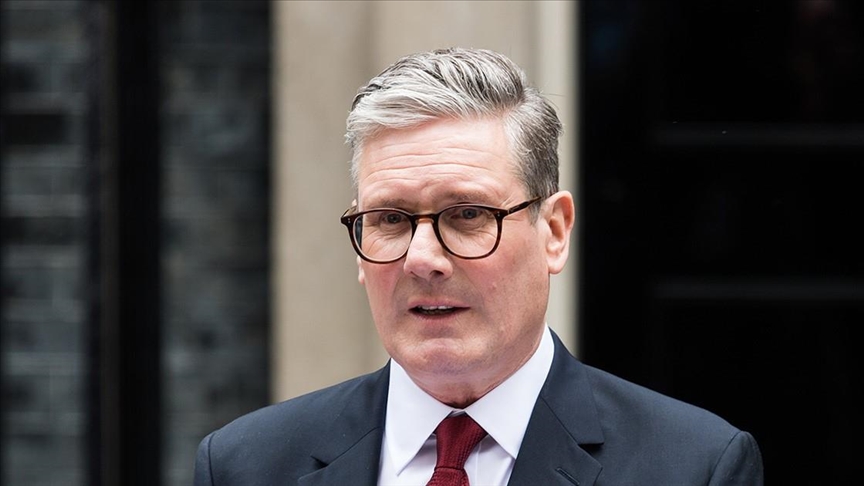
A Ukrainian man who set fire to property linked to British Prime Minister Sir Keir Starmer appears to have been acting on behalf of a wider Russian influence and sabotage operation, a BBC investigation reports.
Prosecutors say that the case was motivated by money, but evidence uncovered by BBC journalists suggests it may have been part of a broader campaign directed from Russia.
Roman Lavrynovych, a 22-year-old Ukrainian builder living in London, was convicted of conspiracy to commit arson after attacks on a former car owned by Starmer and two properties associated with him.
After the Starmer-linked arson attacks, Russian-based accounts circulated a false claim that the suspects were male sex workers involved in a scandal with the prime minister. The story was amplified online by Tommy Robinson and later shared by a senior Russian presidential envoy. There is no evidence supporting the allegation.
Lavrynovych communicated through Telegram with a handler known only as “EL,” who paid him to carry out increasingly serious acts, beginning with putting up posters and progressing to graffiti and arson. After one of the attacks, EL warned him that he had targeted “a very high-ranking person in Britain” and urged him to leave the city. Lavrynovych was arrested within hours.
The BBC has found that EL was not simply a criminal intermediary but appeared to be deeply involved in pro-Russian online operations, because the Telegram messages linked to EL praised Vladimir Putin, promoted Russian nationalist ideas, encouraged attacks in Ukraine, and offered Russian citizenship to people willing to carry out arson. The account also claimed to have access to Western intelligence documents through its user’s father.
EL helped run a fake British far-right group called Direct Action UK, which posed as a grassroots anti-immigration movement. In reality, evidence suggests it was operated from Russia. The group offered cash rewards for vandalism and encouraged attacks on mosques and police. Several mosques and an Islamic school in London were subsequently vandalized after the group advertised payments for such actions.
Before launching Direct Action UK, the same network appears to have operated a fake Islamic organization called the Takbir Foundation, which offered money for Islamic-themed graffiti in Britain, apparently in an attempt to provoke anti-Muslim sentiment and fuel tensions between communities.
Investigators traced EL to a young Russian named Evgeny Lyukshin, a 23-year-old diplomatic trainee and the son of a senior Russian diplomat. Lyukshin has connections to Russia’s foreign ministry, has studied information warfare at Moscow’s MGIMO diplomatic academy, and appears in photographs with figures linked to Kremlin-backed propaganda networks.
The BBC, however, not conclusively prove that Lyukshin and EL are the same person, nor did Lyukshin did not respond to requests for comment. According to experts, the operation resembles other Russian “hybrid warfare” campaigns seen across Europe, involving efforts often recruit young people through social media, offering money for minor acts before escalating to sabotage or criminal activity.
British counterterrorism police say the attacks were clearly intended to intimidate the prime minister and undermine the UK, but they have not been able to prove who directed the operation or whether it was officially backed by the Russian state. Nevertheless, sources told the BBC that authorities in both Britain and Ukraine privately believe Russia was responsible.
Former Defence Secretary Ben Wallace described the attacks as a serious escalation that likely required approval from senior levels of the Russian system.
The Russian government denies any involvement and rejects suggestions that its foreign ministry or officials participated in unlawful activities.
