











Christians celebrate the birth of Jesus Christ, a religious holiday which has its own traditions, popular customs and superstitions. The birth of Jesus is also the first royal feast with a fixed date, in the chronological order of the Savior’s life. This seems to be the first specifically Christian feast of the Savior, although it is not as old as Passover and Pentecost, whose origins are related to the corresponding Jewish holidays.
In some writings about the Birth of the Savior it is shown that the Virgin Mary was to give birth to the Son of God and walked, accompanied by Joseph, from house to house in Bethlehem of Judea, eight kilometers from Jerusalem, asking the people to offer him shelter. Arriving at the house of the old people Crăciun and Crăciunoaie, they did not receive her, and Maria entered the cattle manger, where she was seized by the pains of childbirth. Christmas heard it and felt sorry for her, so he helped her. Crăciun, angry, cut off the old woman’s hands. At Christmas, however, she filled a cauldron with water, heated it and took her to wash the child. Mary told him to try the water, and when he put the stumps in his hands, they grew back. In another version of the story, Maria blows on Christmas’ hands and they grow back.
The birth of Christ is recounted in the Gospels of the apostles Matthew and Luke. Despite small differences, both evangelists affirm that Christ was born in Bethlehem and grew up in Nazareth.
The Evangelists mention that the Virgin Mary gave birth to Christ in a “manger”, without saying clearly whether its place was in a cave or in a fold. The cave as the place where the Virgin Mary gave birth was mentioned after about a century, by St. Justin the Martyr and the Philosopher, but also in the of James. This is not a contradiction, because, as was the custom at the time, the houses were built in front of the caves that were in the area, so that the cave could be used as a stable for animals.
The Church of the Nativity of the Lord in Bethlehem is one of the oldest Orthodox churches in the Holy Land, built by Empress Helen in the fourth century and rebuilt by Emperor Justinian the Great in the sixth century, being one of the most important Christian places of worship.
The Church of the Nativity in the Holy Land is located in the eastern part of the city of Bethlehem, eight kilometers from Jerusalem. The complex that surrounds it, covering about 12,000 square meters, includes, in addition to the basilica itself, an Orthodox, a Catholic and an Armenian monastery. Over time, the Romanian rulers made numerous donations to this church and supported the Holy Places in difficult times.
Religious events and carols
All over the world, Christian peoples, including the Romanian people, have been celebrating the Nativity of the Lord, Christmas, on December 25 for centuries.
At first, the feast was celebrated together with the Epiphany. From the fourth century, the two royal feasts are celebrated separately.
Before the birth of Jesus Christ, this period was associated with myths and the pagan celebration of the winter solstice. By instituting the feast of the Nativity of the Lord, the time after the winter solstice takes on a religious significance.
Christmas is a word of Latin origin that would mean, according to some philologists, “creation”, that is, born at the beginning of the Christian era.
At the birth of Jesus Christ, the Magi from the East brought him gifts like a king: gold, frankincense and myrrh. Today, children and young people announce the Birth of the Savior through carols and receive gifts.
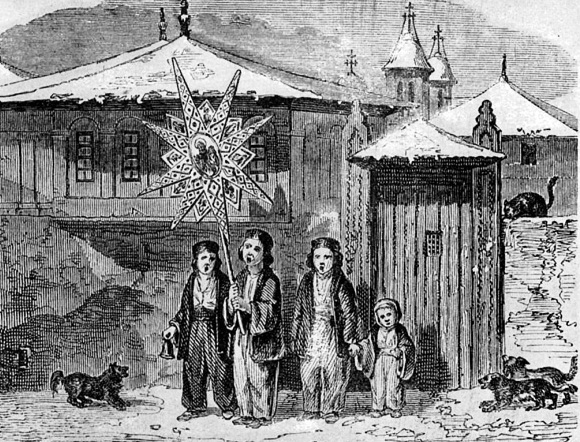
In Romania, Christmas is one of the biggest holidays of Christians, along with Easter and Pentecost. On Christmas Eve, children go with carols to announce the birth of Jesus. Starting from the first day of Christmas, children walk with a star.
The origin of carols, ritual texts dedicated to Christmas and New Year, is not exactly known in the history of Romanians. The children go caroling, to the beautifully decorated houses, singing “The Star Rises” and “Good Morning to Santa Eve!”, but also other songs, being rewarded by the hosts with fruits, pretzels, sweets and money.
“Cunning” or “Herods” is the tradition by which young people represent at Christmas the birth of Jesus Christ, the cunning of Herod, who ordered the killing of infants, and the confrontation of unbelief.
The Goat, the Turk or the Brezaia are part of the Christmas and New Year traditions. With these traditions, young people walk from Ignatius to the second day of Christmas, and in some areas until St. Basil’s Day.
In some parts of Transylvania, children who go caroling are called piţerei, and they are considered bearers of luck and happiness.
In Transylvania, there is a custom of singing carols by the boys near dawn.
In the popular tradition it is said that, through these carols, Christians drive the desert out of the house, from villages and cities, from the country and from all over the world.
Traditions, beliefs and customs
An emblem of Christmas is the decorated tree. This is, however, a relatively recent acquisition.
The fir tree has in Romanian popular culture especially funerary functions: it is either the substitute for the bride or groom, in the case of the death of a “ruthless” (unmarried) young man, or the vegetable double of the deceased, “his sworn brother”, which is said in the ritual songs of Gorj to have risen in the mountains precisely with his birth.
The traditional repertoire of Romanian customs and traditions includes, in addition to the carols themselves – Steaua, Pluguşorul, Sorcova, Vasilica – the games with masks (Turca, Cerbul, Brezaia), folk theater, dances (căluşerii), customs, superstitions and sayings originating in ancient or Christian beliefs and myths.
It is said that God allowed Christmas so that man could be full on this day. In some areas it is said that those who do not have a fat pig for Christmas cannot consider that they were happy that year.
In Bukovina, on Christmas Eve, a colac and a glass of water are placed on the table, because it is believed that the souls of the deceased come to their homes this night, taste the colac and wet their mouths with water.
In some areas, after Christmas, children are no longer allowed to carol, so as not to get boils.
Another custom is for people to put silver money in the water in which they wash, in order to have prosperity and health in the coming year.
On Christmas Day, it is not swept, but only the next day, and the collected garbage must be taken to the trees to be fruitful.
In the parts of Muscel it is believed that the days of December 24, 25, 26 and 27 correspond to the four seasons, and as the weather will be in them, so will the seasons of the following year.
On Christmas Eve, in the villages of Maramureş, the cattle and the doors of the stables are anointed with garlic, so that evil spirits do not take the milk of the cows. Also to drive away evil spirits, people anoint themselves with garlic on their foreheads, backs, elbows and knees and put garlic on the doors and windows of their houses.
In some villages in Maramureş it is said that the woman who does not put tablecloths with ciucălăi on Christmas is cursed, embroidered towels on the walls and pillows with tarnished sides on the bed.
Regarding eating habits, Romanians usually fast for 40 days before Christmas, which ends after the Divine Liturgy on the day of the Savior’s Birth. People then eat at the Christmas table sausages, caltabos, drums, cold cuts, cabbage rolls made from pig slaughtered on Ignat’s Day (December 20), as well as cake.
