











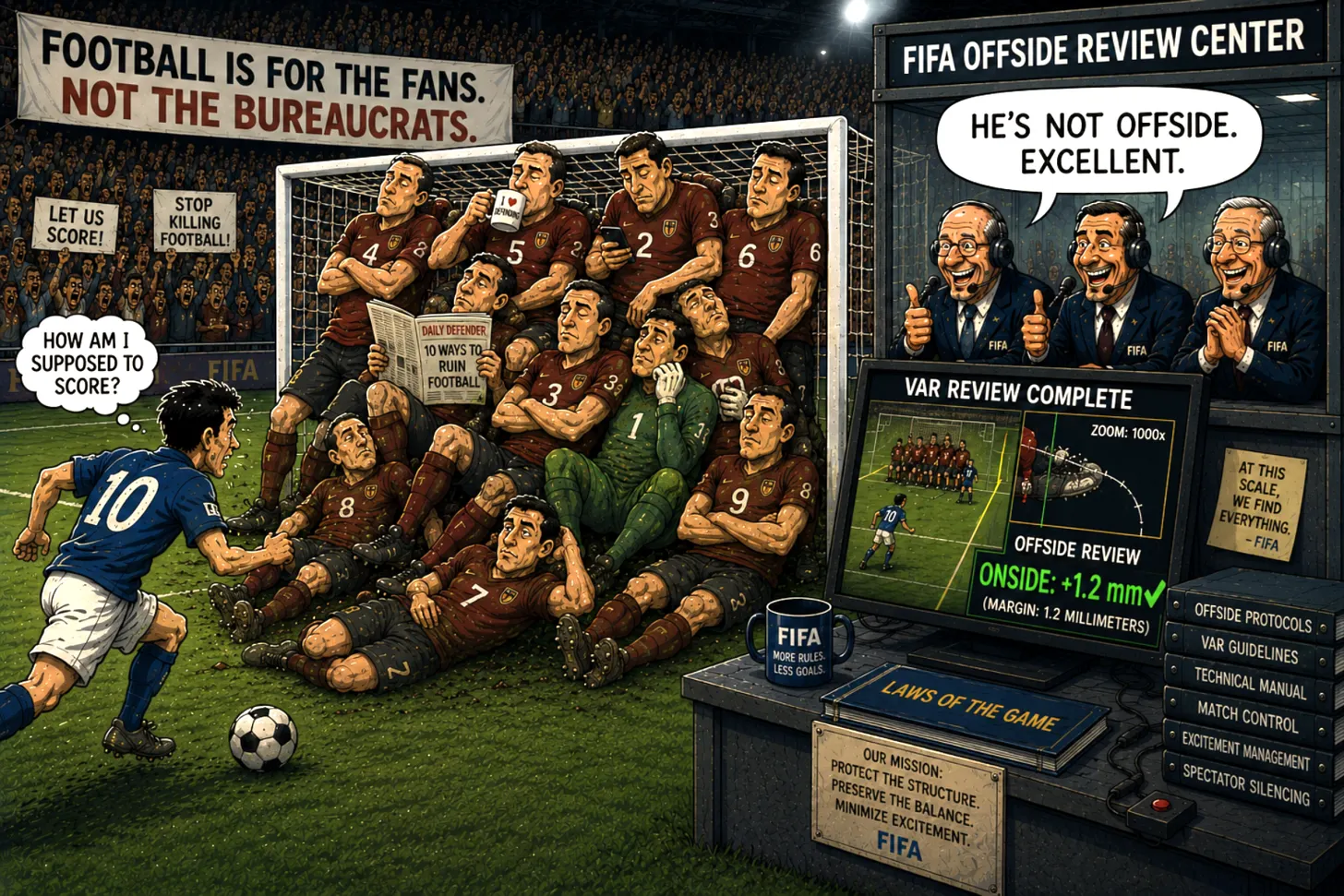
In Part II of our World Cup offering, we say the sport seems determined to protect fans from excitement
Congratulations to my former home team England that just made the semifinal along with France, Spain and Argentina (which robbed Egypt in the quarters courtesy of refs misusing VAR).
As we discussed in the first installment of this two-part series, the most obvious problem with soccer (let us call it that, in honor of the American-hosted World Cup) is its infuriating imprecision. Unlike basketball, American football, or ice hockey, soccer cannot tell fans how much time remains in a game. Stoppage time is estimated, additional time is added at the referee’s discretion, players waste time, and matches routinely continue beyond the number displayed on the board.
But another problem, weirdly under-remarked, is the sport’s infuriating precision — regarding the offside rule especially. As VAR (Video Assisted Referee) and semi-automated offside technology have spread throughout the sport, soccer has become obsessed with measuring positional advantages down to the millimeter. The result is a peculiar contradiction: cavalier with the clock, absurdly pedantic with the position of a toe.
To appreciate what is being lost, consider the most exciting play in ice hockey, a sport that in many respects resembles soccer. A puck squirts loose near center ice and, almost instantly, everyone in the arena holds their breath: a forward has broken free. It is the breakaway. The game, which moments earlier involved ten skaters navigating a complex web of positioning and function, explodes in drama. There is open ice ahead, desperate pursuit behind, and only the goaltender standing between the attacker and the net.
The goalie moves forward to limit the possible angles of the shot anticipated. Every stride heightens the tension. Every second narrows the possibilities. Whether the play ends in a goal or a save, the excitement is maximal, the sensation kinetic.
Soccer, for all its beauty and global popularity, rarely produces this feeling — not because it lacks speed or athleticism, but because the sport has spent more than a century enforcing and refining a rule that systematically suppresses the purest version of the breakaway before it can fully emerge.
The offside rule exists for understandable reasons, yet its modern form has become a self-imposed limitation. Worse still, technological enforcement has transformed a sensible principle into an absurd exercise in geometry. Soccer does not merely regulate breakaways. It all but prevents them — or anything close — from happening at all.
The contrast becomes apparent immediately after a turnover. There is little possibility for the attacking side to exploit a bad pass or fortunate bounce that might create immediate separation between attacker and defender. When a midfielder wins possession and spots a teammate sprinting into open space, the runner must time his movement against the defensive line, delaying the release until everyone has organized themselves to enable the pass to go to an attacker who has a defender between himself and the goal, in accordance to the invisible geometry.
This allows the defense ill-deserved time to recover.
So the rule was always irritating, Now VAR has elevated irritation to absurdity. What was once a judgment call made by a linesman watching athletes run at full speed has become an exercise in stupendous fastidiousness, with technicians drawing lines across frozen images to determine whether a toe, kneecap, armpit or sliver of shoulder was fractionally ahead of a defender at the precise millisecond a teammate touched the ball. VAR gave the silliness a microscope.
The drive for greater precision in soccer started as a genuinely good idea. Perhaps more than any other single incident, it grew out of Frank Lampard’s infamous disallowed goal for England against Germany in the 2010 World Cup. With England trailing 2-1, Lampard struck a magnificent shot from outside the penalty area that crashed off the underside of the crossbar, bounced well over the goal line and came back into play. Everyone watching could see it was a goal. The referee and linesman somehow could not. I was watching the game in a London pub, and I thought a riot would break out.
Germany went on to win 4-1, and one of the most glaring officiating errors in World Cup history became an irresistible argument for technology.
The immediate result was goal-line technology, which uses cameras or sensors to determine whether the entire ball has crossed the line and instantly alerts the referee. It was an excellent innovation. You should not mess with goals. A factual, binary question had a factual, binary answer: did the ball cross the line or didn’t it? The technology ensured that the particular nonsense inflicted on Lampard and England would never happen again at the highest level.
But goal-line technology also helped prepare the ground for VAR – which allows officials watching multiple camera angles to review potentially decisive incidents, including goals, penalties, red cards and cases of mistaken identity. That, too, seemed like a good idea. Why should a World Cup be decided because a referee missed an obvious handball, failed to spot a vicious foul or awarded a penalty for a blatant dive? If technology could prevent catastrophic mistakes, why not use it?
The problem is that the quest to eliminate obvious injustice gradually became a quest to eliminate all imprecision, and soccer was never designed for that. The result has been an epidemic of overly pernicious and sometimes ridiculously comical calls: goals overturned because a player’s toe, shoulder or kneecap was fractionally offside; celebrations interrupted by minutes of forensic examination; beautiful passages of play erased because VAR discovered some microscopic infringement several seconds earlier. Instead of correcting howlers, the technology increasingly acts as a kind of footballing tax auditor, searching frame by frame for technical violations that no human being could have detected in real time and that often had no meaningful impact on the play.
So let’s get back to the offside rule. Defenders say that without it, attackers would simply stand near the opponent’s goal waiting for long passes. Defenders would retreat to mark them. Midfield play would disappear. The game would devolve into little more than launching balls from one end of the field to the other. This concern is legitimate. The field is larger than in hockey, the ball moves more slowly, and abolishing offside altogether would fundamentally alter the sport.
But acknowledging the need for some limitation does not require accepting the current version as enforced via VAR. Preventing attackers from lingering around the goal waiting for easy chances is one thing; invalidate goals because a player’s shoulder extended a few centimeters beyond a defender at the instant a pass was played is another. Yet that is exactly where modern soccer has arrived.
For decades, human limitations concealed the absurdity built into the rule; only obvious offside violations were generally called. Technology revealed the silliness: goals are now routinely disallowed because of body positions that provide no meaningful competitive advantage, forcing entire stadiums to wait through forensic examinations involving freeze frames and computer-generated lines measuring millimeters on a shoe.
(Another VAR problem was evident in the Argentina-Egypt quarterfinal – when Egypt’s extraordinarily beautiful second goal was disqualified when VAR discovered the most miniscule and unintentional case of illegal contact before the play even began, but which caused pretend agony to a player in blue-and-white.)
No reasonable observer can watch a goal overturned this way and conclude that the sport has become more entertaining or fair. And on offside specifically, only an irredeemable pedant can argue that microscopic infractions resemble the problem the offside rule was originally designed to solve – lingering by the goal.
Yes, attackers should not spend ninety minutes standing on top of the other side’s goalkeeper. But if that is the problem, why not address it directly? Soccer could simply prohibit attackers from lingering in a defined area immediately in front of goal – in principle, the same as in hockey. If a striker wants to stand twenty-five yards out waiting for long balls, it may be fine to let him. In most cases that would weaken his team’s defense, resulting in goals for the other side.
One obvious fix would be to limit the use of VAR – perhaps in the way that umpire’s calls on pitches (were they in or outside the strike zone?) are limited in number. Same with NFL challenges flags, which generally have to do with field position and whether catches were in bounds.
The precise reform matters less than the principle behind it. Soccer should be looking for ways to encourage breakaways, not eliminate them. The sport should reward bold attacking runs rather than treating them as potential violations waiting to be discovered by heartless software. Every great sport depends on moments of high drama. Basketball has the fast break. American football has the deep bomb. Hockey has the breakaway. Soccer should have more of them too.
The goal of rules should not be to preserve habits simply because they’re old. That is not the “beauty of the sport.” The goal should be to create the best possible version of the sport. Fix the broken clock, and limit the damage of VAR.