








All things considered, it’s amazing what 35 years can do
The year 2024 was touted as the “year of democracy” with nearly half the global population voting somehow. Much has been a sham, such as the fake election in Russia and even grotesquer fakeries in Azerbaijan, Uzbekistan and such. But what happened in real contests is interesting: With a few exceptions like Mexico incumbents have been thrashed, from the European parliament and France to Britain and the US. The German ruling party will almost certainly soon be booted as well. The people are in a foul, nasty mood.
Bringing us to Romania, which today holds the first round of presidential elections. The decisive second round between the two top vote-getters will be Dec. 8. A week before that they plan parliamentary elections, which will be the real vote for the executive branch. The presidency is somewhat ceremonial, but also not irrelevant: Presidents have some discretion in choosing a prime minister, especially in the fragmented political landscape, and also can under some circumstances disband parliament. It matters.
So on my recent visit to Bucharest, I was fascinated to discover the campaign unfolding with relatively little drama. One could argue that this is unhealthy, perhaps stemming from indifference about democracy, and so suggesting a vulnerability to a future challenge to that democracy. But when you look at the hatreds in the U.S. and much of the West, it’s also a breath of fresh air.
Not that there aren’t issues. Romania, which was admitted into the European Union on Jan. 1, 2007, has not quite completed the journey to transparent and non-corrupt governance, we can fairly say. But it is getting there. Nor is there quite a Western level of prosperity, but here too the advances are stark.
How stark? When I lived in the country as a foreign correspondent about 30 years ago, the average salary hovered around $100/month. Today the per capita GDP is officially just over $18,000, and factoring in for the still-low prices, the purchasing price parity figure is double that figure – in the neighborhood of Italy. Even if unevenly distributed, despite lingering disappointments and dislocations, it’s honestly not bad.
The most promising data are these: Romania’s young people are among the most educated in the democratic world (according to the OECD’s “Education at a Glance 2024” report, 24.6% of those aged 25-34 have tertiary education, far higher than in most countries); and overall English-language proficiency ranks 12th in the world, according to the EF English Proficiency Index.
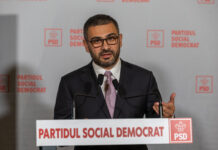
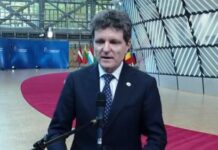
Is it all wine and roses in the election? Obviously not. For the few global readers who care about the details, I’ll report that far-right candidate George Simion of the Alliance for the Unity of Romanians (AUR) may make the second round, probably against incumbent leftist Prime Minister Marcel Ciolacu of the Social Democratic Party (PSD). Other notables include Mircea Geoană, an independent and former NATO Deputy Secretary General, Nicolae Ciucă, representing the National Liberal Party (PNL) and a former Prime Minister, and progressive Elena Lasconi. In a field of 13, none poll above 25%.
Simion was inadvertently assisted by a court decision to ban an even more extreme far-right candidate, so that segment of opinion is no longer split. And he is thought to be receiving a boost from some holistic global Trumpiness in the wake of the US election. His positions are indeed grim: he’s no fan of the EU (though he would not pull out – a Roexit?), hates liberalism, and loves Vladimir Putin. I think he’d be crushed in a second round; no one I spoke to in Romania, which as a NATO member bordering Ukraine is has a stake in the war, wants to embolden Putin by handing him a victory.
Another type of result would elevate to the second round Lasconi, the leader of the Save Romania Union (USR), who advocates for a progressive and reform-oriented agenda prioritizing transparency, anti-corruption measures, and social justice. A victory by her would be a fascinating first, and quite possibly lead to scented candles at Cotroceni Palace, the presidential compound that has been a monument to patriarchy (below I’m interviewing the first post-communist president Ion Iliescu at this venue in 1991).

Mainly, the relative civility of the discourse is simply astounding to anyone who recalls, as I do, the situation from 35 years ago. As anyone over 50 will know, that sounds like a long time, but boy, does it fly by.
To understand just how far the country has come, let’s revisit the extraordinary events of late 1989, when the revolution unfolded with astonishing speed, and the seeds of a new Romania were planted.
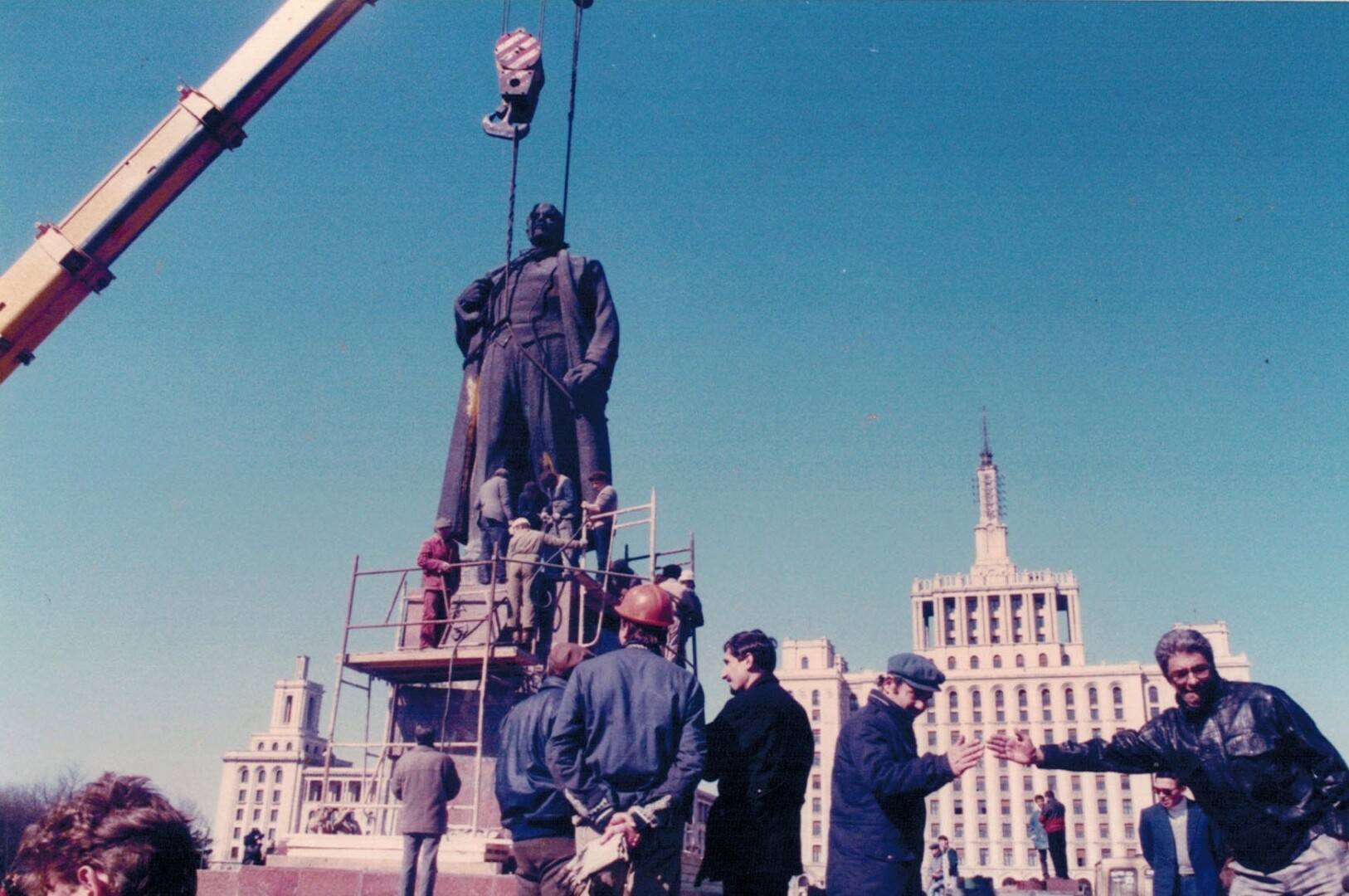
On November 20, 1989, Nicolae Ceaușescu was reelected to head Romania’s Communist Party — a grim reflection of his iron grip on power. Ceaușescu had perfected the machinery of repression, employing the dreaded Securitate to monitor and crush dissent; kids ratted on their parents, friends and spouses betrayed each other, and so on. His regime’s obsession with paying off foreign debt had plunged the country into severe austerity, leading to widespread poverty, food shortages, and deteriorating living conditions.
But within a month, the regime would collapse in a dramatic and violent uprising. The spark came in the western city of Timișoara on December 16, when protests erupted over the attempted eviction of a Hungarian Reformed pastor, László Tőkés. What began as a local demonstration quickly escalated as the government’s brutal crackdown in Timișoara, which left scores dead, fueled outrage across the country. By December 21, protests had reached Bucharest, with thousands gathering in Revolution Square to denounce Ceaușescu.
There was something odd about the protests. Other than Albania, Romania had been the most repressive of the Warsaw Pact countries. The people were supposed to be afraid. Was it despair and bravery – or had there been a subtle signal from the military and the Securitate secret police that they were about to break ranks with communism? After all, the Berlin Wall had fallen in November, Soviet leader Mikhail Gorbachev was signaling that he’s done with Eastern Europe, and most other countries were well on the way to ending the communist experiment. To this day it isn’t clear; even that somehow strikes me as charming in a twisted, crazy way. It’s probably a combination.
In a fateful move, Ceaușescu attempted to deliver a televised speech to quell the unrest, but his typically staged audience began to jeer and boo him — a moment that symbolized the regime’s unraveling.
As chaos spread, Ceaușescu and his wife, Elena, fled Bucharest by helicopter on December 22.
Their escape was short-lived; they were captured later that day and subjected to a swift and controversial trial. With hindsight, it sure looks like the Communists staged a palace coup.
On December 25, 1989, the Ceaușescus were convicted by kangaroo court of high crimes, lined up against a wall, and shot faster than a cameraman could film. A group calling itself the National Salvation Front declared itself in charge and promised elections. Democracy embarked upon its odd, unsteady path.
I arrived in Bucharest as the Associated Press correspondent in February 1990, in an odd situation: I spoke the language quite well, because it was the land of my parents’ birth. They escaped communism in 1960, before I was born, but still spoke the language at home. So I was one of the few foreigners who arrived to what had been a very isolated place in a position to understand, more or less, what was going on.
The country was still reeling from the revolution. The economy was in ruins, infrastructure was crumbling, and the population bore the scars of decades of dictatorship. Fear and mistrust lingered, and the transition to democracy and a market economy seemed an almost insurmountable challenge. Yet, even in those bleak early days, there was a palpable hunger for change. The people I met were determined to rebuild their country, despite the enormity of the task ahead. The Romania of 1990 was a nation at a crossroads — traumatized but hopeful.
An unseemly giddiness verily filled the air. Somehow Ceausescu had become the former owner of tourist sites. Below you see me, exercising some strange journalistic access, enjoying the dictator’s now-vacant seat at a presidium of some sort.

Skullduggeries there were aplenty. For one thing, about 1,000 people had been killed in mysterious circumstances in the two weeks after the revolution, giving rise to myriad conspiracy theories (which we’ll explore next week). For another, anti-Iliescu protests were brutally suppressed with thuggish miners imported from the hinterlands. And of course, there was anger at former Communists escaping justice and ending up running privatized industries and shiny new banks; that’s a palace coup for you.
But over the decades, the trauma receded; a new generation emerged that knew not Ceausescu. I talked with these middle-aged types on my trip. Some are cluelessly nostalgic for communism. Many are frustrated that progress isn’t faster still and dream of emigration. Some would be happy Trumpists in they were in America, probably voting for Simion. And many — happily very many — look set to be the drivers of something very good.

One of the most significant milestones in Romania’s post-communist journey came in 2007, when the country joined the European Union. EU accession marked a watershed moment, signaling Romania’s formal integration into the Western political and economic sphere. It also served as a catalyst for reform, pushing the country to modernize its institutions, tackle corruption, and embrace democratic governance.
Nowhere is Romania’s progress more evident than in Bucharest’s Old Town, known as Lipscani. Once a dilapidated area, Lipscani has been transformed into one of Europe’s most vibrant urban districts. Its cobblestone streets explode with cafes, eateries, noisy bars, and (many) places of ill repute.

Elsewhere modern office buildings are sprouting in another real estate boom drive in part by expectation of a transition to the euro common currency. It’s a stark contrast to the gray, oppressive cityscape of the early 1990s.

Romania’s progress extends beyond its economic and cultural revival. The outgoing president, Klaus Iohannis, is a member of the country’s ethnic German minority — a remarkable fact in a nation where ethnic tensions once ran high. Even historic rivalries, such as those with the Hungarian minority, seem largely subdued today. While challenges remain – witness the rise of Simion – Romania has managed to foster a certain sense of coexistence that stands in stark contrast to the divisions plaguing many other nations.
This positive trajectory is particularly striking when viewed against the backdrop of a troubled world (which we discussed at length on Romanian TV, below, testing what remains of my command of the language). The United States is riven by political and cultural divisions, and has just reelected a twice-impeached authoritarian. Europe grapples with tensions over large Muslim minorities. Israel is ripping itself to pieces. Much of the Arab world remains in turmoil. India is being dragged rightward by Hindu nationalism. China is back to being a full dictatorship.
Romania’s story is a reminder that progress is possible, despite the mutations of our human condition, even in the troubled 21st century.
