












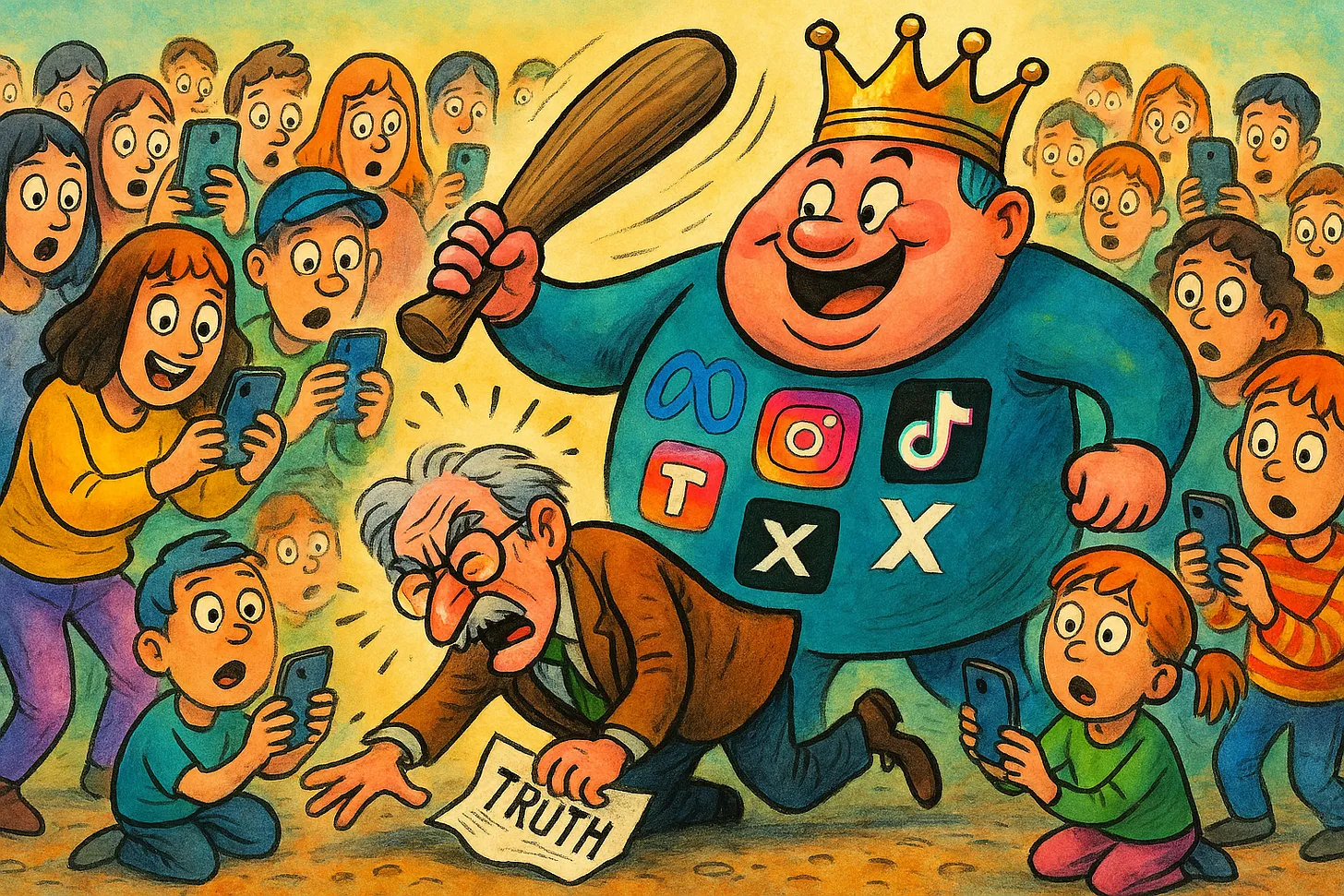
THE WAR ON TRUTH, PART V: Social media is the primary delivery system for lies, radicalization and polarization. Time to hold the algorithms accountable.
The world feels like it’s come unmoored. Democracies are wobbling, alliances are fracturing, and the basic fabric of shared reality is being shredded. Way too many successful politicians seem way too crazy. But the chaos we’re witnessing not just a coincidence of bad actors and bad luck. It is enabled and driven by social media by people prepared to harm society for a hefty profit.
I am referring to the fact that social media algorithms are, with very high probability, engineered to maximize engagement. But lies and radicalism maximize engagement, because the truth can be boring and moderation can seem lame to people scrolling in search of excitement. We are needlessly fatalistic about this, as if there’s nothing to be done or human nature alone were to blame. This is wrong. Social media is doing things a certain way because it’s profitable. But society has no obligation to allow anything that is profitable. Slave labor may be profitable, but we do not allow it.
You’d think all this is obvious, yet limited the damage has proven difficult. Though preventing radicalization and hatred and protecting young people should be imperatives, the global populist right has turned doing nothing into a crusade for “free speech” and part of its war on the “elites” – which another way for saying disdain for expertise and indifference to education.
And yet, some good news has arrived. In a twist no one predicted, two midsize nations have stepped forward with a sense of urgency that the rest of the democratic world has largely lacked: Romania and Australia. In recent weeks they decided to act — one to fight foreign disinformation and defend its electoral process, the other to protect its children from algorithmic addiction and despair.
The urgency of this has been given a prominent platform in recent weeks by the harrowing Netflix series Adolescence, which brutally portrays how a vulnerable teenage boy is groomed by online radicalization and toxic masculinity, driving him to commit a horrific murder. It is a gut-wrenching reminder of what happens when chaos is amplified for profit.
This entire catastrophe is a grand parable of the human condition. After all, social media was once hailed quite reasonably as a force for democratization and connection, elevating the discourse and enabling human on a global scale. And some of that has happened. But mostly, social media has become a machine designed to confuse, divide, and radicalize us – monetizing chaos and incentivizing division, where truth is uncompetitive because emotion outpaces reason and lies, unburdened by reality, are stickier than truth.
On these platforms all opinions — no matter how absurd, hateful, or detached from evidence — get a seat at the table. In this warped digital agora, expert consensus is drowned out by loud amateurs, conspiracy theorists, and well-funded propagandists.
The platforms insist they merely reflect what users want to see and say, but that’s a dodge. In reality, algorithms shape what billions of people receive — and those algorithms are optimized not for the public interest but for engagement, which usually requires rage, fear, or tribal affirmation. Engagement begets income for the owners, so they have made these platforms the primary delivery system for disinformation, polarization, and mistrust.
So this is not about freedom of speech but about what to amplify.
This is a wonderful landscape for populist conmen like Donald Trump – why this why they love social media and hate journalism, with its standards of truth. Autocrats want you to just believe their lies (“I am not robbing you blind”), while the news media has accuracy standards that make it the enemy of a new information order built on viral nonsense.
So what we have here is the ultimate war on truth.
When platforms like X, Facebook, TikTok, or YouTube boost divisive lies over cautious truths, they’re not protecting expression but choosing profits over social cohesion. These platforms aren’t just passively hosting content; they are actively deciding what spreads and what dies in the algorithmic void. That’s an editorial decision, whether they admit it or not.
And yet they’re shielded from the responsibilities of publishers. They rake in revenue from advertising attached to outrageous content, then shrug when called to account.
This problem has grown exponentially since Elon Musk bought Twitter and rebranded it as X. In the name of “free speech,” Musk re-platformed digital rabble-rousers as the site quickly devolved into a premier hub for conspiracy theories and unfiltered nonsense. Musk’s own tweets — often bizarre, frequently conspiratorial, and increasingly aligned with the global populist project — are naturally boosted by the very algorithm he controls.

Musk’s reach, via control of such a platform, undoubtedly helped Donald Trump on his path back to the presidency. X has also become a vehicle for popularizing economic nonsense, including the fantasy that tariffs represent a tax cut for Americans. None of this is a bug. It’s the business model. They want you to be an idiot.
Which brings us to Romania, an unlikely ground zero in the global information war. In late 2024, fringe ultranationalist candidate Calin Georgescu — a conspiracy theorist and Kremlin sympathizer — won the first round of the presidential election after an explosion of TikTok activity. Romanian intelligence found that over 5,000 accounts had generated some 50 million impressions in the campaign’s last days, tying it to Russia.
Romania’s Constitutional Court annulled the result and barred Georgescu from the May 4. And the national communications regulator ANCOM, acting under the EU’s Digital Services Act (DSA), moved to force platforms to explain and justify moderation practices. TikTok was temporarily suspended. Musk lashed out, tweeting a photo of ANCOM’s vice president with the caption: “You can tell who the bad guys are by who is demanding censorship.”
Meanwhile, in Australia, Prime Minister Anthony Albanese took on a different aspect of the tech dystopia: the manipulation of children. Following a spate of suicides tied to online bullying and abuse, his government passed a law banning social media access for those under 16. This is because social media’s pervasive influence has been linked to significant declines in self-esteem, body image, and reading habits among youth.
ong youth.

Platforms like TikTok have been associated with trends that promote unhealthy eating behaviors and unrealistic body standards.
The constant exposure to idealized images on social media can result in lower self-esteem and toxic sentiment. This has been long understood among young women, who face both impossible beauty standards and the message that how they look is all that matters.
But by now the nefarious effect is also evidence in boys and young men, who can neither attain the masculinity levels celebrated online nor the beautiful women – AI-generated or otherwise – that dominate the algorithm; the result – and this is the subject in Adolescence – is misery, a rise in incel groups angrily glorifying misogyny, a chasm between the sexes, and worse. In the show it leads to murder.
Furthermore, the rise of digital media consumption has correlated with a decline in reading habits and comprehension skills in children, as the preference for quick, easily digestible content diminishes the appeal of longer, more complex texts. So young people are perplexed by news articles – a good way to remain ignorant.
Australia’s law fines platforms up to $31 million for failing to enforce age limits. Critics scoffed that it would be impossible to implement. But Australia already banned mobile phones in schools, leading to a 63% drop in bullying-related incidents.
Both countries have understood a larger truth: Left unregulated, these platforms will not protect the public interest but build us a dystopia just to make a few more pesos. And they have shown can act. The question is whether others will have the courage to follow.
France’s education minister endorsed the move and social psychologist Jonathan Haidt called it a “crucial global test.” Even in the U.S., the Senate is now debating the Kids Off Social Media Act. Utah has already passed laws requiring age verification on app stores. This should be one of the main coming policy discussions for responsible people across the political spectrum. And it is ordinary people who should demand it.
The starting point must be transparency. Platforms should be required to reveal how their algorithms rank content — and regulators should be empowered to penalize systems that systematically amplify lies, incite violence, or destabilize democracies.
Think of it like environmental regulation: No one argues that companies have the right to dump toxic sludge into rivers in the name of freedom. Why do we allow social platforms to poison the information ecosystem?
This will require persuasion, legislative will and international coordination. But it’s necessary. If we want a functioning public square, we need rules. If we want democracy to survive, we need truth to compete on a level playing field. Authoritarians, kleptocrats, and demagogues will fight it: they thrive where facts are optional.
In reality, the threat to freedom isn’t regulation. It is distortion, by dint of algorithm, of reality itsel
f.
