









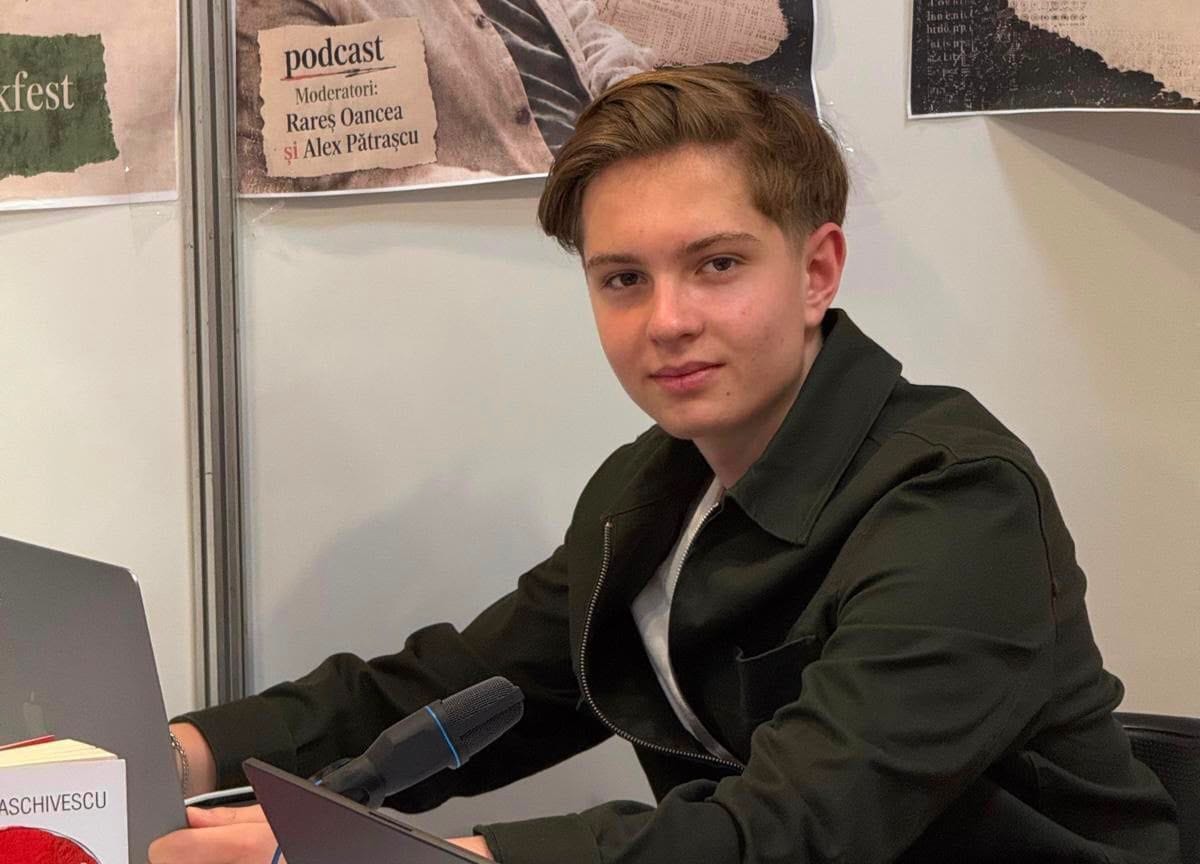
At 16, while many teenagers use social media mainly for entertainment, Rareș Oancea, a high school student from Iași, a city in northeast Romania, created an AI-based platform designed to detect online misinformation. He came up with the idea after the 2024 presidential elections, when he saw how easily Romanians believed and shared false claims.
- Where did the idea for the Truth Seeker platform come from?
The idea came to me in November-December 2024, around the time we had presidential elections. All kinds of posts like “Calin Georgescu, our God” appeared online, I have seen posts with Putin allegedly donating an exorbitant amount to Romania, while Ukraine is harming us. All kinds of things like that. In the comments on these posts I saw that people, instead of being outraged, believed these things. There were no bots, there were no automatic accounts, there were accounts from real people, who posted pictures of their families. I saw how they cursed and promoted a long-forgotten ideology, the ideas of people like Zelea Codreanu or Ion Antonescu . Instead of reading and seeing what the two did, people took for granted what Georgescu was saying and shared rhese ideas. It was hard to see what was happening and do nothing.
At the time of the elections, when you decided to get involved, you were 14 years old. How did you know about people like Codreanu or Antonescu?
I’ve loved history since I was young. Despite comments claiming I don’t know history, I’ve taken part in competitions and Olympiads. That’s one reason I started this project: I was not unfamiliar with the facts.
- Did you already master concepts such as disinformation or hybrid warfare?
Since September 2024, when candidates entered the race for the presidency, I started researching each one. The more I looked, the more I understood the meaning of the terms, the more I understood the way the Romanian state works. On top of that, I also have a family that supports me and is not politically aligned in any way. I can’t say that before the months when I came up with the idea I had an interest in disinformation. But when I saw that it was so oppressive and present everywhere, I decided to use my programming knowledge.
- How long did it take from the idea until the platform was up and running?
The platform was somewhat functional in June after the May 2025 presidential elections. I am still making improvements, because, at the moment, I don’t consider it something revolutionary. That’s why it hasn’t cost much. So far, I haven’t had the necessary finances and access to certain things to make it revolutionary. For example, there is something called “Meta Library”. It is a program that you can only access if you are part of an organization that deals with research. If I were part of it, I would be able to have access to all comments and posts related to a specific topic. I could do some much more in-depth analysis of how a certain type of language is perceived. Truth Seeker is still in development, I can’t say I’ve finished it yet. .
- In the medium term, how do you plan to develop the platform?
If I were to partner with an organization that does research, for example Snoop would fall into that category, I could have access and continue development. Until then, I need to launch the phone app and browser extension.
- Let’s take it “step by step”. How does the platform work?
Whether we are talking about an article, photo or video, the platform has been trained on a database made from 0 mines with different trusted platforms. When it receives a material, the platform searches for the same event everywhere and makes an objective comparison. It makes a sort of summary of each piece of information in the article and verifies it. ChatGPT would take the entire article and say it’s fake because it searched a publication before. The project is still under development, I try to add as many functionalities as possible to make an article as transparent as possible. This is in addition to AI platforms. When it comes to photos and videos, it does reverse image search, that is, it searches every piece of a photo and every frame of a clip to check. The platform can check the face or other details in the photo/video and do an internet search.
For example, I uploaded a video on Telegram of some Ukrainian soldiers who apparently shot mothers with children. That video was actually one where soldiers were asking mothers and children if they were okay. Truth Seeker checked the audio and showed that the text accompanying the video, which said the soldiers were aggressors, was fake.
- Apart from your own platform, what do you think the success of disinformation in front of Romanians comes from?
We are not educated, first of all. Maybe it’s hard for a 16-year-old, who hasn’t finished high school, to say that we are not educated, but it’s true. People believe because they are not taught that they should not believe. When they see such information, instead of doing their own research, looking for what’s behind that information, they take it for granted and propagate it.
In addition to that, I think there is also a dissatisfaction that instead of manifesting itself through activism, it manifests itself through aggression in the online environment. They don’t know how to manifest their emotions in any other way and they do it that way.
- What do you mean when you talk about education, formal education, at school?
Both home and school education are precarious in this regard. I saw a comment on the interview I gave to “Ziarul de Iași” that answered my English teacher who congratulated me on the platform. The comment – also from a teacher – said that my teacher should not talk about politics with young people, because she puts false things in their heads. In that interview, I did not mention anything related to any politician or organization. The lady who commented, in addition to not having read the article, but also addressed a kind of reproach to my teacher, that she would teach us politics at school. That’s not what it’s about. When an 18-19 year old finishes the twelfth grade and does not know how the chambers of parliament work or the difference between parliament and government, i.e. some elementary information, he cannot learn it later if he is not interested. And many people are not interested. When he sees a candidate, he says that he is the best and that’s it, without doing research related to the president’s duties. Those who voted for Calin Georgescu had the impression that the president can change the country 180 degrees. No, the president does not have so many attributions, because Romania is not a presidential republic. The same is true with homeschooling. If a child asks his parent something related to politics, and the parent says “Leave it, you learn when you grow up”, it is wrong. No matter how old your child is, you need to explain it to him in a way that he understands. If you don’t explain it to him, he becomes an adult and will not understand how things work.
- Professionally speaking, what are your plans for the future?
For about a year I’ve been thinking about studying political science, I don’t know if the programs in Romania are suitable. I was thinking of going abroad, but I see what the future holds. I want to be a politician or activist. It’s cliché to say that you want to change the country. I think it’s much easier to change it by not being a politician. I’ll see when I get there.
Romanian civil society launches ‘Immune Romania’ to combat disinformation
