




Portugal and Romania are closer than you’d think.
If you put a Romanian text in a Word document, it detects Portuguese.
Yet linguists define Romanian as an Eastern Romance language, while Portuguese, spoken by 270 million people around the world, is a Western Romance language.
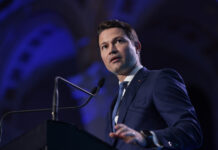
Portugal looks out at the Atlantic Ocean in the far west of Europe, Romania’s Senate president Mircea Abrudean said at Portugal’s national day on Wednesday, while at the other end of Europe, Romania defends the volatile Black Sea region (with Portuguese help).
But the two Latin nations are friends and partners with a common culture, shared values, both overcame a troubled history and share a similar political outlook.
Relations have strengthened in the past two years between the European Union and NATO members. The two countries are going though “a golden era” Ambassador Paulo Cunha Alves told some 400 guests who’d gathered at the National Museum of Art on a sweltering hot June evening to celebrate Dia de Portugal or Camões, and Portuguese Communities Day, named after the 16th-century national poet.
Portugal maintains a continuous military presence in Romania as part of the NATO enhanced forward presence on the Eastern Flank. The Portuguese Armed Forces regularly rotate detachments of some 300 soldiers, primarily deploying mechanized infantry units and special operations forces.
“At the political level, the intensification of regular high-level meetings and contacts between the Romanian and the Portuguese authorities continues. It is perhaps in the defense field that Portugal’s bilateral relationship with Romania has most flourished. It is in Romania that Portugal has its strongest military presence outside its borders, and that presence has been repeatedly reinforced. It is part of our commitment to Romania, to NATO, and to the European security architecture,” Ambassador Cunha Alves said.
“War ravages too many parts of the world. Four years on, Russia’s brutal war of aggression against Ukraine goes on and remains a direct threat to the collective European security architecture and international stability. Portugal fully condemns Russia’s actions and stands wholeheartedly behind Ukraine,” he continued.
There are some 50,000 Romanians living in Portugal and about 2,000 Portuguese in Romania, working in corporate management, engineering, and the diplomatic corps according to Romania’s foreign ministry.
To celebrate Portugal’s national day, guests_ diplomats, government and military officials, local Portuguese nationals and friends of Portugal_ were treated to a spectacle of dance, music and song by the folklore group of the University of Coimbra, Portugal’s fourth-largest city.
The Group of Ethnography and Folklore of the Academy of Coimbra known as GEFAC, founded in 1966, has collected and documented elements of Portuguese popular culture, such as traditional music, dances, theater, customs and habits of Portuguese rural communities.
They transformed these into contemporary cultural expressions, from theater performances to musical or dance spectacles, with the aim of making the common heritage accessible to all.
A group of artists delighted guests with a nine-piece performance of song, dance, live music and theater, ending with the Fandango, an uplifting main folk dance accompanied by guitars, castanets, tambourine or hand-clapping.
Guests left the auditorium at the National Art Museum on a high note and headed for a culinary feast of traditional Portuguese cuisine which included Pastéis de Nata and cod bacalhau com natas_ a dish of cod fish with potato, cream and many other delicious dishes.
Here is Ambassador Paulo Cunha Alves’ speech in full (provided by the Portuguese Embassy):
Your Excellency, the President of the Senate,
Madam President of the Constitutional Court,
Madam Secretary of State for European Affairs,
Other members of the Romanian Government,
Members of Parliament, State Counsellors,
Representatives of the Romanian Armed Forces,
Heads of Diplomatic Missions,
Director of the National Museum of Art,
Ladies and gentlemen, dear friends,
Welcome to the celebration of the Day of Portugal, of Camões, and of the Portuguese Communities. We are delighted to have you here with us on this special occasion, a day when we remember our most celebrated poet, Luís de Camões, who, more than anyone else before or since, best expresses Portuguese identity, language, and culture.
That tradition and identity that Camões so elegantly interweaves in his epic work, The Lusiads, has informed our nation’s character, history, and its view of its place in the world, shaping our foreign policy and how we relate to other people, cultures, and countries. It consolidates our values and frames our guiding principles.
For Portugal, multilateralism is a fundamental cornerstone of its foreign policy. This centrality is rooted in a profound understanding of our national and collective history. It clearly affirms that only a strong, rules-based international order, underpinned by the UN Charter, can enable us to strive effectively for peace and global stability.
Last week, Portugal was elected as a non-permanent member of the United Nations Security Council for the 2027-28 mandate. This is a great responsibility, and Portugal will strive to be a reliable, predictable, and faithful partner that privileges dialogue with all states on equal terms.
We are under no illusion about the magnitude of this task. Like never before, multilateralism claims to be the most effective guarantor of international peace and security, which is under immense and constant pressure.
War ravages too many parts of the world. Four years on, Russia’s brutal war of aggression against Ukraine goes on and remains a direct threat to the collective European security architecture and international stability. Portugal fully condemns Russia’s actions and stands wholeheartedly behind Ukraine.
This brings me to another fundamental pillar of multilateralism and Portuguese foreign policy, one that is deeply rooted in our ethos and that this year celebrates an important milestone. Thirty years ago, the Community of Portuguese Speaking Countries, CPLP, was created.
This organisation serves as a major vehicle for diplomatic coordination, cultural and economic cooperation across all domains among all Portuguese-speaking countries. Our common language, our shared heritage, and our diverse cultures thrive as a continuous example of working through our historical challenges.
There is yet another very important landmark commemoration: 40 years ago, Portugal formally acceded to the European Union. To say this decisive step was transformational is an understatement: it was profound. EU accession allowed for the consolidation of Portuguese democracy, sustained economic growth, and other advancements. European integration has brought many challenges, but many more opportunities, helping to consolidate Portugal’s place within the European family.
In the context of EU enlargement, I’m happy to note that membership talks with the Republic of Moldova and Ukraine will formally start next Monday in Luxembourg.
Naturally, to advance and advocate for these causes, we need the support of our partners and allies. Portugal is happy to count on Romania among its closest partners and friends. Last year, I mentioned that the bilateral relationship between Portugal and Romania was going through a golden era. Twelve months later, I’m happy to note that this level of excellence is being maintained.
Year upon year, we’re bearing witness to a sustained increase in people-to-people and business-to-business exchanges between our two countries. More Portuguese companies are present in Romania, where they have found a market of opportunities.
I’m happy to announce that this dynamism has led to the upgrade of our Trade and Investment Agency Office from a Representation to a Delegation. In practical terms, this means that from the beginning of July we will have an in-country Trade and Economic Counsellor.
In turn, more Portuguese citizens are finding a home in Romania, contributing to a prosperous and solidarity-based community, underpinned by the Portuguese community association, Academia do Bacalhau of Bucharest.
At the political level, the intensification of regular high-level meetings and contacts between the Romanian and the Portuguese authorities continues. It is perhaps in the defence field that Portugal’s bilateral relationship with Romania has most flourished. It is in Romania that Portugal has its strongest military presence outside its borders, and that presence has been repeatedly reinforced. It is part of our commitment to Romania, to NATO, and to the European security architecture.
I greet the Portuguese military commanders here present, as well as their Romanian counterparts, who have gone above and beyond in how they have received our soldiers.
These are all very important elements, but a strong relationship between peoples must underpin the relationship between States. As Ambassador of Portugal, I have elected people-to-people contacts as a cornerstone of Portuguese-Romanian relations.
This year, the Portuguese Embassy, together with the Camões Institute, has done so by designing and implementing an ambitious cultural programme to bring together Romanian and Portuguese citizens and to promote increased intercultural exchange and knowledge sharing.
We have consolidated the network of Portuguese Language Centres and expanded Portuguese language learning programmes with more schools, in addition to those already providing bilingual learning options.
Furthermore, together with the Embassy of Brazil, we organised, for World Portuguese Language Day, a blend of Fado and Bossa Nova innovated by Madalina Petre, alongside other manifestations of Lusophone cultures. Likewise, we organised the second edition of the Portuguese Language Film Festival, this time in Bucharest, building on the resounding success of last year, in Timisoara.
And that brings me to this evening. We will soon be delighted by a performance by the Ethnography and Folklore Group from the University of Coimbra, whose mission has been to collect and promote Portuguese popular and intangible cultural heritage. This evening’s performance will immerse the audience in Portugal’s cultural expressions, enveloping us in its regional diversity and in the portrayal of its humanity and rhythms.
I take this opportunity to thank the National Museum of Art of Romania for hosting us and, for the fourth year running, providing a venue to showcase and celebrate the Portuguese language and culture in its diverse forms.
I would like to thank our sponsors, without whose support we would not be able to organise tonight’s event. A final word of thanks to the staff of my Embassy, who have worked tirelessly over the last few months to bring the National Day celebrations to fruition. I take this occasion to remember publicly Dragos Popescu, a dedicated member of our staff for 25 years who passed away unexpectedly last March.
As a final note, please allow me to address my fellow citizens in Portuguese:
Caros compatriotas e amigos na comunidade portuguesa! Neste dia tão especial, todos devemos sentir orgulho de sermos portugueses, independentemente do local onde nos encontramos ou do que fazemos profissionalmente. Nesta ocasião festiva, em que celebramos também o nosso grande poeta Luís de Camões, precisamos de lembrar aqueles que, ao longo dos tempos, têm levado o bom nome de Portugal até longe da Pátria, nas mais diversas atividades e missões.
Por essa razão, quero agradecer à comunidade portuguesa na Roménia pelo contributo que presta à sociedade local e pelo apoio constante às atividades desenvolvidas pela Embaixada de Portugal.
Viva Portugal! Să trăiască România! Long live the friendship between Portugal and Romania.
Portugal celebrates its national day 40 years after it began path to EU membership
