













We have launched the second volume of the Economic@BNR project, in the current climate which is dominated by multiple uncertainties and challenges, a period when economic policy decisions require coherence, consistency and rigorous substantiation. The volume brings together the most relevant indicators for Romania’s economic situation, given that the nominal convergence criteria represent the quantitative matrix of sustainability benchmarks and the general basis for selecting indicators.
Especially in problematic contexts in terms of governance, it is our responsibility to respond to national economic priorities, with the rigour specific to the analyses carried out within the National Bank of Romania. Currently, the major task of public policies is to sustainably consolidate public finances and regain economic growth.
The landmarks of the analysis stem from decisive questions for Romania’s economic future. What are the key challenges of economic policies for better and more stable governance? To what extent is the correction of imbalances rapidly becoming the basis for sustainable growth? What role do we assign to the balance between the nominal and real dimensions of convergence? How do we manage, in the European context, the needs of security and strengthening competitiveness?
Economically@BNR it contributes to the clarification of such questions, through the objective of providing a platform for research, debate and financial education, highlighting the dominant challenges for the economy and society, in the national and European context.
Financial Sustainability – From Deficits to Nominal Convergence, the second volume of Economic@BNR is probably the most comprehensive x-ray of our economy’s imbalances and opportunities. The analysis provides essential benchmarks for substantiating Romania’s public policy directions in the coming years.
Published in Romanian and English, the volume is also available in electronic format, and can be consulted here: Financial Sustainability – From Deficits to Nominal Convergence.
The research highlights that recent quantitative progress is not sufficient in the long term, which requires substantial transformations if economic progress is also sustainable. It is now necessary to enter the stage of qualitative adjustments, and it becomes imperative to restore economic and financial balances.
In its European path, Romania needs clear objectives and national projects implemented consistently, the key challenges being the consolidation of public finances, financial sustainability and returning to the territory of robust economic growth.
We must be convinced that financial sustainability is the essential condition for ensuring macroeconomic stability and supporting the long-term development of the economy. In this register, I coordinated the comprehensive, thorough analysis of the most relevant themes, over ten interconnected chapters, for diagnosing imbalances, assessing vulnerabilities and outlining development prospects.
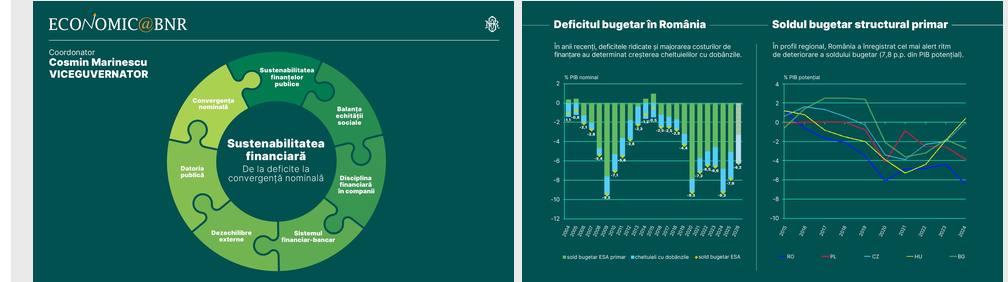
- Sustainability of public finances, by analysing structural pressures on the budget deficit and the conditions for the sustainable correction of fiscal imbalances.
- The situation of budget revenues, from the perspective of the importance of improving the collection capacity for fiscal consolidation and strengthening the sustainability of public finances.
- The situation of public expenditures, in order to understand the allocation of budgetary resources, highlighting the need to increase budgets for education and health.
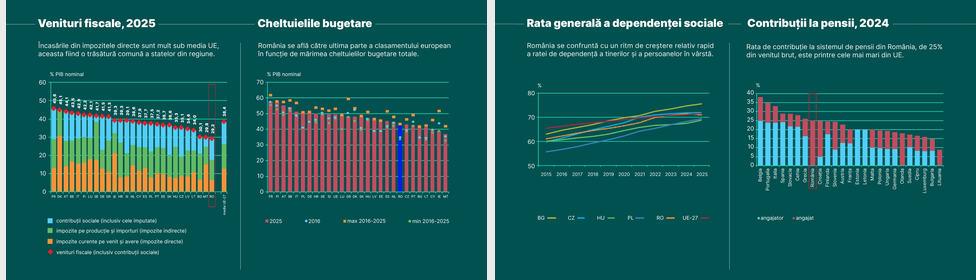
- Imbalances in social systems, analysed in terms of the principle of contribution, as well as the impact on budgetary balance and social cohesion.
- The situation of state-owned companies, examined from the perspective of governance, payment discipline and dependence on public support in the case of some of them.
- The constraints of private companies, in terms of implications for economic resilience, given the persistence of capitalization shortfalls and arrears.
- The financial-banking system, analyzed from the perspective of the degree of development and the intermediation capacity of financial resources to support investments.
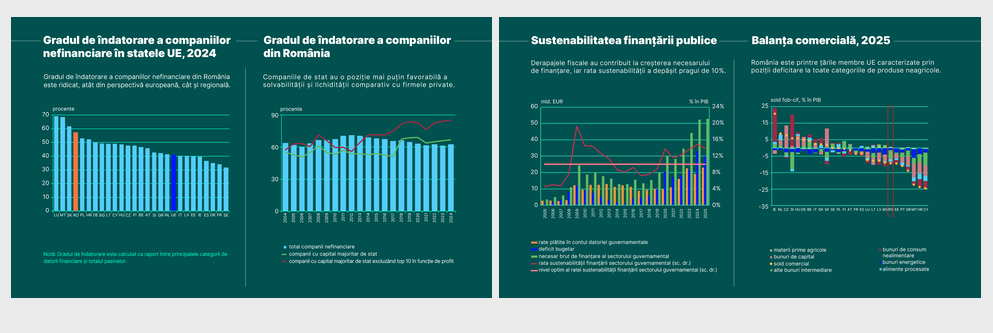
- External imbalances, reflected by the evolution of the balance of payments and the dynamics of external indebtedness, given the persistence of twin deficits as a major vulnerability.
- Managing government debt, in the context of its accelerated growth in recent years, given the importance of maintaining a sustainable financing capacity.
- Nominal convergence, considered as a key dimension of consolidation, alongside real convergence, to ensure financial sustainability.
The research highlighted both the challenges and the advantages of Romania, which are decisive for our regional and European path. Financial sustainability requires both remedying one-off imbalances, but especially structural gaps. That is why it is mandatory to ensure the institutional capacity to responsibly implement structural reforms.
I believe that the strength of the volume lies in its unitary architecture that relates public finances, financial discipline, external position, public debt and nominal convergence, in an approach that goes beyond the fragmentary reading of existing vulnerabilities.
The analysis highlights key challenges of economic policies in Romania in recent years:
➡️ Fiscal responsibility is a condition for sustainable consolidation. Balanced deficit adjustment must be accompanied by policies that support the economy’s productivity, innovation and growth potential, within a coherent and credible public policy framework.
➡️ Effective collection of budget revenues is indispensable for the sustainable correction of imbalances. In education and health, resources must be directed towards quality services, which ensure efficient investments in human capital and sustainable development.
➡️ Continued investment, especially from European funds, protects the economy’s growth potential. But European funding depends on the responsibility of governance, coherent policies and efficient management in the implementation of projects.
➡️ The fairness and sustainability of the public pension system are based on the principle of contribution. Matching contributions to benefits, increased labour market participation and private pensions ensure better income protection in retirement.
➡️ Encouraging adequate capitalisation and stronger financial discipline support sustainable growth and the economy’s resilience to shocks. It is important to strengthen effective mechanisms for the restructuring and orderly exit of non-viable firms.
➡️ The governance of state-owned enterprises must ensure financial discipline and economic efficiency. Management selection based on competency, measurable targets, adequate capitalisation and transparency can limit the vulnerabilities of the sector.
➡️ The sustainable development of financial intermediation supports investments and ensures a better use of resources. This objective requires increasing the degree of bankization of non-financial companies, the development of the capital market and financial education.
➡️ Trade diplomacy and strategic export promotion are key to increasing competitiveness and correcting external imbalances. Facilitating the access of Romanian companies to foreign markets and orienting exports towards goods and services with high added value can improve integration into global value chains.
At its core, financial sustainability is not the simple result of one-off adjustments, but the reflection of a consistent path based on discipline and responsibility. Sustainable convergence is inseparable from the quality of public policies, and effective institutions are the rules focused on decision-making responsibility and financial discipline.
Through the scope of the topics addressed and the applied nature of the analyses, the second volume of Economic@BNR contributes to substantiating the economic policies so necessary to correct macroeconomic imbalances, but also to consolidate the economic path and increase our resilience in the face of future challenges.
The balance between the nominal and the real size of convergence is essential, because this is the only way to prepare the economy for the demands of the euro area. The adoption of the euro can be Romania’s country project for the next decade, conceived as a national strategic project, not just as monetary integration mechanically anchored in nominal convergence.
Romania’s entry into the eurozone should not be seen only as a technical or formal exercise. It is a profound process of economic and institutional maturation, aimed at catalyzing the structural consolidation of the economy, deepening trade integration, strengthening financial resilience, increasing well-being and living standards in society. In this register, the euro becomes the expression of national maturity in the architecture of European convergence.
