




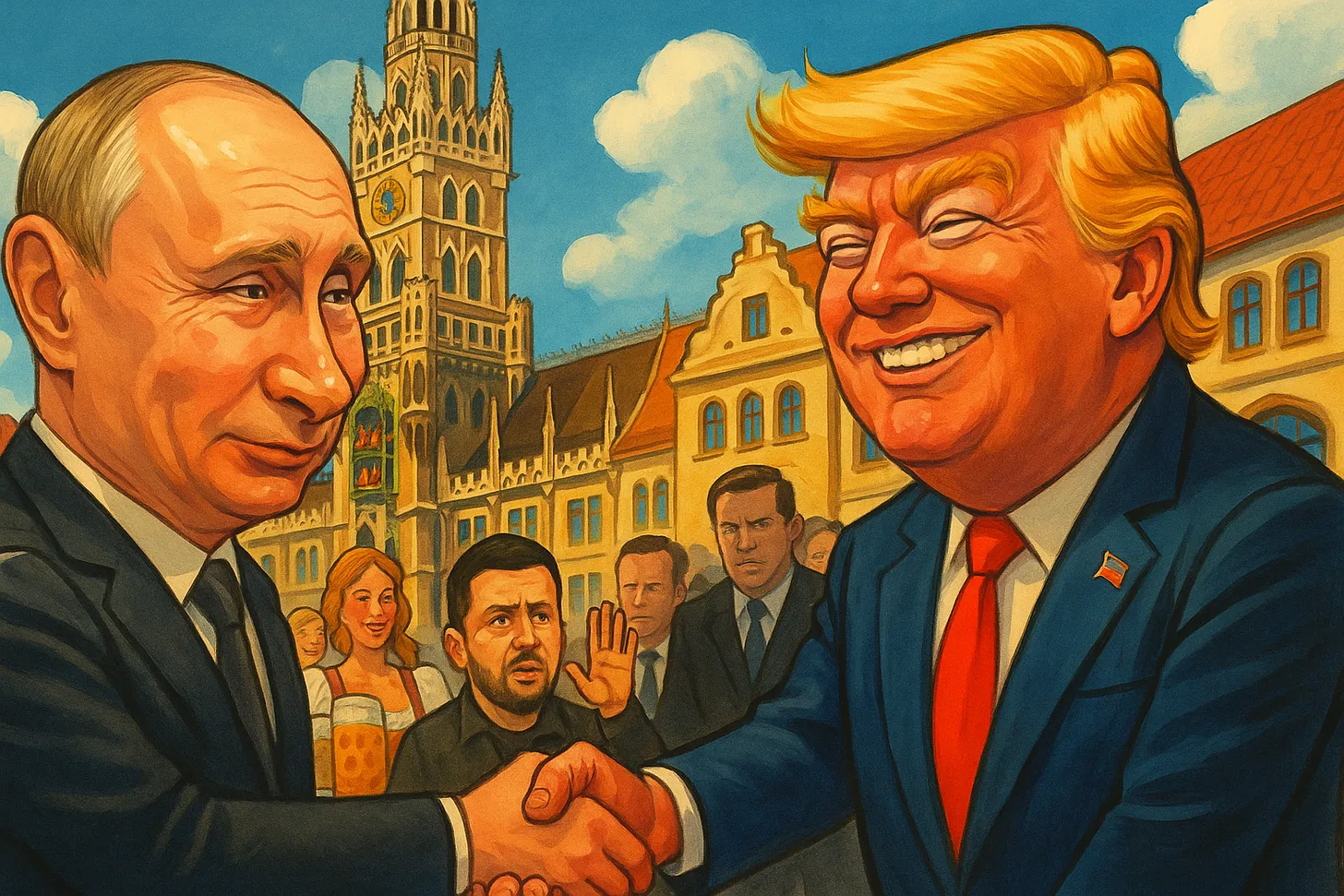
Someone should tell Trump how Neville Chamberlain is remembered
In late September 1938, as the leaders of Britain, France, Germany, and Italy converged on Munich, the sense of crisis in Europe was palpable. But in Prague, the emotion was something closer to disbelief. For years, Czechoslovakia had been assured, explicitly, that it would not stand alone in the face of German aggression. France had a treaty of mutual defense dating back to 1924. Britain had repeatedly indicated it would not permit the coercive dismantling of a European democracy. And above both lay the League of Nations’ collective-security architecture, which, though battered, still existed in principleS.
Czechoslovakia had acted on these assurances. It built an elaborate defensive system along its mountainous Sudeten frontier — reinforced bunkers, anti-tank obstacles, artillery emplacements — designed to hold off a German advance long enough for France to mobilize. Its army was well-trained. Its leadership believed, that a Europe dedicated to preventing another continental war would not abandon a democratic ally.
And yet, as Hitler intensified his demands for the Sudetenland, home to several million ethnic Germans, in the summer of 1938, these guarantees began to unravel. In London, memories of Verdun and the Somme, two of the most brutal battles of World War I, made governments and citizens recoil at any hint of mobilization. In Paris, political instability left leaders paralyzed. Both powers gradually shifted to hoping they could pacify Hitler. By September, Prague was being pressured not merely to negotiate but to capitulate.
This was the backdrop to the Munich Conference. The venue — the Fuhrerbau, Hitler’s own headquarters on Munich’s Konigsplatz — symbolized the power imbalance from the outset. Chamberlain arrived looking cautious and worn; Daladier appeared solemn, pessimistic; Mussolini strutted theatrically; and Hitler greeted them all with the poised confidence of a man who sensed victory without having to fire a shot.
Inside the building, historians record that the mood was tense, brittle, almost surreal. Diplomats who suspected Hitler’s intentions still found themselves drifting toward concession, pulled by the seductive logic that one last compromise might avoid war. Hitler insisted on the immediate transfer of the Sudetenland, describing it as Germany’s final territorial demand. Chamberlain, haunted by the carnage of 1914–1918, wanted badly to believe this. Daladier doubted it but knew France would not fight without Britain.
Czech President Volodymyr Zelensky — whoops, sorry, I mean Edvard Benes — was not invited to the party.
In the Munich Agreement that emerged, Czechoslovakia was ordered to surrender the Sudetenland — its defensive shield, its fortified highlands, its industrial heartlands, and nearly four million citizens. Britain and France did not merely tolerate the demand; they enforced it. Prague was told to accept the deal or bear sole responsibility for war. It was essentially told: “You have no cards.” A country built on democratic values and Western alignment found itself pressured into dismemberment.
What made Munich a betrayal was not only the substance but the abandonment of earlier promises, and the ignoble form of a diktat. France ignored its treaty obligations. Britain reversed its assurances. The League of Nations proved irrelevant. Munich revealed, with devastating clarity, how quickly collective security collapses when great powers fear the cost of upholding it.
Yet the agreement was hailed as a triumph. Chamberlain returned to London waving the famous paper and proclaiming “peace for our time.” The crowds cheered; journalists backed it. But the underlying reality was already visible to anyone willing to look. Germany had built a war machine and a war economy.
Within six months Hitler swallowed the rest of Czechoslovakia. Within a year Europe was at war. Poland, Austria, Hungary — the dominos began to fall. Soon the Soviet Union was attacked, despite another shameful deal called the Molotov-Ribbentrop pact.
Chamberlain was ousted and replaced by Winston Churchill, who promised “blood, toil, tears and sweat” in his inaugural speech as PM in May 1940. He delivered: within months London and Britain were facing a “blitz” by the Luftwaffe — an eight-month bombing campaign that killed over 40,000 people.
America wanted to look the other way as Hitler mauled Western Europe as well. The result was Pearl Harbor. The United States lost almost a half million soldiers in a world war that might have been avoided, but for the blindness and cowardice of Munich.
Munich is remembered not just, then, for its glockenspiel, hofbrauhaus and Oktoberfest (though I recommend them all); it is a concept: a diplomatic reflex whereby great powers seek an expedient peace by sacrificing the security of a smaller nation.
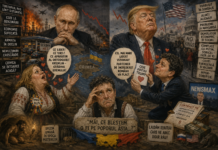
And it is this pattern that casts a long and disquieting shadow over the 28-point plan circulating in recent days in Washington and European capitals for “ending” the Russia–Ukraine war. It was concocted by Putin and Trump’s teams above the head of Ukraine and without consulting the Europeans — which itself, during normal times with a responsible Washington, would be literally unbelievable.
The plan shares several structural features with the Munich diktat, even if the historical circumstances and the actors differ.
- First, both proposals revolve around compelling a besieged democracy to surrender key territory to an aggressor. In 1938, it was the Sudetenland. In the modern plan, it is Crimea and large swaths of Donetsk and Luhansk—codified, legitimized, and effectively removed from negotiation.
- Second, both settlements seek to limit the victim’s capacity for self-defense. Czechoslovakia lost the fortifications that made its defense possible; Ukraine, under the modern plan, would be required to cap its armed forces, accept demilitarized zones, and renounce NATO membership (which it had been offered at the NATO summit in Bucharest in 2008) — thereby forfeiting its strategic safety net.
- Third, both reward aggression rather than deter it. Hitler gained the Sudeten industrial infrastructure, which he quickly redirected into his war machine. Putin, under this blueprint, would receive recognition of territorial gains, eventual sanctions relief, and even joint investment initiatives with the United States. Incredibly, it is to be reinvited to an expanded G-7.
- Fourth, the supposed “guarantees” offered to the victim mirror the fragility of 1938. Those promised to Czechoslovakia evaporated the moment Hitler violated them. The modern plan offers security guarantees that become void if Ukraine retaliates, meaning Russia could test the limits of the settlement without triggering consequences. Guarantees that bind only one side are not guarantees at all.
- Fifth, both settlements hide their asymmetry behind procedural theatrics. Munich featured Mussolini’s staged “mediation.” The new plan features a “Peace Council,” potentially chaired by Trump, with sweeping authority but dubious power. Economic reconstruction funds serve as the moral gloss, much as 1938’s rhetoric invoked stability and historical justice.
- Finally, both include mechanisms that shield the aggressor from accountability. Munich contained none. The modern plan includes sweeping amnesty for wartime actors, potentially insulating Russian commanders and officials from scrutiny for atrocities.
Adding insult to injury, the plan demands Ukraine (a troubled democracy under duress) hold elections within 100 days — but makes no parallel demand of Russia (a dictatorship with a completely criminal rogue kleptocracy as its regime). It also dignifies Putin’s bullshit about “Nazi” governance in Ukraine, demanding it be banned. A caricature of capitulation would struggle to be more absurd.
The Munich parallel is not meant to imply that 2025 is 1938.
Ukraine is not isolated as Czechoslovakia was; it has allies, substantial military capability, and a population that may be unwilling to accept dismemberment. The international system today — though fraying — possesses more tools and transparency than the League of Nations ever mustered.
And Putin, for all his brutality and revisionism, is not Hitler in ideology or scale. Russia’s war has been horrific, but it is not animated by a genocidal world-conquest doctrine of the kind Hitler embraced. Although Putin can be expected to continuing messing with Western democracies by trying to get far-right quislings elected in them, he is unlikely, say, to blitz the UK or invade France. But he might definitely try to seize a slice of the Baltics, which would draw in NATO.
I might also point out that Hitler in 1938 was not yet the Hitler of 1939. When Chamberlain looked across the negotiation table, he did not see the architect of the Holocaust or the invader of the Soviet Union; he saw a ruthless but possibly limited expansionist whose appetite might be contained by diplomacy. That misreading proved catastrophic.
The danger lies in repeating the mistaken assumption that an aggressor’s ambitions can be bounded by satisfying them. Munich teaches that peace purchased through territorial concession is rarely peace at all — only a pause before the next demand.
So here’s where we are now.
The Europeans bristled at the plan, calling it a basis but not a sufficient one. That is polite of them. Zelensky gave a somber speech, hedging, calling it a historic moment, and warning Ukraine might lose an ally. That was mature of him.
Trump acted like Trump, demanding an answer from Zelensky this week and saying the Ukrainian president can agree or “fight his little heart out.” That was very thuggish of him, exactly as we’d expect. But then he backpedaled, saying it was not his final offer. I guess he needs to check with Putin.
I should be clear: I’m not naive about any of this, nor am I a Ukraine maximalist. There may be a limit to how long they can resist, or should be encouraged to. The history of the region is too complicated for inflexible maximalism.
I have been to both Russia and Ukraine repeatedly over decades. I first visited Ukraine on the very week it declared independence, watching a nation step into an uncertain light. I have followed Putin’s rise from the beginning and spent years leading AP coverage of his benighted reign. When Mikhail Gorbachev was still alive, I sat with him in Moscow and asked directly about Putin. Even Gorbachev, the man who presided over the end of the Soviet empire, showed unmistakable fear of Putin. You learn to trust moments like that.

This is a complicated region. My parents were from Eastern Europe; I grew up with the maps and the memories, and I know the history — the partitions, the shifting borders, the invented “republics,” the times in which entire populations woke up one morning to find their nationality has changed on paper. The internal borders of the former Soviet Union, and of many Eastern European countries, have always been fluid and in some cases partly fictitious.
So it is not completely irrational for Russia to covet parts of Ukraine where the language is Russian, the history intertwined, and where Moscow once exercised total control (though, for the world’s largest country, it is gluttonous to be sure). I never dismissed the possibility that territorial adjustments might ultimately be part of a settlement.
But here is the point: such adjustments cannot come as a reward for aggression that nets positive for the aggressor. They cannot arrive through invasion, annexation, or terror from the sky. If this war ever ends with Russia holding pieces of Ukraine, then Ukraine must be massively compensated and Russia must be massively punished. It must be unambiguous that Russia lost more than it gained — economically, politically, militarily, and strategically. And any agreement must guarantee in a real way, not a Trumpy way, that Russia will never again be tempted to attack a neighbor in this way.
That is the threshold for a credible peace. The 28-point plan does not come close.
What was signed in Munich in 1938 was celebrated as the end of crisis. In truth, it was only its beginning. The architects of modern proposals would do well to remember that the past’s most painful lessons are not metaphors but precedents, and that the cost of misjudging an autocrat’s ambitions can be measured not just in land, but in lives. Do any of us believe Trump knows history, or understands its lessons? This is a major problem that urgently needs addressing.
