












Guardrails are useful in preventing corruption and foolishness
By Mihai Razvan Ungureanu and Dan Perry
Romania, which is today holding a rerun of its presidential election, is the improbable ground zero of a new-old global struggle: the populist war against the so-called “elites” and their quaint ideas about fact-based reality, liberal democracy and the values of the Enlightenment.
How did Romania get here? Well, a first effort at balloting in November 2024 was won by a Euroskeptic Kremlin backer after massive social media-based Russian election interference, causing Romania’s Constitutional Court to annul the election, ban the candidate, and prompt a redo. Then, at the Munich Security Conference in February, US Vice President J.D. Vance took a side — Vladimir Putin’s: “Romania straight up canceled the results of a presidential election based on the flimsy suspicions of an intelligence agency,” Vance said, even though there was nothing flimsy about it. “You don’t have shared values if you cancel elections because you don’t like the result … if you’re so afraid of your own people that you silence them and shut them up,” he said in another speech. Elon Musk took to tweeting about censorship.
This Balkan drama is part of a broader global story: Democratic institutions are being undermined around the world not just by external threats but from within. Elected populist leaders are trying to deploy the legitimacy of the ballot box to defang judicial oversight, muzzle the press, and eliminate accountability. This is not democracy at work—it is elections being weaponized to eliminate the guardrails that prevent corruption and despotism. It is the idea that once elected, you can do anything you want.
In Romania, the Constitutional Court — a body whose members are appointed, not elected — embodies the post-communist elite consensus that has shaped Romania’s institutions. Moreover, the country’s two dominant parties, the center-left Social Democrats and center-right National Liberals, which have generally traded power since the fall of communism and are themselves widely viewed as elite pillars, also rallied behind the annulment in horror at the Kremlin-aligned candidate’s success. That has made Romania a prime example of what Donald Trump and his allies see as a global elite conspiracy to control outcomes and suppress “the people.”
Which is why it must be said: It is the much-besmirched “elites” who are protecting democracy — in Romania and in many places around the world. Because democracy does not and should not mean unlimited power for the executive branch of the government. Democracy is more than an election: It is rights and protections and checks and balances.
Since Plato’s warnings in The Republic about the dangers of unchecked democracy, thinkers across history have grappled with how to balance popular will with the need for order, reason, and virtue. From America’s James Madison to Britain’s John Stuart Mill, the architects of modern democracies believed that liberty and reason needed protection from mob rule. The US Constitution was designed not to reflect every popular impulse but to contain them. The same was true of the Magna Carta, the French Revolution’s “Declaration of the Rights of Man and of the Citizen,” and even the post-communist constitutions of Eastern Europe. All were created not by spontaneous popular will, but by relatively small groups of educated, empowered individuals. Elites, in other words.
Romania’s own transition from dictatorship to democracy — beginning with its 1991 constitution after the Romanian revolution and the collapse of the communist regime — was steered by such figures who laid the groundwork for liberal institutions that endure today. The country’s history produced a deep societal aversion to centralized, unaccountable power, which in turn shaped a generation of reform-minded elites who crafted institutions designed to prevent a return to authoritarianism. Working alongside legal and political experts from around the world, Romanian leaders consciously sought to embed liberal democratic principles (which have nothing to do with the word “liberal” in US leftist politics) into the country’s foundation: separation of powers, judicial independence, multiparty elections, and protections for individual rights. Despite ongoing challenges, Romania’s system remains committed to these guardrails essential to liberal democratic governance.
Crucially, Romania’s European Union and NATO integration processes reinforced these structures by requiring anti-corruption reforms, press freedoms, and civil society engagement. Successive reforms, including EU-aligned anti-corruption drives and press freedoms, were likewise elite-led rather than populist in origin (which, in Romania’s case and others’ was always on the edge).
Unlike the aristocratic and philosophical elites of centuries past, modern elites operate in a digital, democratic ecosystem — more visible, more contested, and yet more vital. They are shaped by international educations, think tanks like business magnate George Soros’ Open Society Foundations, and civic initiatives promoting liberalism. It has had great support.
But there are those, such as Putin, who would like nothing more than to turn back the clock – in Romania and in other countries too. Putin’s motivation is part of a broader strategy to destabilize democratic institutions on NATO’s eastern flank. Romania, as a relatively successful post-communist state deeply integrated into Western alliances, represents precisely the kind of liberal democratic model that threatens the Kremlin’s narrative of inevitable Western decay. Undermining Romania also serves multiple strategic goals: testing EU resolve, fracturing unity in Eastern Europe, and sowing distrust in electoral processes. It’s a low-cost, high-yield theater for Russia’s hybrid warfare — especially in an election cycle vulnerable to digital manipulation.
In late 2024, these dynamics reached a crisis point. A fringe ultranationalist and conspiracy theorist named Calin Georgescu stunned observers by winning the first round of Romania’s presidential election propelled by a last-minute explosion of TikTok-driven disinformation. Investigations by an internal TikTok later revealed a coordinated network of about 4,500 accounts, though Romanian separate reports claim the number of involved accounts was far higher, perhaps 25,000. Reports based on Romanian intelligence say many of them are tied to Russian influence operations, and they generated tens of millions of impressions in the final days of the campaign. Romanian prosecutors, according to Bloomberg, requested assistance from Turkish authorities to investigate over 20,000 TikTok accounts. These accounts used Turkish IP addresses and were created with Russian email domains shortly before the Romanian election.
The Kremlin denied any election meddling. of course.
The narrative promoted in the TikTok videos was a familiar stew of anti-elitism, vaccine paranoia, and Kremlin-aligned talking points favoring the far-right candidate. Emotional appeals portrayed Georgescu as a lone voice of truth against a corrupt ruling class, often using dramatic music, black-and-white filters, and teary testimonials accusing Romania’s leaders of “selling the country” to foreign interests. Videos cast Georgescu as the only candidate who “cares about real Romanians” amid a national moral decline and promised to “give the country back to the people.”
Faced with what intelligence authorities called a foreign-influenced digital coup, Romania’s Constitutional Court took the extraordinary step of annulling the results, later barring Georgescu from the next round of voting. The National Authority for Management and Regulation in Communications of Romania, invoking the European Union’s Digital Services Act )whose purpose is to regulate online platforms to ensure a safer, more transparent, and accountable digital environment), and demanded algorithmic transparency from platforms, and called for TikTok access to be suspended.
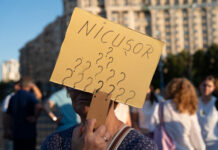
Protests were minimal. But all this triggered outrage across Trump-aligned circles in the United States and abroad who accused Romania’s elites of canceling the will of the people, including Vance, former White House chief strategist Steve Bannon (who met recently with George Simion, another Romanian ultranationalist), and Hungarian Prime Minister Viktor Orban, who said Romania was useful as a case study in how to avoid social media campaigns that might provide courts with “a pretext to annul” elections.
The richest person in the world and fervent Trump ally, Elon Musk himself, weighed in, reposting a photo of Romania’s communications regulator with the caption: “You can tell who the bad guys are by who is demanding censorship.”

But this was not censorship. It was an intervention to safeguard a democratic system under digital siege. Romania’s so-called elites — including constitutional scholars, anti-corruption prosecutors, liberal politicians, and journalists, many of whom were educated in Western institutions and remain committed to democratic norms — corrected the outcome of an election desperately corrupted by foreign interference. They enforced the law. They exercised judgment. The system protected itself from manipulation.
“Liberal democracy” is not merely the act of electing leaders, but a system defined by the belief that even majorities and elected leaders must be constrained by principles. This is the moment when those who still believe in this should step up — journalists and educators, judges and public servants, scientists and philanthropists, and also business leaders who care about more than just the bottom line. In Romania, that has meant using EU law to demand transparency from tech platforms and cancel tainted elections, whatever their result. In the United States, it could mean embracing civic education and media literacy while resisting pressure to gut institutions.
Either way, there will always be an important role for the “elites.”
Mihai Razvan Ungureanu is the former prime minister and foreign minister of Romania, headed the country’s external intelligence service, and is a professor of history at the University of Bucharest.
(A version of this article appeared in Foreign Policy)
