












Britain’s new PM should start the undoing of Brexit and lead NATO’s European flank back into the coalition against an increasingly outrageous Iran
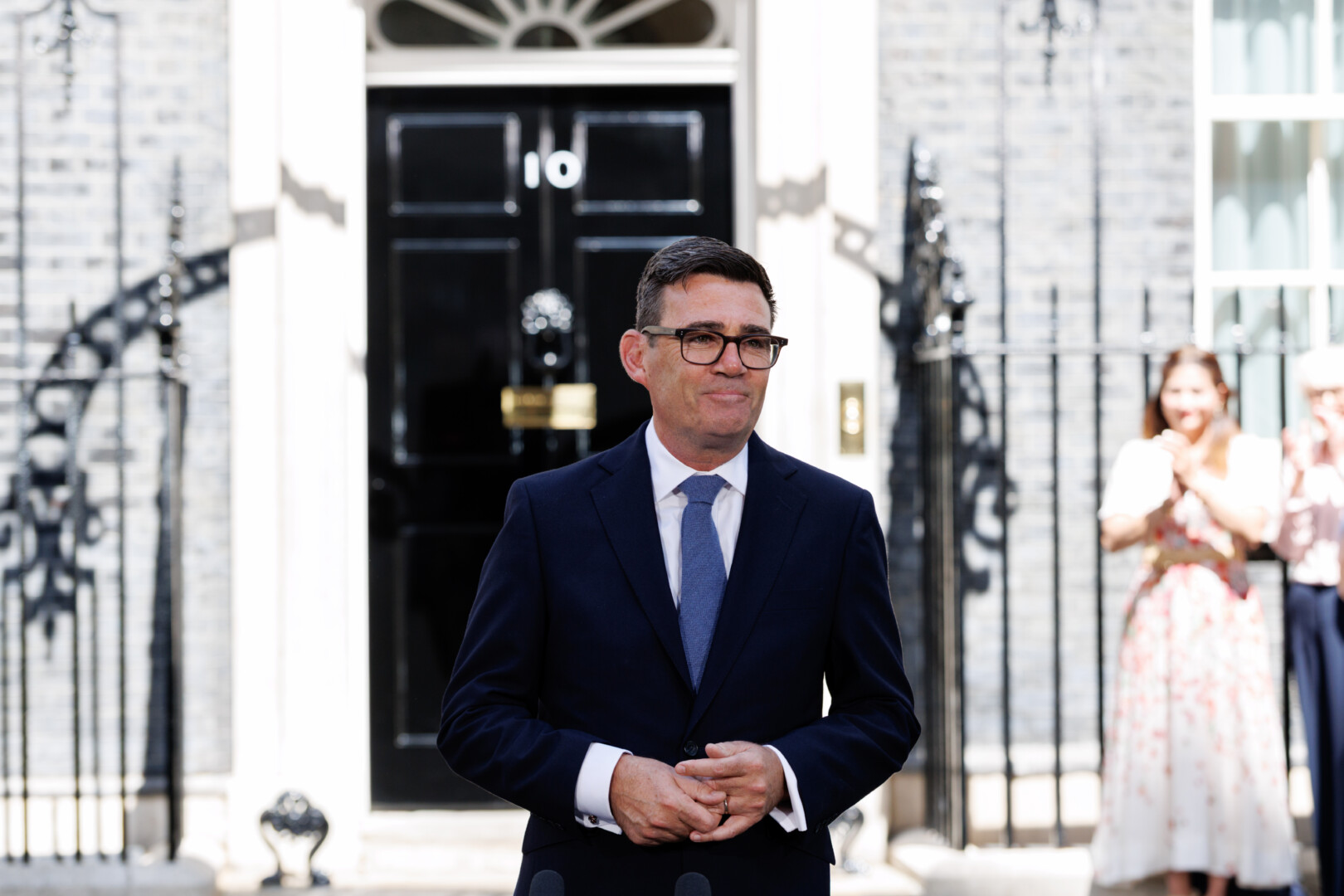
Andy Burnham took over as British prime minister today after the comic unraveling of Keir Starmer’s government, amid the charming pomp and circumstance only Britain can produce. At Buckingham Palace he met with King Charles who pretended to have a say in the choosing of ”His Majesty’s” Cabinet ministers. “It will be the start of a relationship between the Right Honorouble Andy Burnham and his Sovereign,” gushed the Sky News announcer. Priceless.
Burnham emerged as PM and promptly promised “a ten-year plan,” cost of living relief, decentralization, ending homelessness, collaborative government and “positivity,” public housing and mental health support for youth. It was a short speech completely focused on domestic politics and light on specifics — fine for the populist era, but hardly a recipe for Britannia to once more “rule the waves.”
Burnham seems faithful to his long-standing commitment to devolving power away from Whitehall, and also to an instinct for progressive, interventionist economics. Will that help or further burden an economy that has spent a decade underperforming? Commenting on this on Indian television, I offered a different approach to the new prime minister — about foreign policy. If Burnham really wants to leave a mark, and actually turn around Britain’s stagnant economy, then first, start undoing Brexit, and .second, help lead Europe to a serious Iran policy.
Even if your inclination is to be skeptical, consider the following. You may be convinced.
The first should almost be obvious by now.
Brexit has had nearly a decade to justify itself. Instead, Britain finds itself economically stagnant, diplomatically diminished, and increasingly detached from the continent to which it inevitably belongs. The fantasy that Britain could become a kind of offshore Singapore while simultaneously preserving every advantage of European integration has collapsed under the weight of reality.
Public opinion has moved. Most Britons — about 60 percent — now believe Brexit was a mistake, even if many understandably dread reopening the political trauma that accompanied it. That does not mean Burnham should promise another referendum tomorrow morning. It means Labour should stop pretending the question no longer exists. The party desperately needs a positive national project. Higher taxes on successful professionals (as opposed to the truly uber-rich) are not one. Rejoining the European mainstream — carefully, pragmatically and honestly — would be.
Burnham, unlike Starmer, may actually possess the political confidence to say what Labour has spent years whispering: Britain belongs in Europe. Not because every grievance that produced Brexit was imaginary but because geography, economics and history remain stubbornly indifferent to political slogans. Because even if the reptilian Michael Gove claimed “the people have had enough of experts” — populist piffle per excellence — the experts know math.
And the math is pretty clear. Britain’s own Office for Budget Responsibility estimates that Brexit will leave UK imports and exports about 15 percent lower than they would have been inside the European Union and reduce the economy’s long-run productivity by 4 percent—an enormous permanent loss disguised by the slow pace at which it accumulates. GDP per person fell slightly in 2024 and then stagnated through much of 2025. The supposedly triumphant replacement trade deals are almost comically small beside the damage. Put bluntly, Britain surrendered frictionless access to its largest, richest and nearest market in return for deals with Australia, India and so on whose combined projected gains amount to a tiny fraction of the output Brexit destroyed. Incredibly, even immigration from the developing world is way up — replacing the lost Romanians and Poles.
The second challenge lies beyond Europe, but it may define Europe’s future just as much. The confrontation with Iran is making Europe look as ridiculous as Trump, and that is pretty bad. Many European governments found themselves unable to support a strong response to the Iranian regime’s outrages — from massacring protestors to turning Hormuz into an Ayatollbooth, not because they had suddenly become sympathetic to jihadist mania but because Trump — a fool last heard from spewing tariffs and threats to attack Denmark — was the advocate. That’s understandable, since Trump cheapens almost every argument he touches, but it is still wrong, and it has given Tehran strength and succor.
Iran’s criminal leadership benefited from a colossal American error in not planning for the blocking of the Strait of Hormuz, through which a fifth of global oil and LNG flows, and much more. Trump panicked and capitulated, signing an MOU that abdicates almost every war aim: Iran commits to no reforms, continues backing terrorist militias around the Middle East, continues a ballistic missile program capable of reaching Europe, does not even promise to cease its massacres, and gets perhaps a half trillion dollars in the bargain. Instead of taking yes for an answer, the regime is now insisting on control of the Strait of Hormuz, which would give it long-term income, violate international law, and encourage copycat shakedowns at other global choke points.
This is a declaration of war against the world and the world should reject it clearly. Britain’s navy has been much depleted since the Falklands war, of which we have been recently reminded, but it still has a say. Burnham should say it. He should make clear that the UK will help lead a coalition prepared to defend international navigation, deter Iranian aggression, and make clear that coercion of the world’s shipping lanes will meet a unified response.
(Indeed, in the broadcast I urged Indian PM Modi and others to do the same.)
Undoing Brexit would provoke resistance, and building a coherent European response to Iran would require persuading governments that have grown accustomed to strategic hesitation. But politics does not always reward cowards. Burnham might consider what happened when England turned to bunker-mode defense after its first goal against Argentina (it lost momentum and the semifinal, 2-1, to the FIFA-assisted Messi gang).
Burnham has inherited office after a government that slowly dissolved through drift, managerialism and an inability to articulate a compelling national purpose. He now has the chance to give Britain one. Become the prime minister who finally acknowledges that Brexit was a historic mistake and begins the long journey back toward Europe. Become the European leader who reminds the continent that defending the international order cannot depend on whether the current occupant of the White House is corrupt, embarrassing or both.
There is a political reality that Burnham must contend with. Its huge parliament majority is based on an illusion. Labour did not so much win the 2024 election as watch the Conservative Party disintegrate. Starmer secured barely more than a third of the vote — only slightly better than Jeremy Corbyn’s supposedly catastrophic showing in 2019 — yet emerged with one of the largest majorities in modern British history. The Conservatives collapsed after years of psychodrama, incompetence and exhaustion. Nigel Farage’s newish far-right Reform party split the vote on the right. Britain’s first-past-the-post system then converted that fragmentation into a Labour landslide in the seat count in parliament.
Once in power, Labour had no compelling explanation for why it existed beyond the fact that the Conservatives had become intolerable. Starmer offered cautious semi-competence without a shred of inspiration, and weird little scandals about Taylor Swift tickets and the like. The voters began looking elsewhere (as Alison Mutler examined in this AQL story).
Reform continued eating into Labour’s working-class and post-industrial vote, especially among people who feel that the political system regards their concerns about immigration, national identity and economic decline as either embarrassing or illegitimate. The Greens, meanwhile, began stripping away younger and more ideological voters on Labour’s left, including those furious over Gaza, climate policy and the government’s general air of bloodless calculation.
Thus Labour achieved the unusual distinction of being simultaneously outflanked by Nigel Farage and the Greens.
Burnham may be a better retail politician than Starmer. He has some warmth, roots, regional credibility and an instinctive sense of how to sound like a normal human being. That may slow the bleeding. It will not by itself answer the central question: What is Labour now for?
Burnham is probably right that privatization went too far — utilities and essential services should be public — but he is probably wrong that Britain can re-industrialize (he might consult Germany, whose economy may even be more sluggish than Britain’s). Of course no one can argue with a war on homelessness.
But becoming the party that begins to undo Brexit would give Labour an organizing idea large enough to justify its majority (we have explained this at length here). It would connect economic renewal, British influence, trade, investment, security and national identity. It would distinguish Labour from Reform’s backward-looking nationalism, from Conservative incoherence and from the Greens’ politics of permanent protest.
It would also require courage, which is precisely why it could work.
Burnham need not promise an immediate return to full EU membership. He can begin with customs alignment, regulatory cooperation, restored mobility, deeper security integration and a candid acknowledgment that separation has imposed costs Britain can no longer afford to pretend are imaginary. The destination can remain open while the direction becomes clear.
That would give Labour a reason to exist. Britannia will not rule the waves — indeed will not stay afloat in any version of style — again by standing alone on the shore, shaking its fist at the continent. This is an unhappy divorce. To err is human. To refuse to admit it is mulish.
