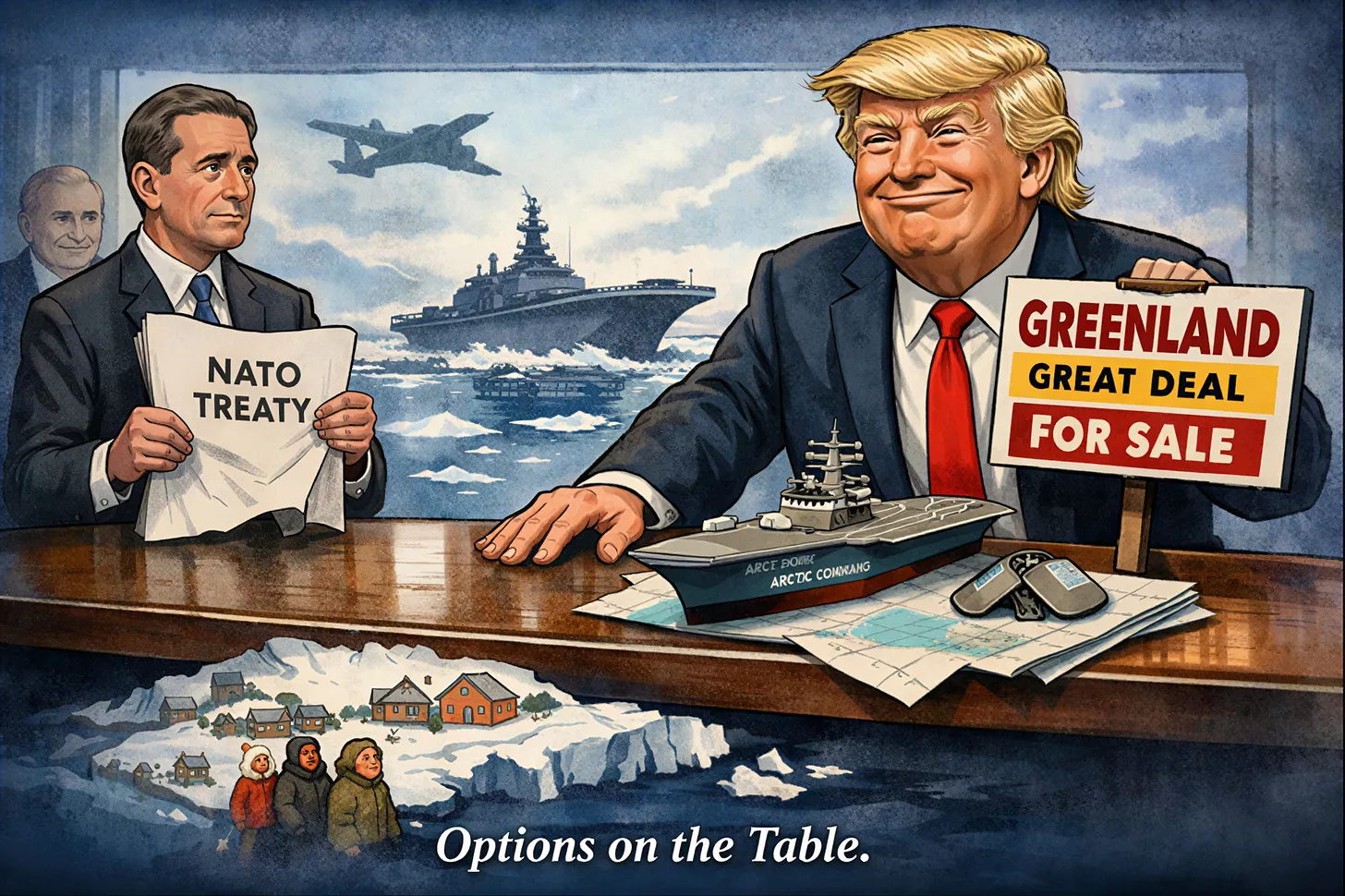
Given the latest reckless salvos from the White House, Denmark’s prime minister warned that an American attack on Greenland would mark the end of NATO.
She’s right: the absurd proposition itself, never mind an actual invasion, makes a mockery of the central idea of Western deterrence—that allies defend one another rather than raid one another.
It is so preposterous that Europe may finally be running out of patience.
Well, for nearly a decade, European leaders hoped Trump could be managed with flattery and delay. They reassured themselves that advisers would restrain him, that courts would block excesses, that elections would solve the problem.
But in his second term Trump has proven unrestrained, and Trumpworld has moved to active political intervention in Europe. He weighed openly into the Polish election, almost demanding Poles vote in a right wing president (which they did, by a whisker), and his allies cultivate far-right movements across the continent, bolster sympathetic media, and launder talking points through trans-Atlantic conferences and think tanks.
The objective is to weaken the European Union, divide NATO, and replace coordinated democratic policymaking with nationalist governments deferential to Washington or Moscow as convenient. Another excellent gift to Russia, and also China.
If Europe cannot draw a red line at threats to seize allied territory, then there is no line left to draw. If the continent shrugs at election interference, encouragement of illiberal populists, questioning of collective defense, and hints of annexation, then it has admitted that its security and sovereignty depend on the whims of one man in Washington.
There are dangers either way. But the approaching U.S. midterms are a factor and a flipping of Congress can go a long way to stopping Trump in his tracks. The American people need to understand how badly their interests are being harmed. So the time may have come for European leaders in all spheres of life to say — publicly and without euphemism — that the United States has become an unreliable steward of the order it once built, and that this unreliability will have consequences. Those consequences should be practical.
Europe possesses the world’s second-largest economy, enormous market power, significant regulatory reach, and the capacity, if it chooses, to build serious military capability. It is capable of imposing costs. It can make clear that treaty obligations are reciprocal, that markets are not one-way gifts, and that interference in European democracy will be treated as seriously as European interference in American democracy would be.
What, concretely, can Europe do?
The nuclear option would be to launch a campaign against the Republican Party, the way that Trump is messing with Britain’s Labour government by backing the far-right Reform UK (whose leader Nigel Farage is also a Putin apologist). Other options include:
- Accelerate real European defense integration, including shared procurement and deployable joint units
- Respond to punitive U.S. tariffs or sanctions with coordinated, proportional measures rather than national scrambling—and express public displeasure with the existing “deal” in which U.S. tariffs on European goods are now generally higher than EU tariffs on U.S. goods
- Use competition and tech regulation to limit platforms that act as megaphones for coordinated political disinformation and amplify division and hate because that’s profitable—the recent $140 million fine against X should be only the beginning—including against interference originating in the United States
- Make clear that U.S. basing rights are valued but not automatic or politically cost-free
- Deepen ties with Canada, Japan, South Korea, Australia, and India to create a wider democratic network rather than a single-axis dependency
- Invest in media literacy and public broadcasting to reduce vulnerability to imported culture-war propaganda
- Fast-track the development of a credible independent deterrence posture—centered on France and the UK—as insurance against U.S. political volatility
None of this requires breaking the alliance. It requires salvaging it—not as dependency, but as partnership. Trump might actually respect the Europeans more.
The deeper argument is moral as well as strategic. Postwar institutions were built not only to prevent interstate war but to prevent the erosion of democracy from within—which always begins with indulgence toward those who treat law as an obstacle and loyalty as currency. Does that sound like Trump?
History suggests that a world in which might makes right and rules matter for nothing does not end up in a good place. Europe once lived almost entirely inside that logic. For centuries, borders were treated as prizes, treaties as temporary, and war as an accepted instrument of policy. Dynasties expanded or collapsed at sword point. Cities were looted, populations displaced, and peace was usually nothing more than an intermission between campaigns.
The system reached its breaking point in the Thirty Years’ War. What began as a struggle over religion and succession became a continent-wide free-for-all that left central Europe devastated.
Entire regions were emptied, trade networks collapsed, and famine followed armies across the map. It was not moral awakening but exhaustion that finally forced change. Out of that wreckage came the slow construction of rules, borders, and treaties — because Europe had learned that a world governed only by force eventually destroys the societies trying to dominate it.
Of course, more trouble was coming in the 20th century. It was only after World War II that a system was put in place that looked like something approaching a civilization. That was the rules-based liberal world order led by the United States — the arrangement currently under attack by the leadership of that same United States, in its recklessness, arrogance, gluttony and ignorance.
Hungarian media: ‘Billions of EU money flowing to Romania from Brussels’. “Something happened”