






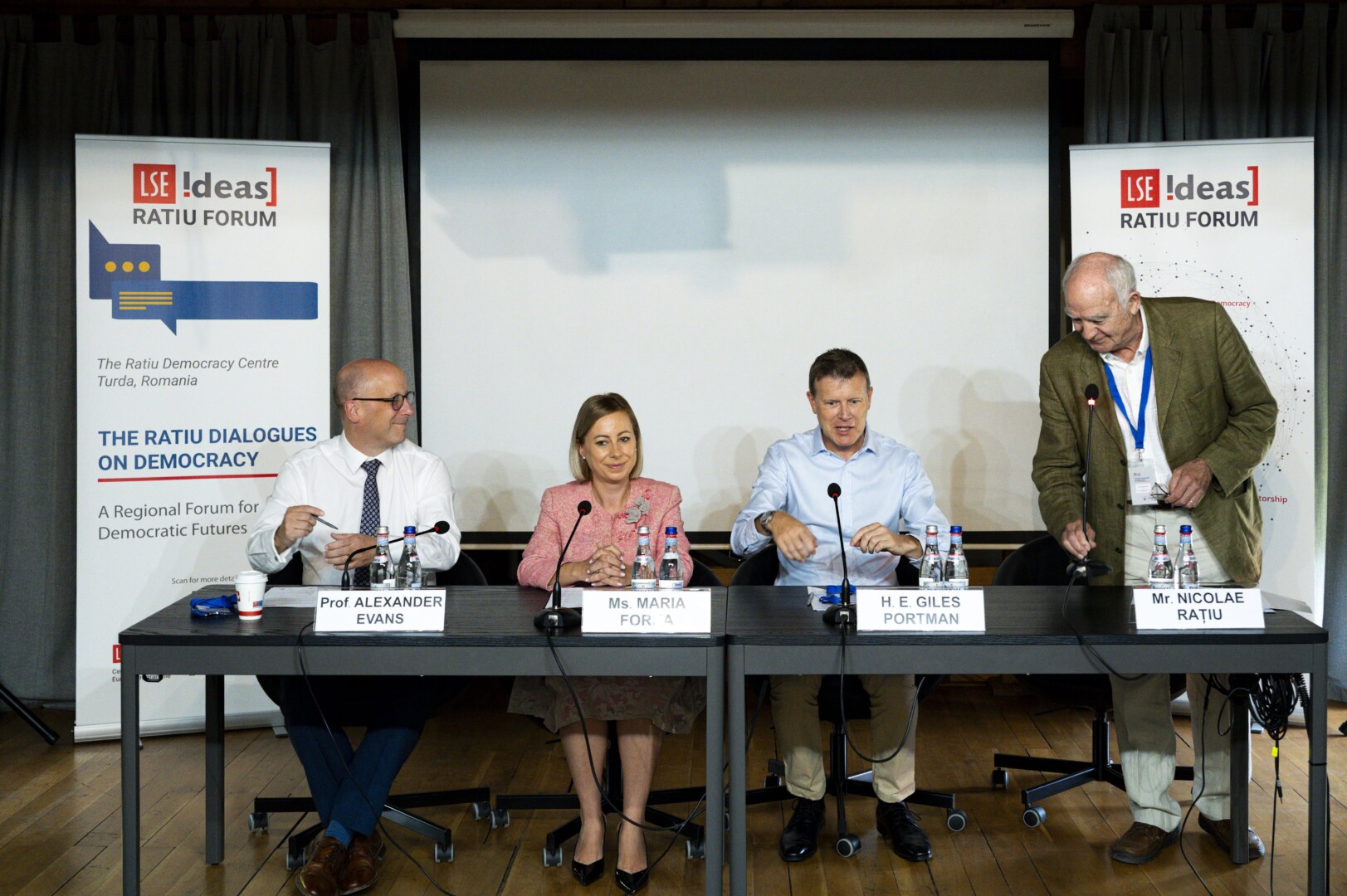
Threats to European democracy and security from hostile state actors and populist parties was the focus of the annual Ratiu Dialogues conference this weekend.
Romanian and international academics, diplomats journalists, former Icelandic Prime Minister Katrin Jakobsdottir and former deputy NATO chief Mircea Geoana discussed U.S engagement in and with European security, tariffs and Russia policy as Russia’s war on Ukraine continues, and a surge in nationalist right-wing parties in Europe.
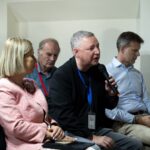
Attendees discussed disinformation spread by hostile state actors and ways to counter the hybrid war on the sidelines of the conference at the Ratiu Democracy Centre, which has become a hub for democratic debate on geopolitics in recent years.
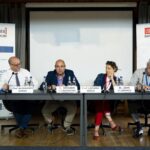
The ‘Realigning for a post-2025 Transatlantic European Security Order’ conference was organized by the Ratiu Forum in partnership with the LSE IDEAS, a foreign policy think tank at the London School of Economics and Political Science that was founded as a think tank for Diplomacy and Strategy.
Universul.net shares some of the remarks made by diplomats and academics at the opening day of the conference.
Opening the conference, British Ambassador to Romania Giles Portman underlined London’s support for Romania and the allies’ joint interests.
“We make sure Romania is the strongest possible NATO ally. We want to see Romania is able to provide best possible support to Ukraine and Moldova: we want to make sure Romania is able to protect UK’s interests in the Black Sea. WE want to see a stronger Romanian voice in NATO and EU,” he said.
Cluj prefect Maria Forna who took part in the opening session, said she hoped the two-day event would “contribute to the clarity our leaders need so much of.”
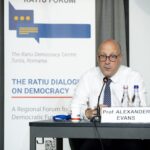
Prof. Alexander Evans, who heads the LSE IDEAS foreign policy thinktank said the geopolitical challenges currently facing the world were not new.
“Let us remind ourselves that populism has been with us for some time. The burden of security sharing between the US and Europe is not new. Questions of changing order are not new too,” he said.
Nicolae Rațiu, chairman of the Ratiu Charitable Foundation, who hosted the event said it was “heartwarming that people still consider my father (Eds: Ion Ratiu, presidential candidate in 1990) the face of another path Romania could have had.”
He noted that at the last Dialogues meeting. “We thought we would be facing a difficult world this year. But this year has outdone our expectations. (…) In Romania we have a new president (Eds: Nicusor Dan) and a new administration that are facing incredible challenges.”
Spasimir Domaradski, a political scientist from the University of Warsaw, told attendees that China was behind Russia’s hostile intentions towards Europe.
“There is turbulence in the Transatlantic relations. We are on the verge of Europe’s demise as a key player in international order,” he said, adding that the 27-member bloc was “the only factor that can maintain the politics of the past 80 years. “
“The EU is slow, it faces numerous challenges, while the other actors act swiftly. But it is a challenge because quite paradoxically, populism is a response to being visible politically. If populism is an inner European problem, that it is one easily fueled from outside. … We are facing the problem of complacency. What is really challenging is how to put together the problem of integration. What glues us now is a sense of threat. We have the need for realignment. There is an argument to carefully craft within the existing frame the return of agency over the EU measures.”
Prof. Luciana Ghica, an associate professor of International Relations and European Studies at the Faculty of Political Science, University of Bucharest.
“The idea of big powers is a myth. We have big military spenders, we can have countries who invest in the well-being of others, even outside their countries. Which one is a big power? When we are speaking about coalitions the key is remembering who we are, I think. Taking a step back from this vision is also very useful.”
“Russia is defeatable. Other countries are defeatable. Russia is a problematic actor because of its behavior, because of its nuclear capabilities, because of the issues related to its disintegration, not because it is a big power,” she said.
“We are focused on the transatlantic model as a model for peace. But we tend to neglect another coalition which helped in the post war era, is the coalition of hope. This is not necessarily a coalition of the richest countries, but it makes people feel they have agency. For those of us who are fortunate enough, it is nice to speak about civic rights and freedom, but you cannot do that on an empty stomach. We should increase aid, not look for security contracts.”
We need “a coalition against ignorance. The fears of those who lived in the vicinity of Russia were dismissed for so long, that now we are paying the price. “
“We need a coalition of people who still believe in politics. We have witnessed an attack against politics, an arena where you can have different opinions. We can have plurality and perspectives and that is not Europe’s demise. Strengthening the trust in political institutions,” is needed as is “the coalition of parliaments. We need to invest back a lot in an open society. Unless we put money where our mouth is we cannot support democracy.
John Florescu, senior television and documentary producer. “In the old age, 23% of the population would get their news from the network channels, but now that is down to 6% and people gather their information from eco-chambers. “
He said Romania’s ruling coalition was “a consequential government, and the (far right) opposition is put off by the speed of its actions.” On Sunday, the government easily survived four non-confidence motions.
Razvan Botis, the vice chairman of the NATO Industrial Advisory Group and Executive Director of the Romanian Defense Industry Shareholders Association.
“We need weapons for deterrence. If you are buying from the wrong side, you cannot use it fully, because the software belongs to the country who produced it.
Iulian Fota, associate professor at the Romanian National Intelligence Agency, said that the Moldova cannot be understood as a country “without knowing the war in Transnistria.”
Sir Laurie Bristow, former British Ambassador to Russia and the UK’s last ambassador to Afghanistan said it was clear “We are leaving the limits of international law order with Ukraine. We are not going to persuade Mr. Putin to see the world differently, but we could put pressure so that a ceasefire (Eds: with Ukraine) is acceptable. We need to see the commonalities of interests, not as we see them, but also as Mr. Trump sees them,” he added.
Samir Puri, author of “Westlessness” mentioned the geostrategic shifts, “ uncharted territory with pluri-centres of powers. “
Ben Noble, Associate Professor of Russian politics at University College London warned that “Russians are increasingly ready to be engaged in a confrontation with Europe.”
At home, Russia is trying to frame (its Ukraine war) veterans as elite to be inserted in administration, to avoid a repeat of the Afgan- Russian war. Half of veterans are unable to find work and clash with young people with diplomas,” he said, revealing insights from inside Russia.
He called for Western partners to work with non-Kremlin allied Russians and not just offer support to Ukraine.

Trump wants to turn the Pentagon into the “Department of War” from “Department of Defense”
