














Romanians remain generally positive about the European Union, seeing membership as beneficial, but are less happy with their quality of life than the average European, according to the European Parliament’s Spring 2026 Eurobarometer.
The survey, carried out between April 9 and May 4, across the EU, shows that Europeans increasingly view the EU as a place of stability in a troubled world, amid geopolitical uncertainty and growing economic concerns.
The survey ended a day before the Romanian government was ousted in a no-confidence vote triggering nearly two months of political turmoil.
At the EU level, 75% of respondents agree the bloc offers stability, up eight percent since October-November 2025, while in Romania, 74% agree and 23% disagree; the rest don’t know.
The result shows that Romanians are aligned with the EU common position suggesting that most think the EU is a factor of stability.
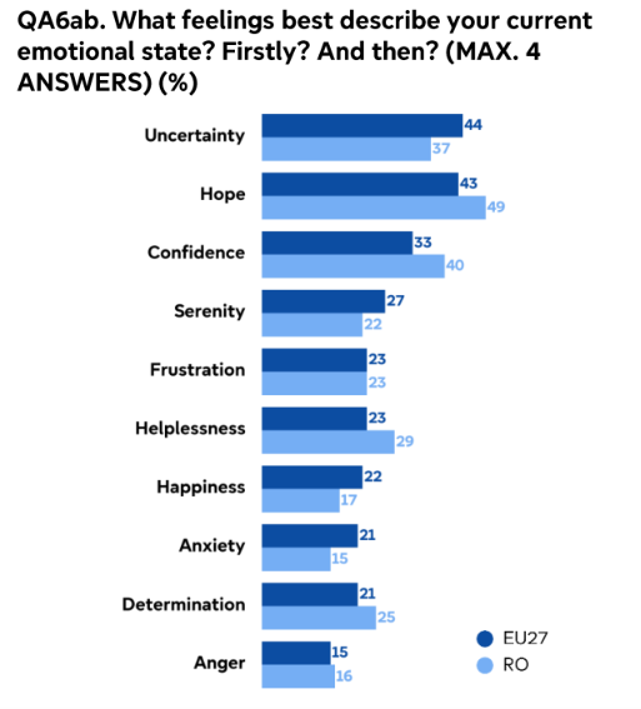
Romanians appear to be more optimistic than the EU average about the global future. Some 58% of Europeans say they are pessimistic while in Romania just 38% share the same view with 57% professing optimism. Interestingly, 60% of Romanians are optimistic about the future of the EU and Romania.
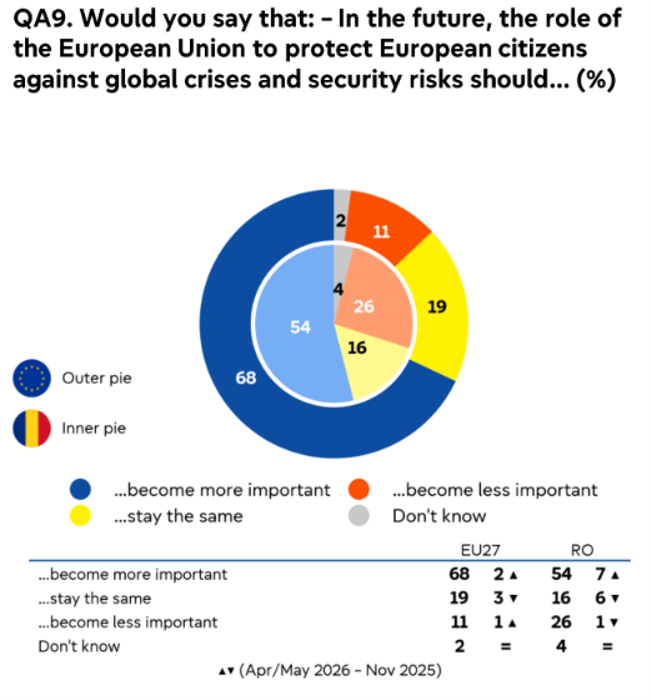
The main perceived benefit of membership is the EU’s contribution to protecting peace and strengthening security, cited by 40% of overall respondents. In Romania, the most frequently cited benefit is that EU membership brings Romanian people new work opportunities, a factor mentioned by 37%, followed by improved cooperation with other EU countries at 30% and stronger security at 28%.
In Romania, inflation and the cost of living also rank first, at 42%, a slightly lower level. Economy and job creation rank second, at 41%, six points above the bloc average. Defense and security are mentioned by 31% of Romanian respondents, while agriculture and food security were picked by 28%, above the EU average of 20%.
One of the sharpest gaps concerns quality of life: 63% of Romanians say they are satisfied with their quality of life, compared with 83% across the EU. Satisfaction is highest among young Romanians and those with higher education, while it falls sharply among people aged 55 and over, those with lower education levels, and respondents who struggle to pay their bills.
he European Parliament’s Spring 2026 Eurobarometer was conducted by Verian between April 9 and May 4, 2026, in all 27 EU member states. A total of 26,421 interviews were conducted across the EU. In Romania, the survey included 1,045 face-to-face interviews conducted between April 9 and April 29.
